










Arman Financial Services Ltd. flags delayed drought risk
Key highlights
- Maharashtra and Karnataka accounted for 7.6% of Arman’s Rs 3,209 crore consolidated AUM at September 2026.
- Arman reported marginal deterioration in Maharashtra repayment behaviour during October, with no material portfolio impact at the time of the call.
- Consolidated GNPA was 2.73% in Q2 FY27, compared with 2.76% in Q1 FY27.
- Collection efficiency moved from 96.9% in June to 96.2% in September, a 40-basis-point decline.
powered by IRIS
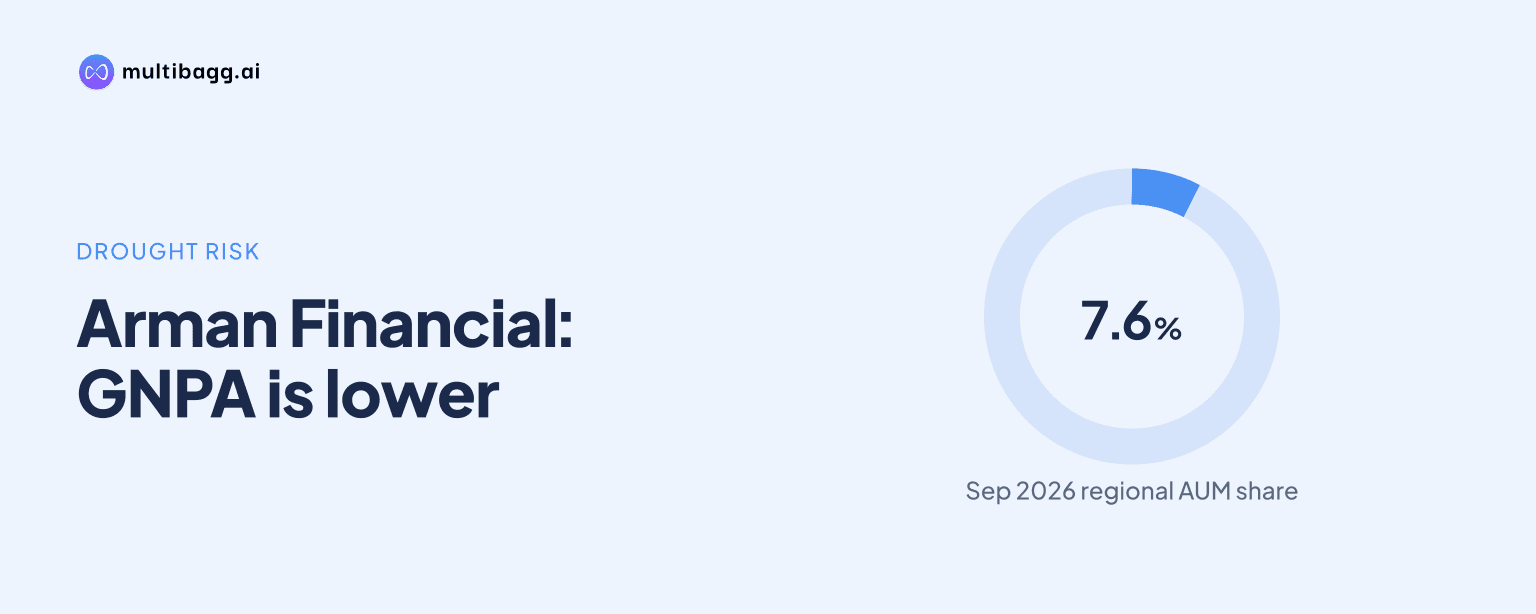
Arman said its Maharashtra and Karnataka portfolio, representing 7.6% of consolidated assets under management (AUM) at September 2026, had remained largely stable despite drought declarations, although repayment behaviour in Maharashtra marginally deteriorated in October and management warned that borrower cash-flow stress may arrive months after poor rainfall.
Know Arman Financial Services inside out
Results, valuation, peers and who's buying, in one view.
How much drought exposure does Arman have?
Arman’s direct exposure to Maharashtra and Karnataka is 7.6% of its consolidated AUM, which stood at Rs 3,209 crore in September 2026. Management said both states had declared droughts in a large number of talukas, while the wider monsoon brought floods in some regions and deficient rainfall in others.
The exposure sits mainly within Namra Finance, Arman’s microfinance subsidiary, whose AUM was Rs 2,424 crore at September 2026, compared with Rs 784 crore in the standalone business. Management said Arman does not lend substantially to borrowers whose sole activity is direct agriculture, although customers can have agriculture-related or allied-agriculture income that may be affected by weak rainfall.
Arman’s September 2026 portfolio was also expanding rapidly, with consolidated AUM up 51% year on year and quarterly disbursements up 72% to Rs 818 crore. Management’s disclosure of a 7.6% state exposure therefore identifies the part of a growing book that could face weather-linked repayment pressure, rather than indicating a portfolio-wide deterioration.
What stress has Arman reported in drought-hit states?
Arman has reported marginal repayment deterioration in Maharashtra, particularly in fresh delinquency buckets during October, while it said it had not seen much impact in Karnataka. Management described the Maharashtra effect as not material at the time of the call, but said that the October change occurred after the September-ended Q2 FY27 reporting period.
Portfolio-wide measures did not show a material worsening in Q2 FY27. Consolidated collection efficiency was 96.5%, gross non-performing assets (GNPA) were 2.73% versus 2.76% in Q1 FY27, and net non-performing assets were 0.92%. Namra’s GNPA was 2.59%, largely unchanged from Q1 FY27, while its net NPA was 1.01%.
In the question session, management said collection efficiency moved from 96.9% in June to 96.2% in September, a 40-basis-point decline. A basis point is one-hundredth of a percentage point. It said the post-monsoon quarter has historically shown a modest seasonal dip and also cited flood-related access disruptions in Bihar and Uttar Pradesh that lasted about seven to 10 days.
Why might drought pressure emerge after the monsoon?
Arman said a poor monsoon or crop failure can affect borrower income and repayment capacity several months after rainfall shortfalls occur. Management therefore said aggregate collections are not enough to assess drought risk, and it is monitoring early delinquencies, collection patterns and borrower cash flows at state, district and branch levels.
Management contrasted the potentially delayed effect of drought with the more immediate disruption caused by flooding. Bihar and Uttar Pradesh faced major flood effects after Nepal floods, but management said conditions settled faster there; in Maharashtra, it identified a 1% dip in zero-days-past-due performance in the most recent month discussed on the call.
The lag matters because Namra had about 5 lakh active customers at September 2026 and individual lending accounted for nearly 40% of its microfinance portfolio. Arman said most borrowers have multiple income streams, which may reduce reliance on a single agricultural activity, but it did not say that this mix eliminates the risk from weaker local cash flows.
Got a follow-up? Ask IRIS
How is Arman responding to local credit risk?
Arman said it will slow lending in specific geographies or reject more customers if local risk indicators require it. Its processes handle about 1.10 lakh applications a month, but management said only about 25,000 to 30,000 customers ultimately receive disbursements after completing the assessment chain.
The company has separated credit approval and recovery from branch operations in its microfinance network, with independent credit teams assessing customers and separate recovery teams supporting collections. Management said comparable customer groups originated under the newer structure have shown roughly 15% lower default rates than loans under the earlier model, while cautioning that the revised system has not yet faced another difficult credit cycle.
Arman is also increasing digital repayment channels, with 49% of microfinance collections coming through Unified Payments Interface and e-NACH as of September 2026. Management said technology investments in loan origination, verification and business intelligence are intended to give it more timely portfolio information, but digital collection methods do not remove the credit effects of a drought.
The Credit Guarantee Fund for Micro Units Credit Guarantee Scheme, or CGFMU, remains a separate uncertainty in the risk framework. As of September 30, 2026, 51% of Arman’s microfinance portfolio and 30% of its MSME portfolio were covered, but loans originated from April 1, 2026 were not yet covered pending renewal; management said the uncertainty does not change its underwriting strategy.
Conclusion
The disclosed drought exposure is limited to 7.6% of consolidated AUM, and reported Q2 FY27 asset-quality measures remained stable, with GNPA at 2.73% versus 2.76% in Q1 FY27. However, the October deterioration in Maharashtra and management’s warning about delayed cash-flow effects mean September portfolio data may not yet show the full effect of deficient rainfall.
The next indicators to watch are fresh delinquencies, zero-days-past-due trends and collection patterns in Maharashtra and Karnataka, alongside any decision by Arman to slow local lending or raise rejections. Management remains positive on H2 FY27, particularly Q4, but has disclosed that it will adjust lending where branch-level conditions show risk; CGFMU renewal terms and timing also remain unresolved.