










Arman Financial Services Limited reports record Rs 51 crore profit
Key highlights
- Arman reported record consolidated Q2 FY27 profit after tax of Rs 51 crore, versus Rs 8 crore in Q2 FY26.
- Consolidated AUM rose 51% year on year to Rs 3,209 crore as of September 2026.
- Management said comparable loans under the revised credit structure had roughly 15% lower default rates.
- Arman's cost-to-income ratio declined to about 42.6% in Q2 FY27 from around 51.7% in Q4 FY26.
powered by IRIS
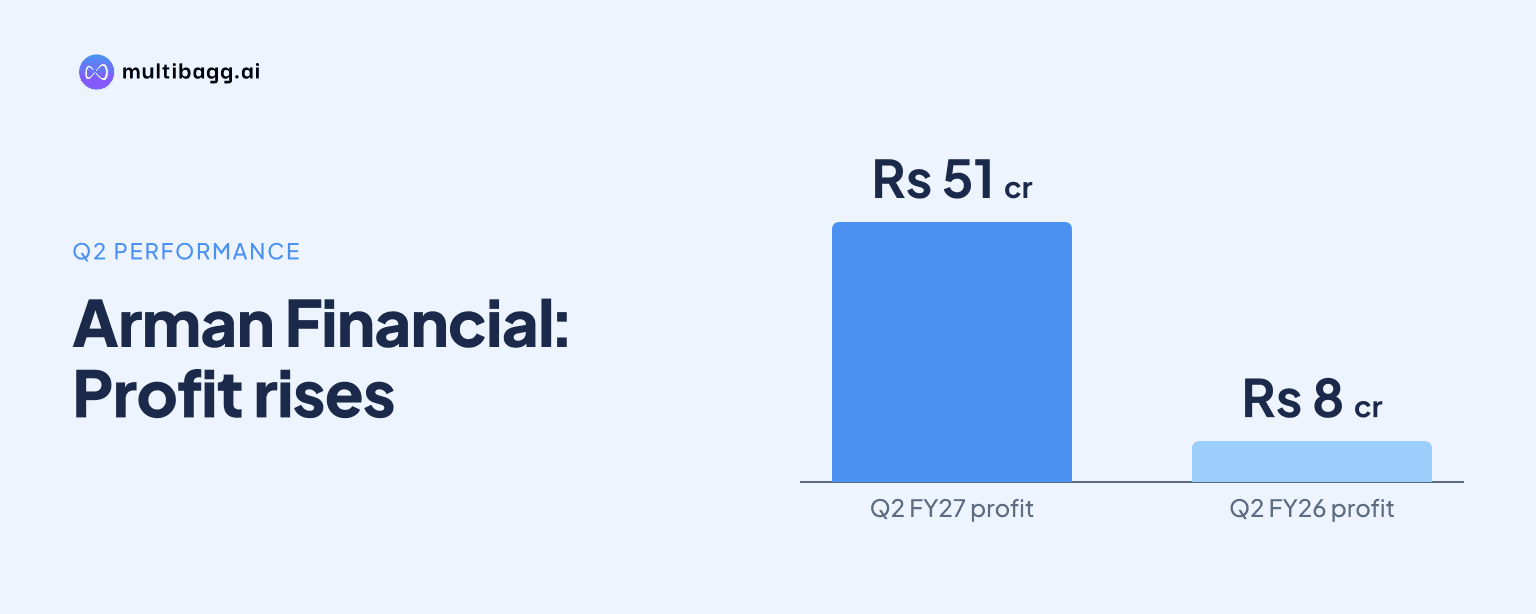
Arman Financial Services Limited reported its highest quarterly consolidated profit after tax of Rs 51 crore in Q2 FY27, versus Rs 8 crore a year earlier, as assets under management rose 51% to Rs 3,209 crore and management said comparable new loans had roughly 15% lower default rates.
Know Arman Financial Services inside out
Results, valuation, peers and who's buying, in one view.
How did Arman deliver its record Q2 FY27 profit?
Arman delivered its record Q2 FY27 profit through higher income, faster loan-book growth and lower operating costs relative to income. Consolidated gross total income rose 48% year on year to Rs 235 crore, net total income was Rs 161 crore, and pre-provision operating profit, or PPoP, reached Rs 95 crore. Provisions and write-offs were about Rs 26 crore, resulting in profit after tax of Rs 51 crore.
The turnaround is also visible over the first half. Arman reported Rs 97 crore of consolidated profit after tax in H1 FY27, compared with a Rs 7 crore loss in H1 FY26, and exceeded its full-year FY26 profit after tax of Rs 57 crore within six months. Consolidated AUM rose 51% year on year to Rs 3,209 crore, while Q2 disbursements increased 72% to Rs 818 crore.
Is Arman's credit overhaul lowering loan defaults?
Yes, management said loans originated under Arman's revised credit structure have shown roughly 15% lower default rates than comparable loans made under the earlier model. For microfinance customers, an independent credit team now assesses and approves borrowers, while a separate recovery team handles collections in branches needing additional support.
Management said the structure is established across the microfinance network and lets branch teams focus on business development and customer service. It also reported that fresh delinquencies had declined from prior years and repayment behaviour had improved across most operating states for four consecutive quarters since the improvement began in H2 FY26. Management cautioned that the underwriting model's full effectiveness will only be known in the next difficult credit cycle.
Digital repayment is another part of the operating change. About 49% of microfinance collections came through Unified Payments Interface, or UPI, and e-NACH channels as of September 2026. Individual lending accounted for almost 40% of the microfinance portfolio, and management said digital collections reduce reliance on door-to-door cash collection as that business expands.
How have Arman's asset quality and costs changed?
Arman's reported asset-quality indicators were broadly stable in Q2 FY27, while its cost-to-income ratio declined from the preceding peak. Overall collection efficiency was 96.5%, gross non-performing assets, or GNPA, were 2.73% versus 2.76% in Q1, and net non-performing assets, or NNPA, were about 0.92%. X-bucket collection efficiency was about 99.4%, despite a marginal monsoon-related seasonal decline.
The cost-to-income ratio improved to about 42.6% in Q2 FY27 from around 51.7% in Q4 FY26. Management attributed the earlier peak to investment in credit, recovery, technology and personnel, and said operating expenses were no longer increasing at the same pace as AUM. It targets operating expenses of about 7% of AUM by March 2027, from around 8% in Q2 FY27 and an earlier peak of roughly 9% to 10%.
Consolidated net interest margin, or NIM, was 18.2% in Q2 FY27. Annualised return on AUM was 6.7% and annualised return on equity was 20.5%, compared with 1.5% and 3.7%, respectively, in Q2 FY26. Those changes occurred alongside the rise in consolidated profit after tax to Rs 51 crore from Rs 8 crore.
Got a follow-up? Ask IRIS
Which businesses drove Arman's AUM growth?
Namra Finance, Arman's microfinance subsidiary, drove most of the group expansion, reporting AUM of Rs 2,424 crore as of September 2026, up 61% year on year and 12% from the previous quarter. Namra disbursed Rs 654 crore in Q2 FY27 and reported profit after tax of Rs 34 crore, compared with a Rs 1 crore loss in the prior-year quarter.
Namra's gross total income increased 56% year on year to Rs 168 crore, net total income was Rs 113 crore and PPoP was Rs 67 crore. Its NIM rose to 16.6% from 15.37% in Q1, which management partly linked to the growing share of individual lending. GNPA was 2.59%, NNPA was 1.01%, net write-offs were Rs 12 crore, and the subsidiary had about 5 lakh active customers.
Arman's standalone business reported AUM of Rs 784 crore in September 2026, up 26% year on year and 3% sequentially. Micro, small and medium enterprise, or MSME, lending represented about 74% of standalone AUM, followed by loans against property at about 13% and two-wheeler lending at 12%. Q2 disbursements were Rs 164 crore and standalone profit after tax was Rs 17 crore.
What could affect Arman's FY27 outlook?
The pending renewal of the CGFMU Credit Guarantee Scheme remains an unresolved matter for Arman. Eligible loans originated up to March 31, 2026 remain covered, but loans originated from April 1, 2026 were not covered at the time of the call, pending government approval and final renewal terms. As of September 30, 51% of the microfinance portfolio and 30% of the MSME portfolio remained covered.
Weather conditions are also being monitored by geography. Maharashtra and Karnataka had declared droughts in a large number of talukas, and together accounted for 7.6% of consolidated AUM. Management reported marginal deterioration in repayment behaviour in Maharashtra after the drought declaration, though it said the effect was not material, and it is tracking early delinquencies, collections and borrower cash flows at state, district and branch level.
Arman reported consolidated shareholders' equity of Rs 1,033 crore and liquidity of about Rs 334 crore as of September 30, alongside Rs 150 crore of undrawn sanctions from existing lenders. Total borrowings, including off-balance-sheet direct-assignment liabilities, were Rs 2,659 crore. Incremental borrowing cost declined to 11.3% in Q2 from 11.7% in Q1.
Conclusion
Arman's Q2 FY27 results combined a record Rs 51 crore quarterly profit with 51% AUM growth to Rs 3,209 crore and stable reported collection indicators. Management attributes part of the change to separating credit approval from recovery work, maintaining selective underwriting and increasing digital collections, while noting that the revised credit model has not yet been tested through another severe microfinance downturn.
The next measures to watch are management's plan to reduce operating expenses to about 7% of AUM by March 2027, the government's decision on renewal terms for the CGFMU scheme, and repayment trends in Maharashtra and Karnataka, which represented 7.6% of consolidated AUM. Management also said H2, particularly Q4, has historically been the stronger part of its financial year.