










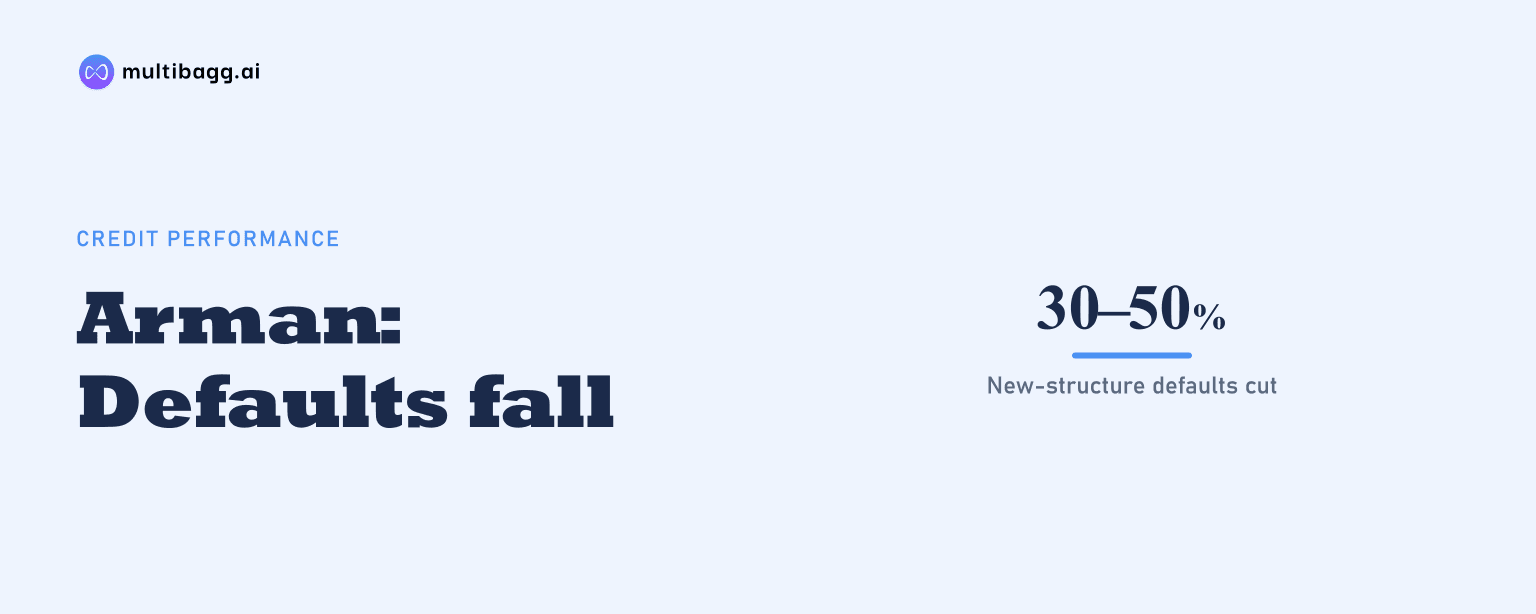
Arman says redesigned MFI cohorts cut defaults by 30-50%
Key highlights
- Arman says new-structure MFI cohorts have 30-50% lower defaults.
- 347 MFI branches used Arman’s independent credit structure as of Q2FY27.
- Arman reported 96.3% overall collection efficiency and 99.4% X-bucket collection efficiency in September 2026.
- Consolidated GNPA was 2.73% in September 2026, versus 3.69% in September 2025.
powered by IRIS
Arman Financial Services says its redesigned microfinance institution (MFI) credit structure reduced defaults by 30-50% in new cohorts, with 347 MFI branches operating under the independent credit structure as of Q2FY27. The overhaul separates customer sourcing, underwriting and recovery while adding digital verification, household-level checks and branch-level credit approval.
Know Arman Financial Services inside out
Results, valuation, peers and who's buying, in one view.
How has Arman redesigned MFI underwriting?
Arman has redesigned MFI underwriting by putting digital identity checks, household assessment and traceability controls before loan approval. Its instant loan-verification process uses optical character recognition, face-match Know Your Customer checks, one-time-password mobile checks and Unified Payments Interface penny-drop bank verification. These steps are intended to validate borrower identity and bank-account details at onboarding before a loan enters the portfolio.
Arman’s household-level process combines a credit-bureau application programming interface, a rule engine, the Reserve Bank of India’s 50% repayment cap and Guardrails 2.0. The company also uses what it calls 4D traceability: geotagging, a house photograph, address and mobile checks, and branch geofencing. This framework addresses borrower over-leverage, which Arman identifies as a key risk alongside sector and tail events.
The MFI redesign is part of a broader underwriting approach across products. For individual loans, Arman lends to proven MFI borrowers with a bureau score of 700 or above and assesses business stability, repayment behaviour and fixed-obligation-to-income ratio. For loan against property, the maximum loan-to-value ratio is 65%, alongside legal, technical, fixed-obligation-to-income and central-approval checks, while two-wheeler loans are hypothecation-secured through more than 50 Gujarat dealers.
What does the independent credit structure change?
Arman’s independent credit structure separates the field team that sources customers from the Branch Credit Manager, or BCM, who evaluates income and credit risk. The field team identifies and initially engages customers, but the BCM conducts an independent assessment using proprietary credit tools and data checks. The BCM then approves or rejects an application according to the assessment, policy guardrails and portfolio norms.
The change removes loan approval from the frontline sourcing role. Arman states that the BCM is solely responsible for approvals and rejections in its individual-loan process, while its risk-governance framework says customer acquisition, underwriting and collections are performed by separate teams. This is the operational difference from a structure in which sourcing and credit decisions sit closer together at branch level.
As of Q2FY27, 347 MFI branches were on the independent credit structure, compared with 466 microfinance branches in total at the same point. Arman also reports approximately 50% faster sourcing-to-disbursement and 100% paperless electronic-signature and cashless disbursements under its operating framework.
How are collections separated from loan approval?
Arman separates collections from underwriting through a dedicated recovery team with independent processes and targets. After customer onboarding, the collection journey begins with a unique UPI quick-response code and mandate setup, followed by repayment reminders through local-language text messages. In-house field teams then conduct personalised follow-ups, while real-time monitoring tracks portfolio health and early-warning signs.
The company reported that 306 MFI branches had a dedicated recovery structure in the first half of financial year 2027, or H1FY27. At September 2026, cashless collections covered 49.0% of the MFI loan book, overall collection efficiency was 96.3%, and X-bucket collection efficiency was 99.4%. Arman does not define X-bucket in the presentation, but presents it separately from overall collection efficiency.
Collection controls are also linked to borrower access and risk mitigation. Arman Suvidha, the company’s Android application, gives borrowers access to account information, repayment schedules and loan documents at any time. Separately, 51% of the MFI portfolio was covered by a guarantee arrangement as of September 2026, according to the collection-model page.
Got a follow-up? Ask IRIS
What governance oversees Arman’s redesigned credit model?
Arman says its Board-level Risk Management Committee oversees adherence to underwriting, portfolio and regulatory norms. Information-technology alerts and business-intelligence tools track changes and flag anomalies, creating a monitoring layer beyond the branch and recovery teams. The stated arrangement combines operational separation with central oversight of the rules used in credit decisions.
Independent internal auditors periodically review credit processes, portfolio quality, operational controls and regulatory compliance. Their reports go to the Audit Committee and have a direct escalation route to the Board. The presentation characterises this audit structure as independent assurance over the effectiveness of governance and controls, rather than as a measure of future credit performance.
The company pairs those controls with capital and liquidity disclosures. As of September 2026, Arman reported a 36.26% capital-to-risk-weighted-assets ratio and Namra Finance Limited, its wholly owned microfinance subsidiary, reported 37.19%. Available liquidity was Rs 334 crore, while Arman separately described an approximately Rs 300 crore liquidity buffer as around 1.5 months of repayments and said it had more than 50 lenders as of September 30, 2026.
What evidence does Arman provide on early credit outcomes?
Arman’s principal early outcome is its statement that defaults in new-structure MFI cohorts are 30-50% lower. The presentation does not provide the underlying default rates, cohort origination dates, comparison period or definition of default. The figure should therefore be read as management’s operational disclosure on newly originated cohorts, rather than a portfolio-wide reported default ratio.
The company does disclose portfolio-quality movement at the consolidated level. Gross non-performing assets, or GNPA, declined to 2.73% in September 2026 from 3.69% in September 2025, a reduction of 0.96 percentage points. Earlier, GNPA had fallen from a 4.13% peak to 3.43% by March 2026, while fourth-quarter FY26 impairment cost moderated to Rs 17 crore.
That improvement followed a period of deliberate book rationalisation and elevated provisions. Consolidated assets under management, or AUM, fell from Rs 2,594 crore in Q1FY25 to Rs 2,130 crore in Q1FY26 as Arman prioritised asset quality over growth; impairment cost was Rs 248 crore in FY25 and Rs 148 crore in FY26. By September 2026, AUM had risen to Rs 3,209 crore, and individual business loans represented 41% of AUM, showing that growth resumed with a more diversified book mix.
Conclusion
Arman’s disclosed 30-50% reduction in defaults for new MFI cohorts is tied to a specific redesign: separate sourcing, BCM-led underwriting and independent recovery operations, reinforced by digital verification and household-level repayment checks. The wider data show GNPA at 2.73% in September 2026 versus 3.69% a year earlier, alongside 96.3% overall collection efficiency and 99.4% X-bucket collection efficiency.
The next measure to watch is whether the early cohort outcome persists as the structure extends beyond the 347 MFI branches reported in Q2FY27. Arman’s FY27 focus is disciplined growth, customer-level cash-flow assessment, funding-cost optimisation and improved operating efficiency; its September 2026 AUM of Rs 3,209 crore and 41% individual-business-loan mix provide the disclosed starting point for judging that plan.