










Arman individual business loans comprise 41.03% of total AUM
Key highlights
- Individual business loans represented 41.03% of Arman AUM in the September 2025 product-mix disclosure, versus 34.52% for JLG microfinance.
- Microfinance AUM, including individual business loans, rose to Rs 2,424 crore in H1FY27 from Rs 1,507 crore in H1FY26.
- MSME AUM increased to Rs 584 crore in H1FY27, while LAP AUM rose to Rs 104 crore.
- Arman reported consolidated GNPA of 2.73% in September 2026, compared with 3.69% in September 2025.
powered by IRIS
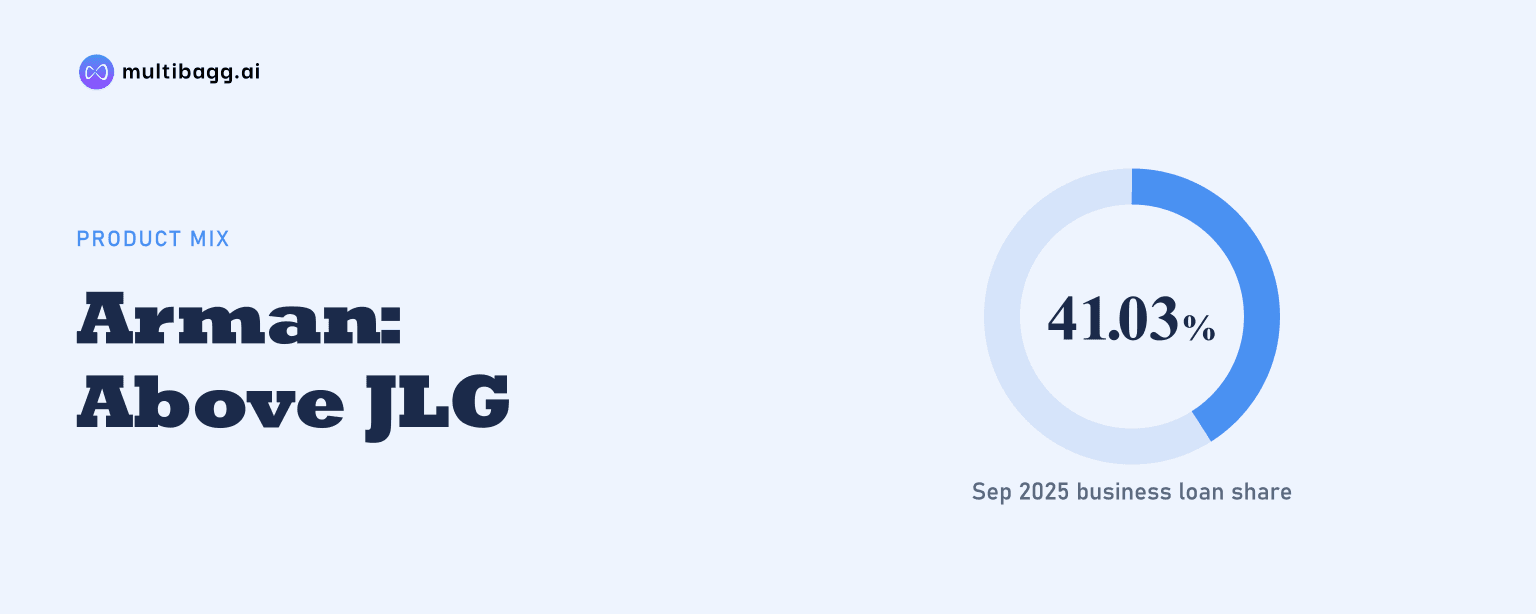
Arman Financial Services Limited reported individual business loans as 41.03% of assets under management (AUM) in its September 2025 product-mix disclosure, exceeding the 34.52% share of joint liability group (JLG) microfinance by 6.51 percentage points. MSME loans accounted for a further 18.20% of AUM, leaving individual lending as the largest stated category.
Know Arman Financial Services inside out
Results, valuation, peers and who's buying, in one view.
What is Arman’s current product mix?
Arman’s disclosed portfolio mix is led by individual business loans at 41.03% of AUM, followed by JLG microfinance at 34.52% and MSME loans at 18.20%. Two-wheeler loans represented 2.92% and loan against property (LAP) represented 3.33%, taking the five product shares to 100% after rounding.
Individual business loans exceeded JLG microfinance by 6.51 percentage points in the September 2025 disclosure. The presentation says Namra Finance Limited, Arman’s wholly owned subsidiary, offers microfinance to women. It also identifies individual business loans as a microfinance product in its product-offerings classification.
The Q2FY27 ticket sizes are not measured on the same date as the September 2025 AUM shares. Individual business loans had an average ticket of Rs 1 lakh, above JLG’s Rs 57,000 but below LAP’s Rs 5.67 lakh. The presentation does not separately disclose September 2026 AUM shares for individual business loans and JLG loans.
How did Arman’s lending books change in H1FY27?
Arman’s microfinance AUM, including individual business loans, rose to Rs 2,424 crore in H1FY27 from Rs 1,507 crore in H1FY26, while disbursements increased to Rs 1,184 crore from Rs 605 crore. The average ticket in this combined segment increased to Rs 80,000 from Rs 51,000.
The combined microfinance data cannot isolate the AUM growth of individual business loans because the reported segment includes JLG and individual loans. However, it recorded the largest absolute AUM increase among the four reported lending segments, rising by Rs 917 crore. JLG lending is described as small-ticket funding for women undertaking income-generating activity, including livestock, dairy, agriculture-allied work and kirana stores.
MSME AUM increased by Rs 111 crore to Rs 584 crore, although its average ticket declined to Rs 71,000 from Rs 77,000. Two-wheeler AUM rose by Rs 19 crore to Rs 94 crore, while LAP AUM rose by Rs 29 crore to Rs 104 crore. LAP disbursements were Rs 30 crore in H1FY27, below Rs 35 crore in H1FY26 despite the higher outstanding book.
Got a follow-up? Ask IRIS
How do Arman’s lending products differ?
Arman’s products differ mainly by loan ticket, tenure, borrower type and security structure, with individual business loans carrying a Rs 1 lakh average ticket and a 24-month tenure. JLG loans have a Rs 57,000 average ticket and run for 12 to 24 months, whereas LAP has a Rs 5.67 lakh average ticket and a 36-to-84-month tenure.
MSME loans are individual enterprise and working-capital loans for small rural businesses in areas Arman describes as low competition. The business operated through 135 branches in seven states and reported a 35.12% H1FY27 yield excluding direct assignment income. Management describes MSME as Arman’s highest-return-on-assets product and says it intends to grow the business over time.
Two-wheeler lending consists of hypothecation-backed loans for self-employed and cash-salaried borrowers in semi-urban and rural locations. The business operated only in Gujarat through more than 50 dealerships, with an H1FY27 average ticket of Rs 76,000. LAP, launched and piloted in Q4FY24, operated in Gujarat and had newly entered Telangana and Madhya Pradesh by September 2026.
LAP had an average ticket of Rs 5.3 lakh in September 2026, and Arman disclosed a maximum loan-to-value ratio of 65%. Management identifies LAP as a key growth driver, although the presentation gives no numerical AUM target. Its H1FY27 yield excluding direct assignment income was 24.97%, compared with 25.48% for two-wheeler loans.
What do Arman’s asset-quality and collection data show?
Arman reported consolidated gross non-performing assets (GNPA) of 2.73% in September 2026, compared with 3.69% in September 2025. At segment level, microfinance GNPA, including JLG and individual loans, declined to 2.6% from 3.8%, while MSME GNPA declined to 3.3% from 3.9%.
Two-wheeler GNPA fell to 3.2% in September 2026 from 5.0% a year earlier. LAP GNPA was 1.5% in September 2026, compared with 0.3% in December 2025. Net non-performing assets were 1.0% for microfinance, 0.5% for MSME, 1.5% for two-wheelers and 1.2% for LAP in September 2026.
Total collection efficiency was 96.3% in September 2026, down from 96.6% in August 2026 and 96.7% in July 2026. Microfinance collection efficiency was 96.2%, MSME was 96.6%, and two-wheeler efficiency improved to 96.4% from 95.4% in August. Total collections were Rs 226.3 crore against Rs 234.9 crore due in September.
Cumulative provisions stood at Rs 80.1 crore as of September 30, 2026, covering 2.5% of consolidated AUM and 2.9% of on-book AUM. Namra Finance accounted for Rs 52.5 crore of cumulative provisions, while the standalone business accounted for Rs 27.6 crore. The presentation attributes collection trends to field-level follow-ups, closer portfolio monitoring and disciplined collection efforts.
Conclusion
Arman’s September 2025 product mix places individual business loans at 41.03% of AUM, ahead of JLG microfinance at 34.52%. The combined microfinance segment, which includes both products, grew to Rs 2,424 crore in H1FY27, while MSME, two-wheeler and LAP books also increased from H1FY26 levels. Consolidated GNPA declined to 2.73% in September 2026 from 3.69% a year earlier.
The next point to watch is a product-mix update on a common reporting date, because the AUM shares are dated September 2025 while the average tickets are based on Q2FY27. Management’s stated priorities are controlled growth, customer-level cash-flow assessment, disciplined lending, growth in MSME and development of LAP with a maximum 65% loan-to-value ratio.