










Artemis international patients supplied 30% of Q2 revenue
Key highlights
- International patients supplied 30% of Artemis Gurugram revenue in Q2 FY27, versus 32% for insured patients.
- Oncology, neuro and orthopaedics together contributed 46% of Artemis Gurugram revenue in Q2 FY27.
- Artemis Gurugram revenue from operations rose 14.5% year on year to Rs 298.44 crore in Q2 FY27.
- Gurugram EBITDA increased 21.8% year on year to Rs 70.96 crore in Q2 FY27, lifting the EBITDA margin to 23.8%.
powered by IRIS
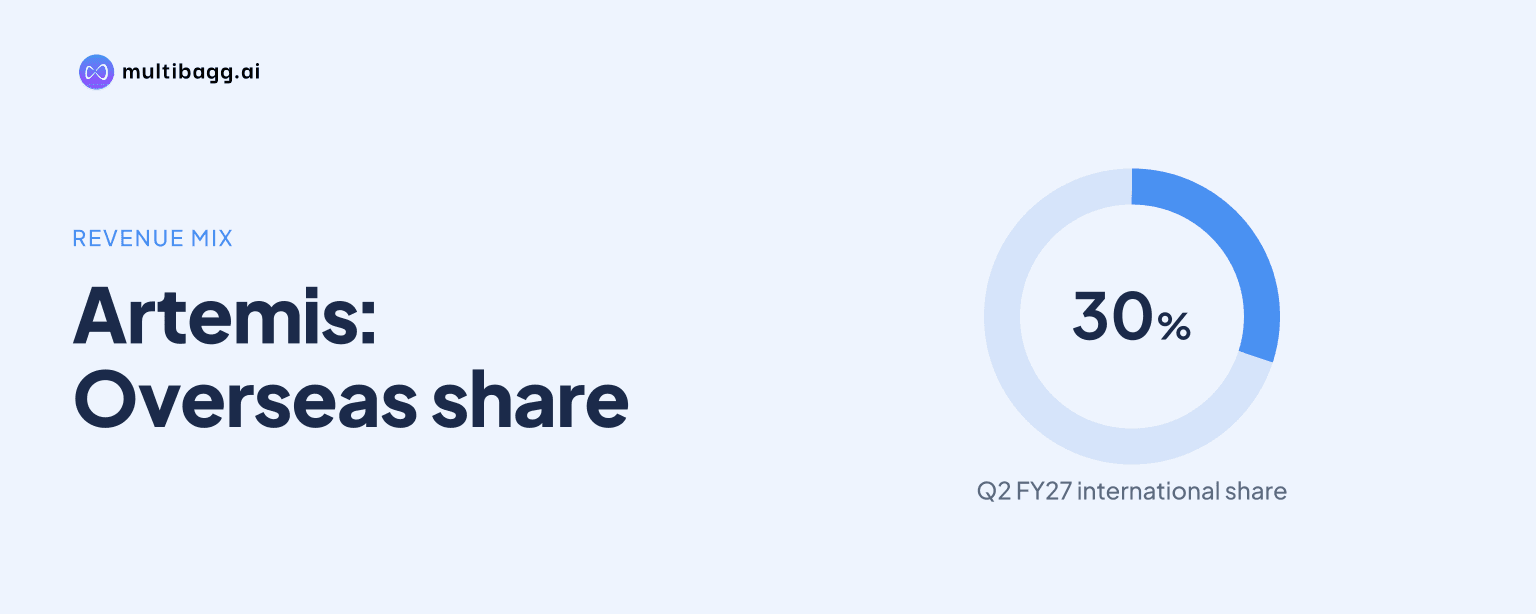
Artemis Hospitals, referred to here as Artemis, reported that international patients supplied 30% of Gurugram revenue in Q2 FY27, behind insured patients at 32%. Oncology, neuro and orthopaedics generated a combined 46% of revenue, while average revenue per occupied bed reached Rs 86,631, up 6.6% year on year.
Know Artemis Medicare Services inside out
Results, valuation, peers and who's buying, in one view.
How much Q2 revenue did international patients supply at Artemis?
International patients supplied 30% of Artemis Gurugram revenue in Q2 FY27. Insured patients were the largest payer group at 32%, followed by domestic cash patients at 22% and government schemes at 16%, leaving international patients as the second-largest contributor to quarterly revenue.
The international share increased by 3 percentage points from 27% in Q1 FY27, but fell by 2 percentage points from 32% in Q2 FY26. For H1 FY27, international patients represented 29% of revenue, compared with 31% in H1 FY26, while the insured-patient share increased to 32% from 31%.
Artemis says its international patient base spans more than 150 countries and is supported by partnerships across Africa, the Commonwealth of Independent States, the Middle East and South Asian Association for Regional Cooperation nations. Management describes international-patient revenue as about 27% to 30% of total revenue and says the case mix supports premium average revenue per occupied bed, or ARPOB.
Which specialties generated the most Artemis revenue in Q2 FY27?
Oncology, neuro and orthopaedics were Artemis's three largest specialty revenue categories in Q2 FY27, contributing 16%, 15% and 15%, respectively. Their combined 46% share exceeded cardiology's 8%, while internal medicine and general surgery each accounted for 5% of Gurugram revenue.
Oncology's share declined by 3 percentage points from 19% in Q2 FY26 to 16% in Q2 FY27, while orthopaedics increased by 1 percentage point to 15%. Neuro remained at 15%, cardiology fell to 8% from 9%, and gastroenterology increased to 4% from 2% over the same year-on-year comparison.
Artemis states that about 60% of revenue comes from high-acuity specialties. The platform has 14 Centres of Excellence across more than 40 specialties, including oncology, transplants, robotic surgery and advanced critical care; it also disclosed a partnership with KIMS to establish a heart and lung transplant programme.
Got a follow-up? Ask IRIS
How did Artemis Gurugram operating metrics change in Q2 FY27?
Artemis Gurugram revenue from operations rose 14.5% year on year to Rs 298.44 crore in Q2 FY27, while inpatient, or IP, volume increased 12.0% to 9,787. Revenue was also 7.2% above Rs 278.49 crore in Q1 FY27, when IP volume was 9,181.
ARPOB reached Rs 86,631 in Q2 FY27, up 6.6% from Rs 81,248 in Q2 FY26 and 1.1% from Rs 85,690 in Q1 FY27. Bed occupancy rose to 68.1% from 64.1% a year earlier and 65.7% in the preceding quarter, while occupied beds increased to 374 from 349 in Q2 FY26.
The Gurugram facility had 550 operational beds in Q2 FY27, compared with 544 in both Q2 FY26 and Q1 FY27. Average length of stay, or ALOS, declined to 3.52 days from 3.67 days a year earlier and 3.54 days in Q1 FY27, alongside the increase of 1,047 IP admissions from Q2 FY26.
How did Artemis profitability and capacity plans develop?
Artemis reported Gurugram earnings before interest, tax, depreciation and amortisation, or EBITDA, of Rs 70.96 crore in Q2 FY27, up 21.8% from Rs 58.28 crore in Q2 FY26. EBITDA margin increased by 141 basis points to 23.8%, while profit after tax, or PAT, rose 25.9% to Rs 40.43 crore from Rs 32.10 crore.
Compared with Q1 FY27, Gurugram EBITDA increased from Rs 61.63 crore and EBITDA margin rose from 22.1% to 23.8% in Q2 FY27. PAT increased from Rs 33.06 crore, lifting the PAT margin to 13.5% from 11.9%; H1 FY27 revenue from operations was Rs 576.94 crore, up 15.0% from Rs 501.84 crore in H1 FY26.
At the consolidated level, Q2 FY27 revenue from operations was Rs 311.04 crore, up 13.2% year on year, while reported EBITDA was Rs 62.89 crore. Adjusted EBITDA was Rs 71.50 crore, and Artemis states that this measure excludes revenue and EBITDA losses of the Raipur unit, which began operations in July 2026 with more than 300 beds.
Artemis has outlined capacity of about 2,000 beds by 2030, compared with about 800 operational beds across its flagship Gurugram hospital and allied platforms. The company has also executed a management services agreement for a 650-plus-bed South Delhi super-speciality hospital, planned to begin operations in Q4 FY29 or FY30.
Conclusion
Artemis's Q2 FY27 disclosure shows that international patients were a substantial revenue source at 30%, close to the 32% contribution from insured patients. The payer mix coincided with a specialty profile led by oncology, neuro and orthopaedics, as well as higher IP volume, occupancy and ARPOB at the Gurugram facility.
The next disclosed markers are the ramp-up of the Raipur hospital, the planned Q4 FY29 or FY30 opening of the 650-plus-bed South Delhi facility, and progress toward about 2,000 beds by 2030. Artemis also disclosed shareholder approval for a proposed Rs 700 crore fund raise for growth initiatives and capital requirements.