










Artemis Shanti creates Rs 8.61 crore gap in Q2 EBITDA
Key highlights
- Reported consolidated EBITDA was Rs 62.89 crore in Q2 FY27, while adjusted EBITDA was Rs 71.50 crore after excluding Artemis Shanti’s losses.
- Adjusted EBITDA grew 22.7% year on year in Q2 FY27, compared with 7.9% growth in reported EBITDA.
- Artemis Hospital Gurgaon’s revenue rose 14.5% year on year to Rs 298.44 crore, with EBITDA increasing 21.8% to Rs 70.96 crore.
- Gurgaon occupancy increased to 68.1% in Q2 FY27 from 64.1% a year earlier, while ARPOB rose 6.6% to Rs 86,631.
powered by IRIS
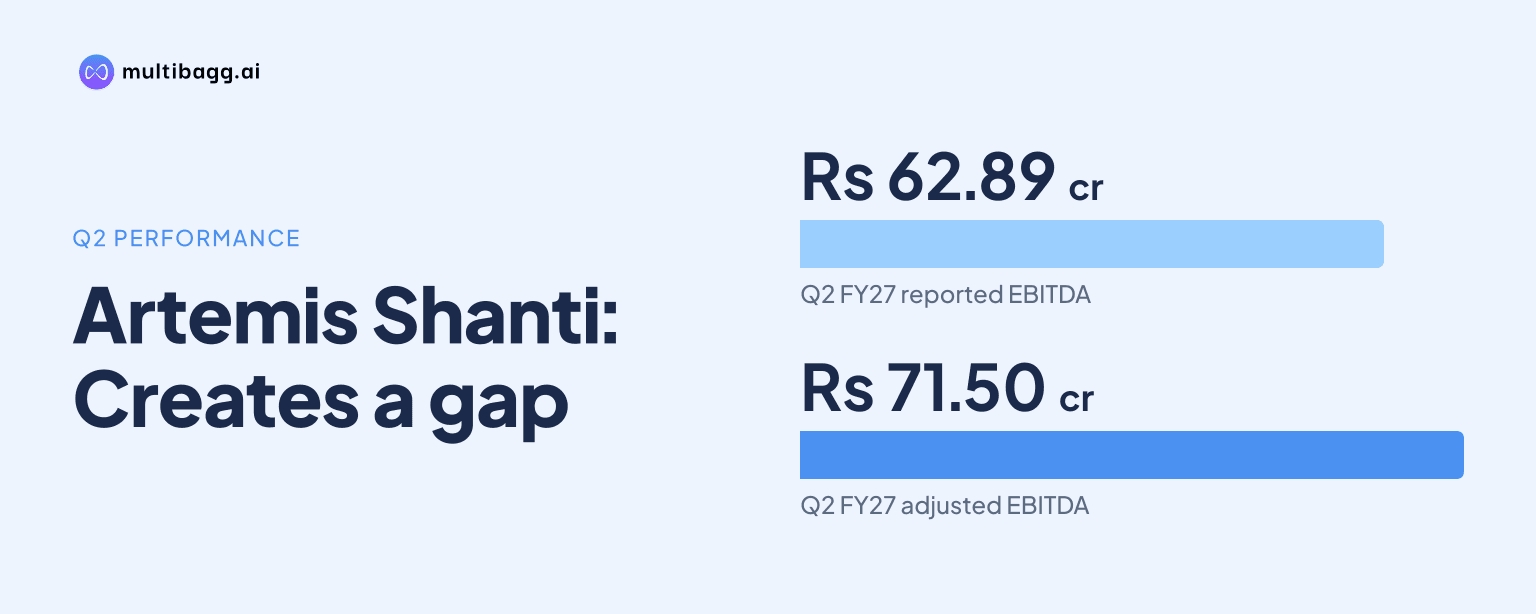
Artemis Shanti Hospital, Raipur created an implied Rs 8.61 crore difference between reported and adjusted consolidated earnings before interest, tax, depreciation and amortisation (EBITDA) in Q2 FY27. Reported EBITDA was Rs 62.89 crore, while adjusted EBITDA was Rs 71.50 crore after excluding the Raipur unit’s revenue and EBITDA losses.
Know Artemis Medicare Services inside out
Results, valuation, peers and who's buying, in one view.
How much did Artemis Shanti affect Q2 FY27 EBITDA?
Artemis Shanti created an implied Rs 8.61 crore adjustment between reported and adjusted EBITDA in Q2 FY27. This is the difference between consolidated reported EBITDA of Rs 62.89 crore and adjusted EBITDA of Rs 71.50 crore. The presentation defines adjusted EBITDA and adjusted EBITDA margin as excluding revenue and EBITDA losses of the Raipur unit, which began operations in July 2026.
The distinction is visible in year-on-year growth rates. Reported EBITDA rose 7.9% from Rs 58.27 crore in Q2 FY26, whereas adjusted EBITDA rose 22.7% from the same Rs 58.27 crore base. Reported EBITDA margin was 20.2%, compared with 21.2% a year earlier, while adjusted EBITDA margin was 23.3%, up 210 basis points, or 2.10 percentage points, year on year.
Why did reported profitability lag adjusted profitability?
Reported profitability lagged adjusted profitability because Artemis Shanti entered consolidated reporting after its July 2026 launch, while the adjusted measure removes the Raipur unit’s revenue and EBITDA losses. The presentation does not disclose separate quarterly revenue, occupancy, patient volumes or standalone EBITDA loss for Artemis Shanti. The Rs 8.61 crore gap between reported and adjusted EBITDA is therefore the visible measure of its Q2 effect.
The contrast also appears in sequential figures. Reported EBITDA increased 1.7% from Rs 61.82 crore in Q1 FY27 to Rs 62.89 crore in Q2 FY27. Adjusted EBITDA increased 15.7% from Rs 61.82 crore to Rs 71.50 crore over the same comparison, with Q2 FY27 the first supplied period identifying a Raipur adjustment.
At the profit after tax, or PAT, level, consolidated PAT increased 3.7% year on year to Rs 31.10 crore but declined 1.1% quarter on quarter from Rs 31.44 crore. Reported PAT margin was 10.0%, below 10.9% in both Q2 FY26 and Q1 FY27. The presentation does not attribute the PAT movement specifically to Artemis Shanti.
What was Artemis’s established hospital performance in Q2 FY27?
Artemis’s established operations showed faster growth in adjusted consolidated EBITDA than in reported EBITDA during Q2 FY27. Revenue from operations rose 13.2% year on year to Rs 311.04 crore and 8.3% quarter on quarter from Rs 287.32 crore. Adjusted EBITDA of Rs 71.50 crore was Rs 8.61 crore above reported EBITDA and produced the disclosed 23.3% adjusted EBITDA margin.
Artemis Hospital, Gurgaon provides a separate view of established operations. Its revenue from operations increased 14.5% year on year to Rs 298.44 crore, while EBITDA rose 21.8% to Rs 70.96 crore. Gurgaon’s EBITDA margin reached 23.8%, compared with 22.4% in Q2 FY26 and 22.1% in Q1 FY27, and operational beds increased to 550 from 544 a year earlier.
Patient activity in Gurgaon also increased. In-patient volume rose 12.0% year on year to 9,787, while average revenue per occupied bed, or ARPOB, increased 6.6% to Rs 86,631. Occupancy rose to 68.1% from 64.1%, and average length of stay declined to 3.52 days from 3.67 days, alongside higher revenue and EBITDA at the Gurgaon hospital.
Got a follow-up? Ask IRIS
What is Artemis Shanti and when did it begin operations?
Artemis Shanti is a 300-bed multi-specialty tertiary-care hospital in Raipur that commenced operations in July 2026. The facility lists more than 20 specialties and 11 centres of excellence, including cardiology, oncology, neurosciences, orthopaedics, nephrology, critical care and emergency medicine. It also provides 24x7 emergency services.
The hospital is part of a broader capacity plan. Artemis Hospital, Gurgaon has 700 beds following the opening of its third tower, and the presentation says additional floor area ratio could add about 250 or more beds, taking capacity to 950 to 1,000 beds. The group has also executed a management services agreement for a 650-plus-bed super-specialty hospital in South Delhi.
The South Delhi facility is planned to become operational in Q4 FY29 or FY30. Management’s stated funding plan includes a proposed approximately Rs 700 crore fund raise, approved by shareholders, for growth initiatives and capital requirements. The presentation also identifies an 80-bed Artemis Curepipe Hospital that started in FY24 and a 110-bed Artemis Cascavelle Hospital operationalised in FY27.
How did the Gurgaon revenue mix change in Q2 FY27?
Gurgaon’s Q2 FY27 revenue mix was led by oncology at 16%, neuro at 15% and orthopaedics at 15%. Oncology declined from 19% in Q2 FY26 and 17% in Q1 FY27, while neuro increased from 14% in Q1 FY27. Orthopaedics increased from 14% in Q2 FY26 and remained unchanged from Q1 FY27.
The payor mix also changed from the preceding quarter. International patients contributed 30% of Q2 FY27 revenue, up from 27% in Q1 FY27 but below 32% in Q2 FY26. Insured patients accounted for 32%, domestic cash patients for 22%, and government schemes for 16%, compared with 33%, 23% and 17%, respectively, in Q1 FY27.
The higher 68.1% occupancy, Rs 86,631 ARPOB and 9,787 in-patient volume at Gurgaon occurred alongside these mix changes. The presentation does not quantify the contribution of each specialty or payor category to the 14.5% year-on-year increase in Gurgaon revenue from operations to Rs 298.44 crore.
Conclusion
Artemis Shanti’s July 2026 opening explains why reported consolidated Q2 FY27 EBITDA of Rs 62.89 crore was below the Rs 71.50 crore adjusted measure that excludes the Raipur unit’s revenue and EBITDA losses. The implied Rs 8.61 crore gap coincided with 22.7% adjusted EBITDA growth, while Gurgaon recorded 14.5% revenue growth and a 23.8% EBITDA margin.
The next result to watch is Artemis Shanti’s progression beyond its first partial quarter, because the presentation does not provide standalone revenue, patient activity, occupancy or loss figures for the 300-bed hospital. Management’s proposed approximately Rs 700 crore fund raise and the South Delhi facility’s expected Q4 FY29 or FY30 operational date are the disclosed milestones in the expansion plan.