










Artemis targets 2,000 beds by 2030 with Delhi expansion
Key highlights
- Artemis Hospitals targets roughly 2,000 beds by 2030, compared with about 1,000 beds in 2026.
- The planned South Delhi hospital will have more than 650 beds and is expected to begin operations in Q4 FY29 or FY30.
- Gurugram occupancy rose to 68.1% in Q2 FY27 from 64.1% a year earlier, while ARPOB increased 6.6% to Rs 86,631.
- Q2 FY27 Gurugram revenue increased 14.5% year on year to Rs 298.44 crore and EBITDA rose 21.8% to Rs 70.96 crore.
powered by IRIS
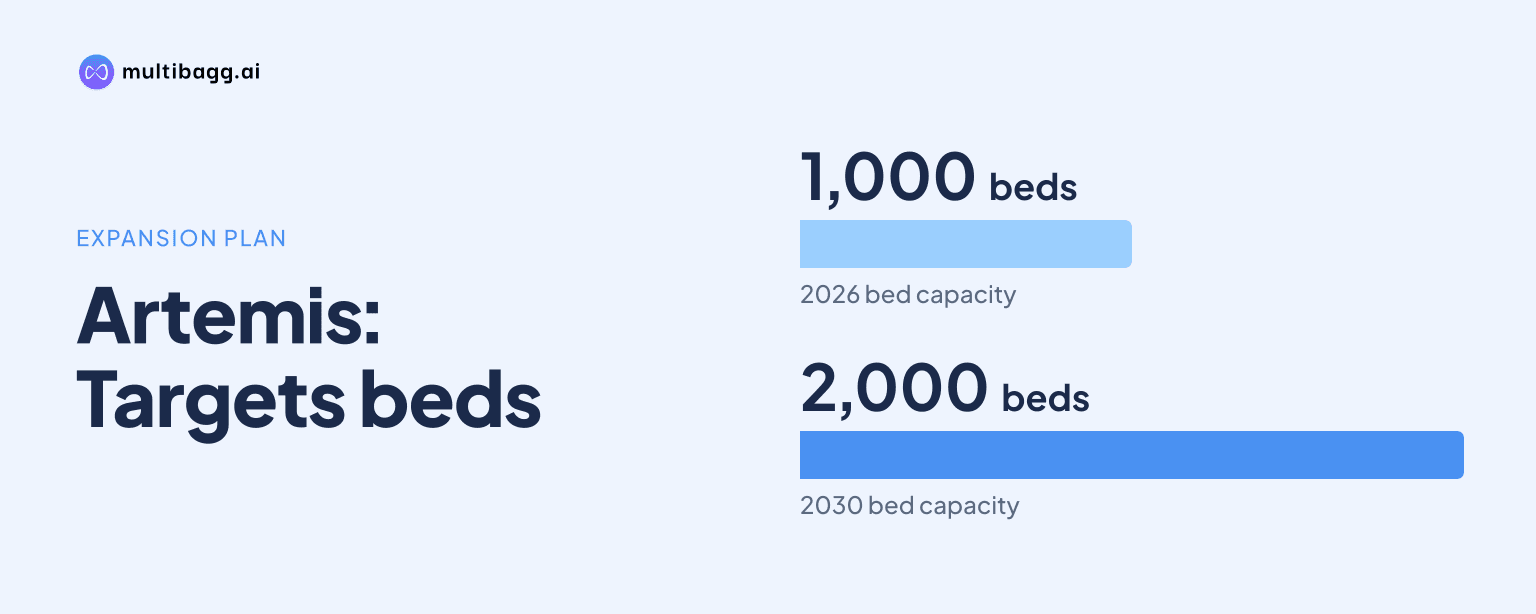
Artemis Hospitals targets roughly 2,000 beds by 2030, compared with about 1,000 beds shown in its 2026 roadmap. Artemis plans to use a 650-plus-bed South Delhi hospital, expected in Q4 FY29 / FY30, and further Gurugram development rights that could lift the existing 700-bed hospital to 950-1,000 beds.
Know Artemis Medicare Services inside out
Results, valuation, peers and who's buying, in one view.
How will Artemis reach 2,000 beds by 2030?
Artemis plans to reach roughly 2,000 beds by 2030 through the South Delhi project and further Gurugram capacity. Its roadmap records 394 beds when the Gurugram hospital opened in 2007, 700 beds after Tower III opened in 2025, and about 1,000 beds in 2026 after the Raipur hospital opening. The roadmap identifies about 900 additional beds in the VIMHANS and Gurugram pipeline.
The stated path represents a further approximate doubling from the roughly 1,000-bed 2026 level. Artemis describes the rise from 394 beds in 2007 to about 1,000 beds in 2026 as 2.7 times growth, before the planned step-up to around 2,000 beds. Its business-overview slide separately refers to a target capacity of about 2,000 beds by 2029, while the roadmap and company overview use 2030.
The network already spans Delhi-NCR, Central India and Mauritius. Artemis began operations at its 300-plus-bed Raipur super-speciality hospital in July 2026, while its Mauritius operations include the 80-bed Artemis Curepipe Hospital under an operations and maintenance agreement. The presentation also says Artemis operationalised a 110-bed Artemis Cascavelle Hospital in Mauritius in FY27.
How much can Artemis expand in Gurugram?
Artemis says Gurugram could reach 950-1,000 beds from the current 700 beds through floor-area ratio, or FAR, development rights. The hospital received Platinum Green Building Certification, which the presentation says entitles it to a 15% FAR increase. Artemis also says purchasing additional FAR to 2.15 could add about 250-plus beds.
The presentation gives two different capacity indications for the Gurugram opportunity. Its business-overview page says the 15% FAR increase and additional FAR could add more than 200 beds, taking the hospital above 900 beds. Its strategic-growth page says additional FAR could take capacity to 950-1,000 beds, without reconciling the difference or setting a construction date.
Gurugram’s operating data show higher utilisation during Q2 FY27. The hospital had 550 operational beds, compared with 544 in Q2 FY26, while occupancy rose to 68.1% from 64.1%. Inpatient volume increased 12.0% year on year to 9,787, and average revenue per occupied bed, or ARPOB, increased 6.6% to Rs 86,631.
The hospital also reduced average length of stay, or ALOS, to 3.52 days in Q2 FY27 from 3.67 days in Q2 FY26. Occupied beds rose to 374 from 349 over the same comparison, while the total bed capacity remained 700. These metrics describe the present operating base but do not establish a timeline for the proposed 200-plus or 250-plus additional beds.
Got a follow-up? Ask IRIS
What does the Artemis South Delhi agreement cover?
Artemis has executed an MSA for a 650-plus-bed super-speciality hospital in Nehru Nagar, South Delhi. The planned facility is expected to cover about 7 lakh square feet of built-up area on about 3.5 acres of leased land. Artemis describes the arrangement as a long-term 30-year operating agreement that gives it operating control through an asset-light model.
The planned South Delhi hospital has an expected operational date of Q4 FY29 / FY30. That timing follows the July 2026 commencement of Raipur operations and makes South Delhi a major element of the bed target described for 2030. The presentation does not disclose the project’s construction cost, the building owner, a commissioning schedule or the number of beds to be opened in phases.
Artemis says the project will extend its presence beyond Gurugram into a premium Delhi-NCR healthcare catchment with high ARPOB. Its network plan envisages complex cases moving from smaller centres to Gurugram, supported by shared clinical protocols, connected records and clinical workflows. The presentation also identifies coordinated procurement, research collaboration and clinician training as mechanisms for linking sites.
What financial and operating results accompany Artemis expansion?
Artemis reported growth in Gurugram revenue, earnings and patient activity in Q2 FY27. Revenue from operations increased 14.5% year on year to Rs 298.44 crore, while earnings before interest, tax, depreciation and amortisation, or EBITDA, increased 21.8% to Rs 70.96 crore. Profit after tax, or PAT, rose 25.9% to Rs 40.43 crore.
At the consolidated level, Q2 FY27 revenue from operations increased 13.2% to Rs 311.04 crore and PAT increased 3.7% to Rs 31.10 crore. Consolidated EBITDA rose 7.9% to Rs 62.89 crore. Adjusted EBITDA, which excludes Raipur unit revenue and EBITDA losses, was Rs 71.50 crore, up 22.7% from Rs 58.27 crore in Q2 FY26.
The difference between reported and adjusted consolidated EBITDA reflects the Raipur unit’s revenue and EBITDA losses as defined by Artemis. In Gurugram, oncology represented 16% of Q2 FY27 revenue, while neurosciences and orthopaedics each represented 15%, together accounting for 46%. International patients accounted for 30% of Gurugram revenue in Q2 FY27, compared with 32% in Q2 FY26, and insured patients represented 32%.
Artemis says shareholders have approved a proposed Rs 700 crore fundraise for growth initiatives and capital requirements. The presentation does not state the timing, instrument, final terms or allocation between the South Delhi project, Gurugram expansion and other requirements. That leaves the funding structure for the planned capacity additions undisclosed.
Conclusion
Artemis’s planned move to roughly 2,000 beds rests principally on extending its established Gurugram hospital and bringing a 650-plus-bed South Delhi facility into operation. Raipur added 300 beds from July 2026, while Gurugram’s Q2 FY27 data showed revenue growth, higher occupancy and a larger inpatient volume against Q2 FY26.
The next disclosed milestones are the expected Q4 FY29 / FY30 operating date for South Delhi and the proposed Rs 700 crore fundraise. Readers should also watch for clarification of Gurugram’s final capacity addition, because the presentation cites both more than 200 beds and about 250-plus beds, producing different total-capacity ranges.