










Artemis targets 2,000 beds as expansion timetable takes shape
Key highlights
- Artemis plans around 2,000 operational beds within three to five years.
- Artemis expects its 250-bed Gurugram Tower 4 to open in H2 FY28.
- Artemis targets Q4 FY29-FY30 for operations at its 650-plus-bed South Delhi hospital.
- Artemis Raipur reported 10% occupancy, Rs 5.3 crore revenue and a Rs 9 crore first-quarter loss.
powered by IRIS
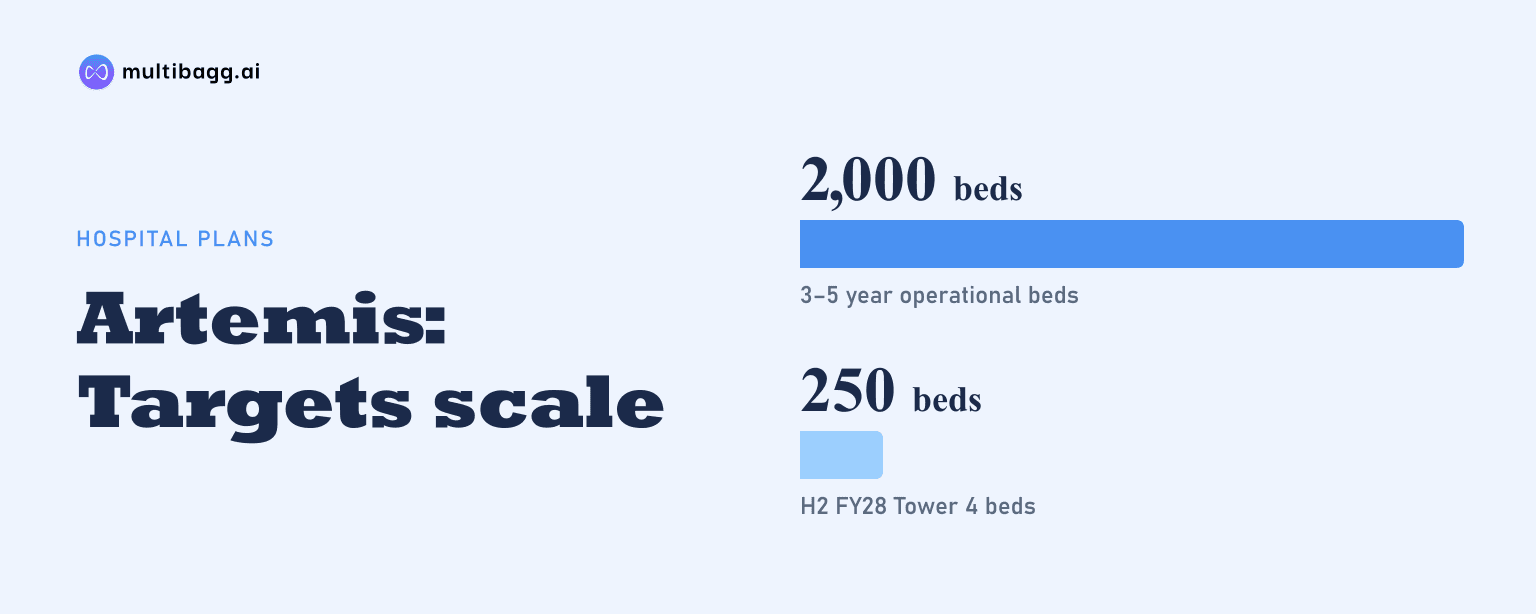
Artemis Medicare Services Limited plans to operate around 2,000 beds within three to five years, supported by a 250-bed Gurugram tower, its operating 300-bed Raipur hospital and a proposed South Delhi facility with more than 650 beds. Management disclosed the targets during its November 2, 2026 Q2 and H1 FY27 earnings call.
Know Artemis Medicare Services inside out
Results, valuation, peers and who's buying, in one view.
How will Artemis reach 2,000 operational beds?
Artemis plans to reach around 2,000 operational beds by combining the Raipur launch with additions in Gurugram and South Delhi over three to five years. The 300-bed Artemis Shanti Hospital in Raipur began operations in July 2026, Tower 4 at the Gurugram campus is planned to add 250 beds, and the South Delhi project is proposed with more than 650 beds.
The near-term expansion is Tower 4, which is intended to take the Gurugram campus from 700 beds to more than 900 beds. Management said the 250-bed tower will use additional floor area available through the campus’s Platinum Green Building certification, increasing capacity at the existing location rather than through a separate Gurugram site.
The disclosed additions show that the target depends on three locations with different stages of development. Raipur was operating from July 2026, Tower 4 had an H2 FY28 target, and South Delhi had a Q4 FY29-FY30 operating target. Management did not provide a separate, bed-by-bed bridge from these projects to the roughly 2,000-bed network goal.
When will Artemis add Gurugram and South Delhi capacity?
Artemis expects all 250 Tower 4 beds in Gurugram to open in H2 FY28 and expects the South Delhi hospital to begin operations in Q4 FY29-FY30. In response to an analyst question, management said the Gurugram beds would be commissioned “all in one go,” rather than in phases.
The South Delhi facility is planned as a tertiary and quaternary-care hospital in Lajpat Nagar with more than 650 beds. During the November 2026 call, management said drawings had been submitted to the Municipal Corporation of Delhi, or MCD, and demolition of the old building was under way. It also said it was monitoring the effect that Delhi’s Graded Response Action Plan, or GRAP, pollution restrictions could have on work.
Artemis said the project will operate under a 30-year operation and management contract with the VIMHANS Trust. Management described the site as trust land, said it had been awaiting environmental clearance, and said all other compliances were in place. The Q4 FY29-FY30 target remains management’s expectation rather than an announced commissioning date.
Got a follow-up? Ask IRIS
What is the financial and operating base for the expansion?
Artemis reported consolidated revenue from operations of Rs 311 crore in Q2 FY27, up 13.2% year on year, and Rs 598.4 crore in H1 FY27, up 13%. Management attributed the growth to demand in cardiac sciences, oncology, neurosciences, orthopaedics, transplants and other complex treatments, alongside an early contribution from Raipur.
The reported Q2 FY27 EBITDA margin was 20.2%, compared with an adjusted operational EBITDA margin of 23.3%. For H1 FY27, the reported EBITDA margin was 20.8% and the adjusted operational measure was 22.4%. Profit after tax was Rs 31 crore in Q2 FY27, up 3.7% year on year, while H1 profit after tax was Rs 62.5 crore, up 22.2%.
The mature Gurugram hospital reported its highest-ever EBITDA margin of 23.8% in Q2 FY27, according to management. International patients contributed about 30% of quarterly revenue and came from more than 150 countries. Management said this diversified international patient base reduces dependence on a single region while the newer facilities develop.
How is Artemis Shanti Hospital in Raipur ramping up?
Artemis said its 300-bed Raipur hospital had 10% occupancy after operations began on July 29, 2026, and recorded a Rs 9 crore loss in its first quarter. Doctors had been onboarded from July 1, while theatres, the catheterisation laboratory and related services began operating on July 29.
Raipur generated Rs 5.3 crore of first-quarter revenue, exceeding management’s estimate of Rs 4.3 crore. Management had expected a first-quarter loss of Rs 9 crore to Rs 10 crore. Average revenue per occupied bed, or ARPOB, was Rs 30,000 to Rs 32,000, compared with Artemis’s initial estimate of Rs 26,000 to Rs 27,000 based on competitors.
Management attributed the initial ARPOB outcome to a clinical mix led by higher-end surgeries rather than routine care. It also said the hospital had recruited doctors from Chhattisgarh and was receiving a positive response from central India. These are management assessments, while the 10% occupancy and Rs 9 crore loss indicate that the facility was still in its early operating ramp-up.
Raipur’s first-quarter loss contrasts with the 23.8% Q2 FY27 EBITDA margin reported by the established Gurugram hospital. Management said its next priorities were gradual occupancy ramp-up at Raipur, Tower 4 development in Gurugram and progress on South Delhi, alongside expansion of clinical capabilities across more than 40 specialties.
Conclusion
Artemis has set out a multi-stage route to around 2,000 operational beds, with Raipur already open, Gurugram Tower 4 expected in H2 FY28 and the larger South Delhi project targeted for Q4 FY29-FY30. Revenue growth of 13.2% in Q2 FY27 provides the operating backdrop, but the Rs 9 crore first-quarter loss at Raipur shows that new capacity will not have the same near-term financial profile as the mature Gurugram hospital.
The next disclosed milestones are Tower 4’s H2 FY28 opening target, the South Delhi project’s demolition, clearance and construction progress, and Raipur’s occupancy and revenue trend after its July 2026 start. Management also said it was actively finalising assets and expected investors to hear about both those assets and a fund raise by January or February 2027.