










Artemis plans February 2027 raise for hospital acquisitions
Key highlights
- Artemis expects a capital raise around the end of January or beginning of February 2027.
- Management said prospective hospital targets are EBITDA-positive and generally at least 350 beds.
- Gurugram delivered a 23.8% EBITDA margin at 68% occupancy in the quarter discussed.
- Raipur reported Rs 5.3 crore revenue and a Rs 9 crore first-quarter loss after its July 29 start.
powered by IRIS
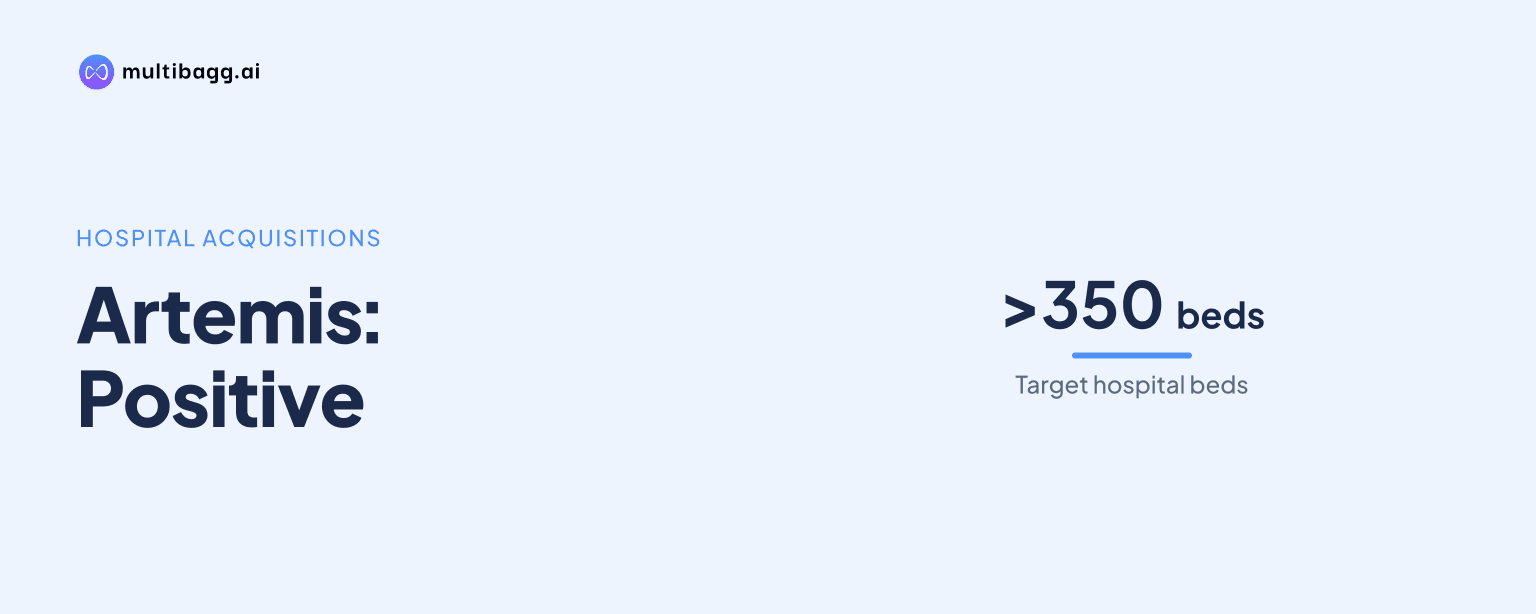
Artemis plans to raise capital between late January and early February 2027 after finalising hospital targets that management said are earnings before interest, tax, depreciation and amortisation (EBITDA) positive. The proposed expansion focuses on facilities of at least 350 beds in Delhi National Capital Region (NCR) and tier-2 city capitals in central and eastern India.
Know Artemis Medicare Services inside out
Results, valuation, peers and who's buying, in one view.
When will Artemis raise capital for hospital acquisitions?
Artemis expects to raise capital around the end of January or the beginning of February 2027, subject to completing target finalisation and compliance checks. Management said investors could hear about both the assets and the raise by January or February 2027, while describing the work as a priority.
The timing is conditional rather than a completed financing. Management said it was waiting until after Diwali to finalise targets because it wanted all compliances met before signing, and Artemis did not disclose the amount to be raised, the financing instrument, the number of assets or the proposed purchase values.
Management confirmed that the prospective targets are EBITDA-positive. That criterion contrasts with Artemis Shanti Hospital in Raipur, which started operations on July 29, recorded a Rs 9 crore loss in its first quarter and had 10% occupancy at the time discussed on the call.
What hospitals does Artemis want to add?
Artemis is seeking large-format hospitals in Delhi NCR and in capitals of tier-2 cities in central and eastern India, rather than northern India. Management said its market assessment considered healthcare need, insurance penetration and patients' capacity to pay for tertiary care.
The company may pursue a combination of greenfield projects and brownfield operating assets. Management said it would assess acquisition cost as well as local demand and capacity to pay, but did not provide a cost-per-bed target or an acquisition budget for the potential transactions.
Management said future hospitals tied to the fundraise would be at least 350 beds and could be 500 beds. That would make them larger than the planned 220-to-250-bed Tower 4 addition in Gurugram, while potentially smaller than the 650-bed South Delhi project.
How will Artemis sequence hospital and cardiac-care growth?
Artemis plans to prioritise the fundraise and larger hospital additions before further Artemis Cardiac Care expansion. Artemis Cardiac Care reported EBITDA of Rs 70 lakh and profit after tax (PAT) of Rs 20 lakh, but management described the business as relatively smaller than the proposed hospital programme.
After acquisitions funded through the raise, management said Artemis may add four or five cardiac-care units. It indicated that if the raise takes place in February 2027 and an announcement follows in March or April, it could consider expanding cardiac care by the third quarter of the following year.
Management attributed this sequence to the cost of cardiologists in Delhi NCR and smaller cities. It said smaller cardiac units need economies of scale to generate more meaningful absolute margins, although the current cardiac-care operation has broken even and reported positive EBITDA and PAT.
Artemis also has organic capacity plans running alongside its acquisition work. Tower 4 is expected to add all 220 to 250 beds in one phase by the second half of financial year 2028, while the South Delhi project is targeted for operationalisation in the fourth quarter of financial year 2029-30.
Got a follow-up? Ask IRIS
What operating trends support Artemis's expansion plan?
Artemis said its Gurugram facility delivered a 23.8% EBITDA margin at 68% occupancy in the quarter discussed. Management said it was confident occupancy could reach 75% with cost points broadly unchanged, which it expects would raise EBITDA.
The Raipur hospital is at a different stage of maturity. It reported revenue of Rs 5.3 crore against management's expectation of Rs 4.3 crore, but its first-quarter loss was Rs 9 crore and occupancy was 10% after its July 29 operational start.
Management put Raipur's quarterly operating cost, including fixed costs, at about Rs 10 crore. It said doctors and major departments, including cardiology, cardiac surgery, neurology, neurosurgery, transplants and robotic surgery, were already in place, limiting the scope for material further cost additions beyond some nursing hires.
Artemis maintained a 12-to-15-month break-even timeline for Raipur. Management expects occupancy to rise to at least 20% to 25%, and possibly 30%, in coming quarters, while average revenue per occupied bed (ARPOB) began at Rs 30,000 to Rs 32,000 versus the Rs 26,000 management cited for competitors.
What uncertainties could affect Artemis's funding plan?
The principal disclosed uncertainty is execution of the hospital transactions before the targeted January-February 2027 raise. Artemis has not named targets, disclosed their locations, provided a valuation, specified the financing mix or set out pro forma revenue, EBITDA or return expectations.
Regulatory developments affecting oncology medicines remain another unresolved issue. Management said no policy statement had been issued at the time of the call and estimated that a 20% margin cap on oncology drugs could reduce EBITDA by 0.5% to 0.8%.
For a hypothetical wider drug-price intervention, management estimated an EBITDA effect of 1% to 1.25%, noting that more than 50% of other medicines were already subject to National Pharmaceutical Pricing Authority guidelines. Management also said room-rent regulation would have zero impact on Artemis because its room rates were already aligned with three-star hotel rates.
Conclusion
Artemis has linked a planned late-January to early-February 2027 capital raise to the acquisition of EBITDA-positive hospitals, with facilities generally starting at 350 beds. The strategy places larger hospital assets in Delhi NCR and central and eastern India ahead of a possible four-to-five-unit expansion of Artemis Cardiac Care, while Gurugram and Raipur continue on separate operating paths.
The next milestones are target finalisation after compliance checks, the proposed January-February 2027 funding announcement and Raipur's progress toward break-even within 12 to 15 months. Management also targets 220 to 250 Tower 4 beds by the second half of financial year 2028 and South Delhi operations in the fourth quarter of financial year 2029-30.