










Artemis says oncology cap could cut EBITDA by up to 0.8%
Key highlights
- Artemis said a 20% oncology-drug margin cap could reduce EBITDA by 0.5% to 0.8% at most if implemented.
- Artemis said a hypothetical cap across all drugs could have a 1% to 1.25% EBITDA effect.
- Artemis reported Q2 FY27 revenue from operations of Rs 311 crore, up 13.2% year on year.
- Artemis said room-rent restrictions would have zero impact because its tariffs are already at three-star rates.
powered by IRIS
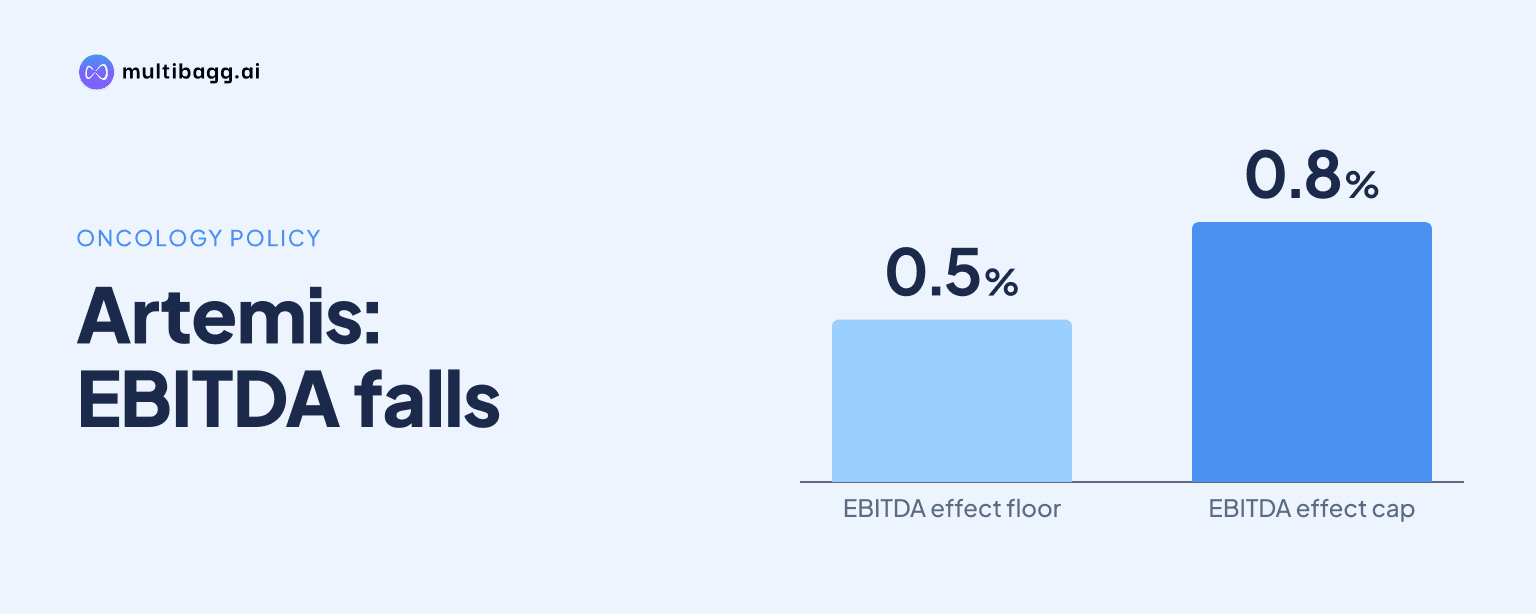
Artemis Medicare said during its Q2 FY27 earnings call that a proposed 20% cap on oncology-drug margins could reduce earnings before interest, tax, depreciation and amortisation, or EBITDA, by 0.5% to 0.8% at most in the short term if implemented. Management said no oncology-drug policy statement was then in force and court proceedings remained unresolved.
Know Artemis Medicare Services inside out
Results, valuation, peers and who's buying, in one view.
What is Artemis’s estimated EBITDA impact from an oncology-drug cap?
Artemis estimates that a 20% oncology-drug margin cap would reduce EBITDA by 0.5% to 0.8% at most in the short term, if it becomes policy and is implemented. Management described the calculation as a back-of-the-envelope assessment and said the outcome depends on several unresolved conditions, including the eventual policy framework and the court process.
Management said the company’s drug margins are already close to the range being discussed, apart from a few immunotherapy drugs and other products. It added that maximum retail prices, or MRP, are set by manufacturers rather than hospitals, while hospitals negotiate against those prices. An analyst described oncology as around 20% of Artemis’s business, but Artemis did not separately disclose oncology revenue or pharmacy revenue in the call.
Artemis compared the potential oncology measure with earlier regulation of stents and implants, saying the previous intervention was a harder hit. The company gave no historical financial figure for that comparison, but management said a 20% cap on oncology margins would be smaller because current margins are already near the level under discussion.
Is an oncology-drug price cap already in force for Artemis?
No, Artemis said there was no policy statement or policy guideline on oncology drugs at the time of its Q2 FY27 call. Management said Artemis and the private-hospital consortium had submitted their views to the court, but could not say when, whether or in what form a policy decision would emerge.
Management said there was no current concern about losing business from the proposal. Its 0.5% to 0.8% estimate is therefore a conditional scenario rather than earnings guidance. Artemis said its representation had explained that its drug margins broadly align with the margin range being discussed and that it did not expect the matter to create a major industry disruption.
The regulatory discussion came as Artemis reported Q2 FY27 revenue from operations of Rs 311 crore, up 13.2% year on year. Reported consolidated EBITDA was Rs 62.89 crore, or 20.2% of revenue, while adjusted operational EBITDA was Rs 71.5 crore, or 23.3%. Management cited demand across cardiac sciences, oncology, neurosciences, orthopaedics, transplants and other complex treatments.
Would broader medicine price controls have a bigger effect?
Artemis said a hypothetical cap extending across all drugs could raise the EBITDA effect to about 1% to 1.25%, although management stressed that this is not the policy currently being discussed. It said more than 50% of medicines outside oncology are already covered by National Pharmaceutical Pricing Authority, or NPPA, guidelines.
Management cited high-end antibiotics, intensive-care unit medicines and immunosuppressants used after transplants as medicines already subject to pricing rules. That existing coverage is why Artemis did not mechanically apply the oncology scenario to all pharmacy sales. The company did not provide a calculation for a universal drug cap, leaving the 1% to 1.25% range as management’s indicative assessment.
International patients contributed about 30% of Artemis’s Q2 FY27 revenue, providing context on the group’s patient mix. Artemis said it serves patients in more than 150 countries, including the Middle East, Africa, the Commonwealth of Independent States, South Asia, Canada and Nordic countries. The call did not disclose how much oncology-drug revenue comes from international patients or from any individual geography.
Got a follow-up? Ask IRIS
Would room-rent restrictions change Artemis’s procedure prices?
Artemis said room-rent restrictions would have zero impact on its pricing because its room tariffs are already at three-star rates and many treatments are offered as packages. Management said procedure prices would not need to change under a room-rent proposal because its packages are already lower than those of most competitors, according to its assessment.
An analyst asked whether procedure charges could be realigned if room tariffs were capped. Artemis responded that its Gurugram room rents are comparable with three-star hotel rates and are already included in package pricing. Management said hospitals charging five-star room rates may face a different outcome, but did not identify competitors or provide a numerical comparison of package prices.
The room-rent issue is separate from the oncology-drug proposal. Artemis’s zero-impact assessment concerns its existing room-rate and package structure, whereas the 0.5% to 0.8% estimate concerns a possible 20% oncology-drug margin cap. The transcript therefore sets out two distinct regulatory mechanisms and two different management assessments.
How does the regulatory exposure compare with Artemis’s expansion plans?
The potential 0.5% to 0.8% EBITDA effect comes alongside Artemis’s plan to increase operational capacity to around 2,000 beds over three to five years. Artemis Shanti Hospital in Raipur, a 300-bed multispecialty tertiary-care hospital, began operations in July 2026, while Tower 4 at the Gurugram campus is planned to add 250 beds in one phase by H2 FY28.
Raipur remained in an early ramp-up stage during Q2 FY27, with 10% occupancy, revenue of Rs 5.3 crore and a loss of Rs 9 crore. Revenue exceeded management’s Rs 4.3 crore estimate, while average revenue per occupied bed was Rs 30,000 to Rs 32,000, above the Rs 26,000 to Rs 27,000 level management attributed to competitors. Artemis maintained a 12- to 15-month break-even timeline for the facility.
At Gurugram, Artemis reported its highest hospital EBITDA margin of 23.8% at 68% occupancy in Q2 FY27. Management said it aims to lift occupancy to 75%, with cost points remaining broadly unchanged, and expects the 220 to 250 beds in Tower 4 to require mainly additional nursing and medical-officer costs. These operating targets, together with the regulatory outcome, will affect the future of the group’s 20.2% reported consolidated EBITDA margin.
Conclusion
Artemis has placed a numerical boundary around the oncology-drug regulatory issue discussed in its Q2 FY27 call: management estimates that a 20% margin cap would reduce EBITDA by no more than 0.8% in the short term if implemented. That assessment reflects current drug margins, existing NPPA coverage for many other medicines and a room-rate structure that management says already matches three-star levels.
The next points to watch are the court and policy outcome on oncology pricing, for which Artemis gave no timing, and the company’s expansion milestones. Management expects Raipur to break even within 12 to 15 months, plans to add 250 Gurugram beds by H2 FY28, and expects the proposed 650-plus-bed South Delhi hospital to commence operations in Q4 FY29-FY30.