










Belding completes 200,000+ sq. ft. integrated campus in 11 months
Key highlights
- Belding completed a 200,000+ sq. ft. integrated campus in 11 months.
- The campus includes 170,000 sq. ft. of manufacturing space and 30,000 sq. ft. of administrative space.
- Belding installed 2 MW of solar infrastructure with substations, water, compressed air and fire-safety systems.
- The 9-acre site required 64,000+ cubic metres of excavation reuse and 2,330+ running feet of retaining walls.
powered by IRIS
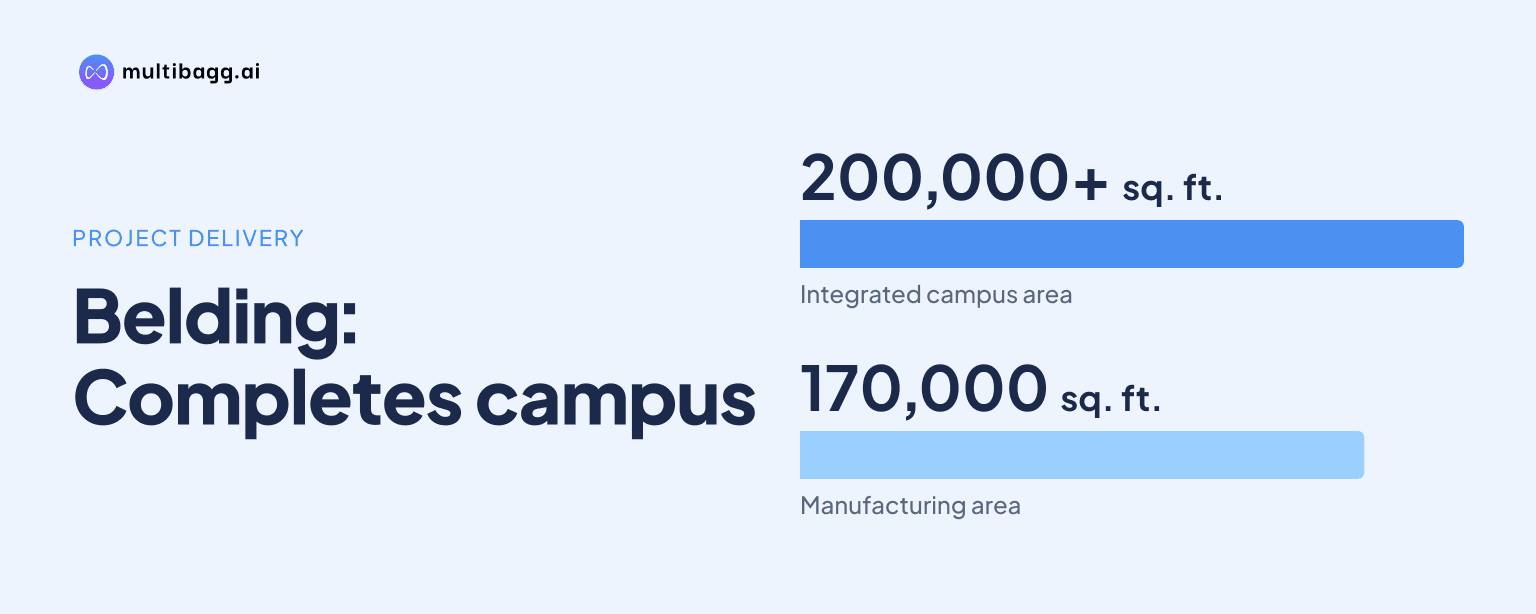
Belding completed a 200,000+ sq. ft. integrated campus in 11 months, converting a 9-acre greenfield hill-and-valley site into 170,000 sq. ft. of manufacturing space, 30,000 sq. ft. of administrative space and a facility with 2 MW of solar infrastructure.
Know Belding India inside out
Results, valuation, peers and who's buying, in one view.
How did Belding complete the campus in 11 months?
Belding completed the project through a staged 11-month programme beginning with land acquisition, planning, design and site mobilisation in Month 1. The company secured a 9-acre greenfield hill-and-valley site, prepared the terrain from Month 2 to Month 5 and built the main facility between Month 5 and Month 7.
Site preparation involved excavating and reusing more than 64,000 cubic metres of material on site. Belding also constructed more than 2,330 running feet of retaining walls, reaching up to 72 feet in height, to turn the terrain into a construction-ready platform.
The construction phase produced a 170,000 sq. ft. manufacturing facility and a 30,000 sq. ft. administrative building. Those two stated buildings total 200,000 sq. ft., while Belding describes the delivered integrated campus in Month 11 as exceeding 200,000 sq. ft.
Belding then installed utilities and renewable-energy systems from Month 7 to Month 10, before delivery in Month 11. This sequence indicates that the project moved from civil works to building construction and then to systems integration, rather than treating building completion as the final milestone.
What space does Belding's new campus include?
Belding's campus includes 170,000 sq. ft. of manufacturing space and 30,000 sq. ft. of administrative space. The manufacturing component is 140,000 sq. ft. larger than the administrative building, based on the two areas disclosed in the presentation.
The 170,000 sq. ft. manufacturing facility is presented as the production base within the wider 200,000+ sq. ft. integrated campus. Belding's facility overview also shows operational floors and a separate administrative building, alongside its stated focus on precision, quality and scalable execution.
Belding describes its manufacturing platform as covering design, product development, product integration, precision engineering, advanced fabrication and manufacturing. The company says this original equipment manufacturer and original design manufacturer platform can support complete solutions, customised product development, sub-assemblies and contract manufacturing.
The stated commercial focus includes edge data centres, battery energy storage systems, known as BESS, and global contract manufacturing. Belding also says its market outreach extends beyond the domestic market to opportunities in the United States and Middle East.
Got a follow-up? Ask IRIS
Which utilities and site systems were installed at Belding's campus?
Belding installed 2 MW of solar infrastructure alongside mechanical, electrical and plumbing, or MEP, systems, substations, water infrastructure, compressed-air systems and fire-safety systems from Month 7 to Month 10. These systems were integrated before the 200,000+ sq. ft. campus was delivered in Month 11.
The completed campus also includes a sewage treatment plant, or STP, an effluent treatment plant, or ETP, rainwater harvesting and electric-vehicle-ready infrastructure. Belding lists these as delivered features, rather than future additions, together with landscaped areas.
The landscape component covers more than 1 acre and includes 1,548 plantations. It forms part of the Month 11 delivery package following the earlier excavation of more than 64,000 cubic metres and construction of retaining walls across the 9-acre site.
Belding separately presents a 3 gigawatt-hour, or GWh, BESS assembly capacity under its integrated energy-storage platform. That presentation identifies a BESS assembly line, robotic automation and solar infrastructure, while the campus page identifies the 2 MW solar installation as part of its operational utilities.
What production capabilities does Belding house under one roof?
Belding lists computer numerical control, or CNC, fabrication, surface finishing and ingress-protection, or IP, testing among the capabilities housed under one roof. Its named equipment includes a Trumpf CNC fibre laser, a TruPunch 1000 CNC turret punching machine and a TruBend 1100 CNC press brake machine.
The CNC fibre laser is described as cutting large-format sheet metal, while the TruPunch 1000 produces holes, slots, louvers, embosses and formed sheet-metal features. The TruBend 1100 is used for high-accuracy bending of small and medium-sized sheet-metal components.
Belding also identifies a paint booth and shot-blasting equipment with a motorised trolley for surface treatment. The paint booth provides controlled, dust-free painting and uniform coverage, while shot blasting removes rust, cleans surfaces and improves adhesion before protective finishing.
The IP testing function assesses enclosure integrity for dust resistance, water protection, durability and compliance. Separately, Belding says its modular and containerised edge data-centre products can support deployments of up to 5 MW, with about 1 MW of containerised capacity in every 5-day cycle across 14 manufacturing bays.
Conclusion
Belding's 11-month build combined terrain preparation on a 9-acre site with a 200,000+ sq. ft. manufacturing and administrative campus, 2 MW of solar infrastructure and utility systems including STP, ETP and rainwater harvesting. The 170,000 sq. ft. manufacturing area is supported by CNC fabrication, finishing and IP testing capabilities aligned with Belding's OEM, contract-manufacturing, edge data-centre and BESS platforms.
What to watch next is execution against the capacity and commercial plans disclosed by Belding. The presentation says order-book building and revenue recognition commenced in Q2FY27, while it also presents 3 GWh of BESS assembly capacity and containerised data-centre output of about 1 MW every 5-day cycle across 14 manufacturing bays.