










Belding India hybrid BESS targets 40-80% diesel reduction
Key highlights
- Belding India says its Hybrid BESS can reduce diesel consumption by 40-80%, depending on load profile.
- Belding India states that its BESS systems range from 250 kWh to 5 MWh and have at least 90% round-trip efficiency.
- Belding India reports 3 GWh of BESS assembly capacity supported by a robotic automated line.
- Belding India says its integrated manufacturing campus exceeds 200,000 square feet and includes 2 MW of solar infrastructure.
powered by IRIS
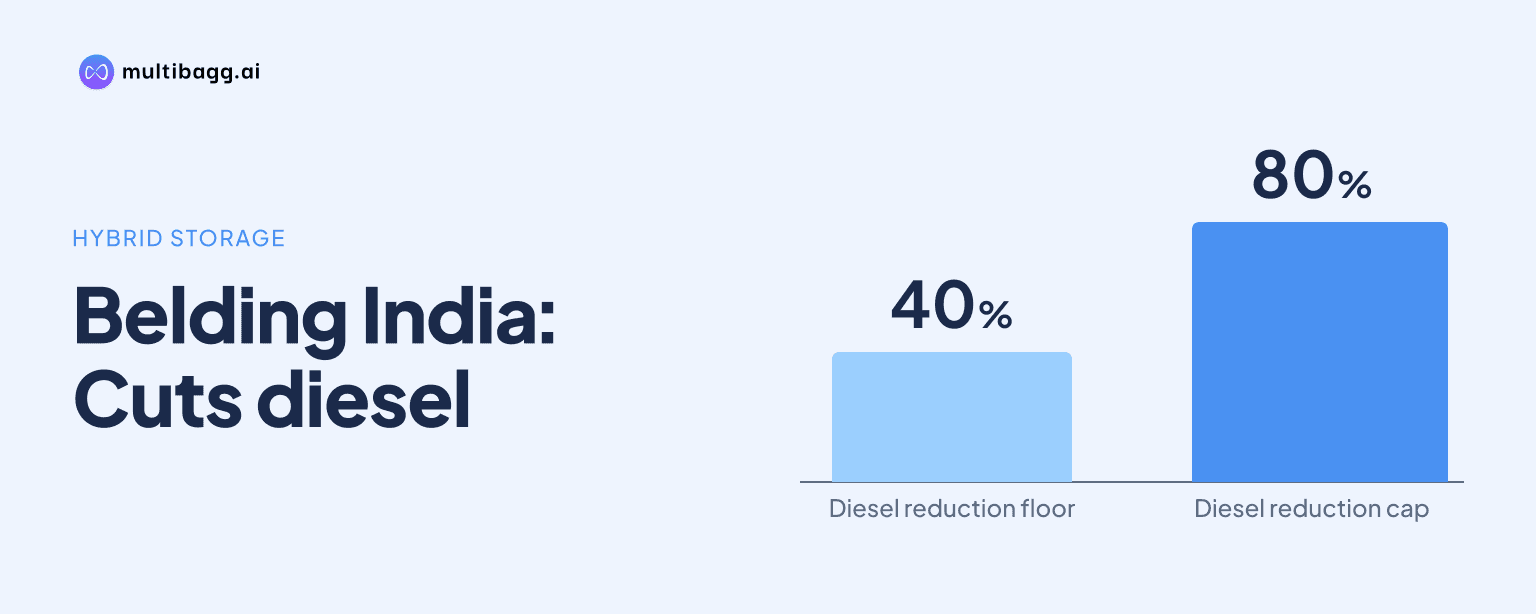
Belding India Limited says its hybrid battery energy storage system (BESS) can reduce diesel consumption by 40-80% in generator-based backup-power systems, depending on the load profile. Belding India identifies data centres, hospitals and telecom towers as suitable uses, and says its broader BESS systems range from 250 kilowatt-hours to 5 megawatt-hours.
Know Belding India inside out
Results, valuation, peers and who's buying, in one view.
What diesel reduction does Belding India’s hybrid BESS target?
Belding India says its Hybrid BESS is designed for diesel generator-based power systems and targets a 40-80% reduction in diesel consumption. The stated result depends on the load profile, and the presentation does not provide a standard generator size, battery duration, fuel baseline or test methodology for the range.
Belding India presents the product as a hybrid solution intended to reduce dependence on conventional backup systems while providing uninterrupted, high-quality power for critical operations. In launch material headed “Belding India launches hybrid BESS at IESW 2026,” the accompanying staff-writer line is dated July 13, 2025; the presentation does not reconcile the two displayed references.
How is Belding India’s BESS range configured?
Belding India says its BESS systems range from 250 kilowatt-hours (kWh) to 5 megawatt-hours (MWh) per system and have round-trip efficiency of at least 90%. Round-trip efficiency measures the energy available after a battery has been charged and discharged, relative to the energy used for charging.
Belding India describes an integrated system comprising packs, modules, thermal management, a battery management system, an energy management system, fire suppression and its bi-directional power conversion system intellectual property. It also offers turnkey systems and component-level supply of containers, racks and modules, creating a distinction between complete deployments and hardware-only supply.
The portfolio is shown in four formats: a battery module, a modular BESS, an integrated hybrid enclosure and a grid-ready container platform. Belding India therefore places the diesel-reduction proposition in the hybrid-enclosure format, while presenting larger containerised systems for grid-ready applications.
Which users can deploy Belding India’s hybrid BESS?
Belding India identifies data centres, hospitals and telecom towers as suitable Hybrid BESS users. These applications are named in connection with the product’s diesel-generator backup-power design, rather than as disclosed customer installations or signed contracts.
Belding India also lists renewables, grid modernisation, microgrids, industrial loads, smart cities and genset replacement as applications for its wider BESS platform. This separates the Hybrid BESS’s stated backup-power function from the broader storage portfolio’s grid, renewable and industrial deployment uses.
Data centres are also part of Belding India’s digital-infrastructure offering. Its modular and containerised edge data-centre products are specified at up to 5 MW per deployment, with about 1 MW of containerised capacity produced every five-day cycle across 14 manufacturing bays; the presentation does not say the Hybrid BESS is bundled with a particular data-centre project.
Got a follow-up? Ask IRIS
What manufacturing capacity supports Belding India’s BESS offering?
Belding India reports 3 gigawatt-hours (GWh) of BESS assembly capacity on a robotic automated line. It describes its manufacturing scope as extending from cell integration to containerised deployment, while stating that battery cells are imported; the 3 GWh figure is assembly capacity rather than reported production or installed capacity.
Belding India says its integrated campus was completed in 11 months and includes 170,000 square feet of manufacturing space and a 30,000-square-foot administrative building. The campus totals more than 200,000 square feet and includes 2 MW of solar infrastructure, along with substations, water systems, compressed air and fire-safety systems.
The manufacturing set-up also includes computer numerical control fiber-laser cutting, turret punching and press-brake equipment, plus ingress-protection testing, paint-booth and shot-blasting facilities. Those capabilities align with Belding India’s stated supply of BESS containers, racks and modules, but the presentation does not disclose utilisation of the 3 GWh assembly line.
What commercial progress has Belding India disclosed?
Belding India says order-book building and revenue recognition had commenced in Q2FY27. It lists organisations including Sterling & Wilson, Tata Gotion, Lineage Power, Replus, Bharat Electronics, IndianOil, Vertiv and Chennai Metro Rail Limited as clientele, without assigning any of them to Hybrid BESS orders or disclosing contract values.
Belding India’s stated commercial focus covers edge data centres, BESS and global contract manufacturing, with outreach targeted at the United States and Middle East. Its original equipment manufacturer and original design manufacturer platform covers design, product development, product integration, complete solution delivery, sub-assemblies and contract manufacturing.
Belding India also reports a 100% acquisition of Evolve IT Solutions, adding baggage and parcel screening, cargo and vehicle inspection, and artificial-intelligence-enabled imaging across more than eight critical-infrastructure end markets. The presentation identifies that acquisition as a security-technology expansion and does not link it to Hybrid BESS revenue or deployment.
Conclusion
Belding India’s disclosed Hybrid BESS proposition is a 40-80% diesel-consumption reduction target for generator-based backup systems, with results dependent on load profile. The product sits within a 250 kWh-to-5 MWh BESS range that includes integrated systems, component supply and containerised formats, supported by stated 3 GWh assembly capacity.
The next disclosed commercial point to watch is Belding India’s Q2FY27 order-book building and revenue recognition, particularly whether later disclosures identify storage orders, deployments or line utilisation. Management also identifies the United States and Middle East as outreach markets, but the presentation provides no Hybrid BESS sales target, project value or scheduled commissioning date.