










BELDING offers 5 MW edge centres in five-day production cycles
Key highlights
- BELDING offers modular and containerized edge data-centre deployments of up to 5 MW.
- BELDING states it can manufacture about 1 MW of containerized capacity every five days.
- BELDING lists 14 parallel manufacturing bays for modular data-centre production.
- BELDING cites 1,900 MW of installed Indian data-centre capacity in FY26, more than triple the FY19 level.
powered by IRIS
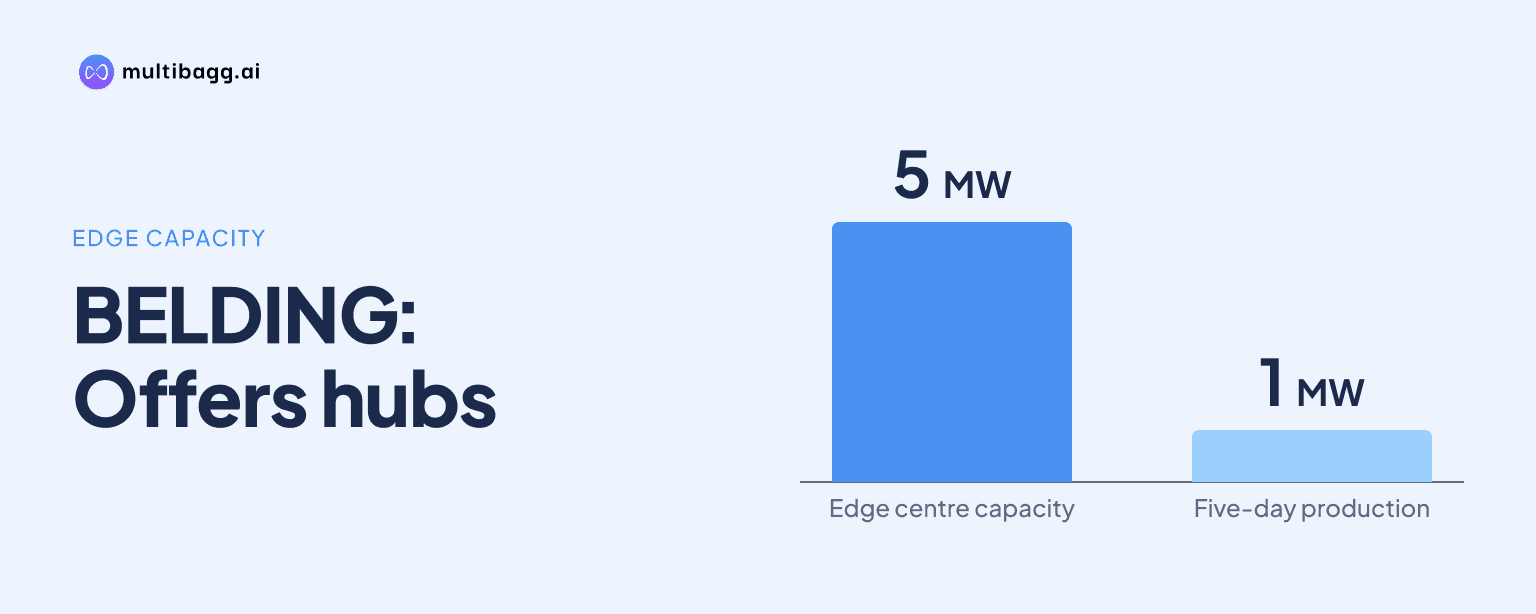
BELDING offers modular and containerized edge data-centre deployments of up to 5 MW and states it can manufacture about 1 MW of containerized capacity in every five-day production cycle. Its digital-infrastructure offer combines factory-built products with turnkey delivery from design through commissioning, using 14 parallel manufacturing bays.
Know Belding India inside out
Results, valuation, peers and who's buying, in one view.
What edge data-centre product does BELDING offer?
BELDING offers prefab data centres and containerized edge data centres, with modular, plug-and-play deployments of up to 5 MW each. The presentation places these products in its digital-infrastructure business and describes them as factory-built infrastructure for faster, localised deployment. It identifies two formats: prefab data centres and containerized EDCs, with EDC meaning edge data centre.
BELDING presents the offer as turnkey delivery, covering design through commissioning under a single point of accountability. This combines engineering, manufacturing and engineering, procurement and construction, or EPC, execution within the stated delivery model. The 5 MW figure is a maximum per deployment, whereas the 1 MW figure refers to containerized manufacturing capacity in a five-day cycle, so they measure product scale and production output respectively.
The presentation describes the modular and containerized systems as applicable to Energy and Utilities, Telecom, Oil and Gas, and Public Infrastructure. BELDING does not provide project counts, customer names, installed capacity or revenue for the 5 MW edge-data-centre offer. Its disclosed proposition is therefore defined by the product formats, deployment ceiling and turnkey mechanism rather than reported commercial delivery volumes.
How does BELDING manufacture modular data centres?
BELDING states that it has 14 parallel manufacturing bays and can manufacture about 1 MW of containerized capacity every five days. The 14-bay configuration is the stated production setup supporting its modular data-centre offer. The presentation does not give annual output, utilisation, capacity per bay or separate production rates for prefab data centres.
BELDING lists computer numerical control, or CNC, fibre-laser cutting, turret punching and press-brake bending equipment for sheet-metal fabrication. The equipment named includes a Trumpf CNC fibre laser, a TruPunch 1000 turret punching machine and a TruBend 1100 press-brake machine. These machines are presented as supporting precision, repeatability and scalable production of sheet-metal components.
The manufacturing facilities also include shot blasting, a paint booth and ingress-protection, or IP, testing. BELDING says shot blasting removes rust and improves surface adhesion, while the paint booth is designed to provide controlled, dust-free painting and uniform coverage. Its IP testing assesses enclosure integrity for dust resistance, water protection, durability and compliance, which are relevant mechanisms for fabricated container enclosures.
Got a follow-up? Ask IRIS
Which sectors can use BELDING edge data centres?
BELDING identifies Energy and Utilities, Telecom, Oil and Gas, and Public Infrastructure as applications for its modular edge data centres of up to 5 MW. These are the four end-use segments specified for the prefab and containerized products. The presentation does not assign a different product size, production rate or customer base to any of the four sectors.
BELDING's stated turnkey model runs from design through commissioning, while its wider data-centre value-chain description includes EPC, electrical systems, cooling, networking, power, security and facilities management. This list sets out the disciplines associated with a data-centre project. BELDING does not quantify the share of these activities undertaken in-house or identify whether each discipline is supplied on every modular deployment.
The distinction between the 5 MW data-centre ceiling and the five-day 1 MW production cycle is material when reading the offer. A single deployment can be up to 5 MW, while the stated manufacturing measure is about 1 MW of containerized capacity per cycle. The presentation does not state whether a 5 MW deployment is produced through five consecutive cycles, multiple bays operating in parallel or another production configuration.
What market conditions does BELDING cite for edge data centres?
BELDING cites India having 1,900 MW of installed data-centre capacity in FY26, which it says was more than triple the FY19 level. This is a comparison across periods supplied in the presentation, although it does not give the FY19 installed-capacity figure. BELDING also cites a projected expansion from 1.5 GW to 9 GW to 12 GW by 2031, with GW meaning gigawatts.
BELDING also cites Mumbai as ranking sixth globally for data-centre capacity under construction, ahead of London and Dublin. Its listed structural-demand measures include more than 518,000 5G towers, more than 950 million internet users and more than 630 million daily Unified Payments Interface, or UPI, transactions. The presentation links these measures to digital demand and edge deployment rather than to BELDING's operating performance.
The company identifies cloud adoption, artificial intelligence, high-performance computing, or HPC, 5G rollout, the digital economy, data localisation and banking rules as demand drivers. It says artificial-intelligence workloads could reach 55% of data-centre capacity by FY30. BELDING does not state what proportion of this cited market demand it expects its prefab or containerized systems to address.
Conclusion
BELDING's edge-data-centre proposition brings together up to 5 MW modular deployments, a stated output rate of about 1 MW of containerized capacity every five days and 14 parallel manufacturing bays. The offer is supported by in-house fabrication, finishing and IP testing, alongside turnkey delivery from design to commissioning for four named infrastructure sectors.
The next items to watch are whether the cited capacity expansion to 9 GW to 12 GW by 2031 is followed by disclosed BELDING deployments, customers or order intake. The presentation sets out a 5 MW deployment ceiling and a five-day production measure, but leaves annual output, factory utilisation, project pipeline and the division of demand between prefab and containerized products unresolved.