










Belding retains auditor qualification over unreconciled balance categories
Key highlights
- Belding’s September 30, 2026 standalone review retained the qualification also cited in its March 31, 2026 standalone audit.
- Belding reported standalone total assets of Rs 1,079.0493 crore at September 30, 2026.
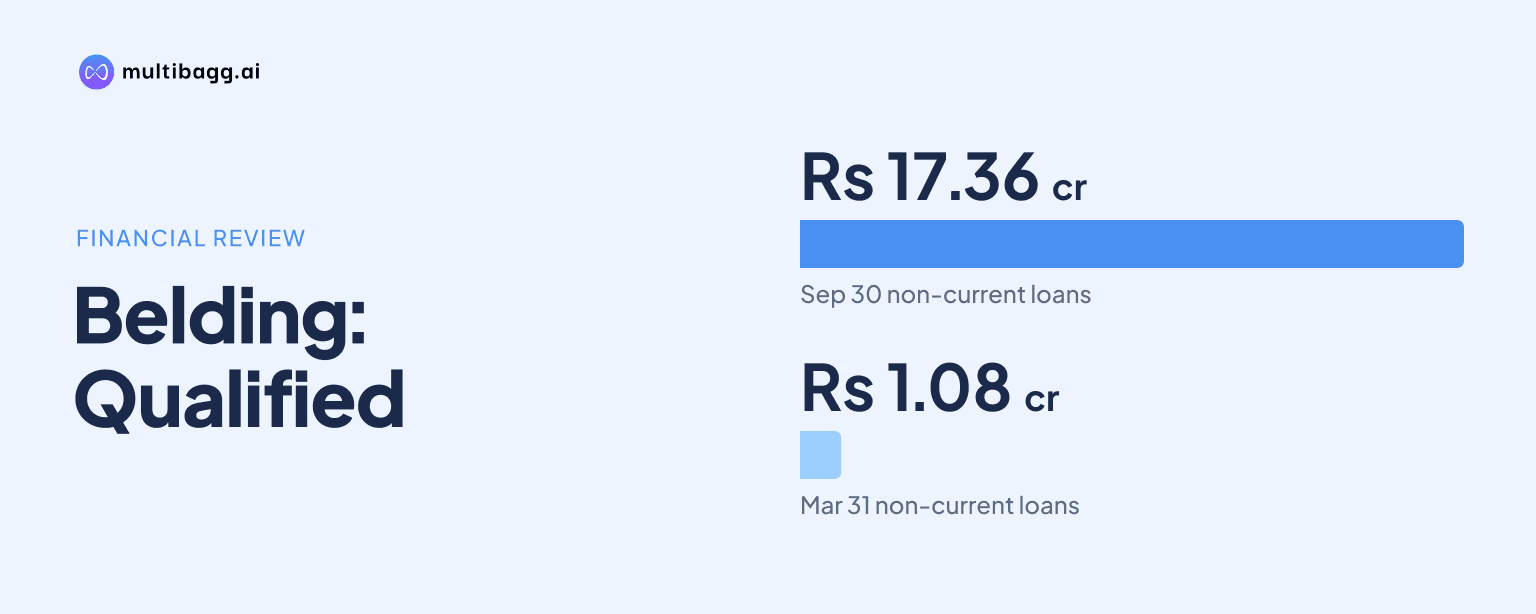
- Belding’s non-current loans were Rs 17.3643 crore at September 30, 2026, versus Rs 1.0784 crore at March 31, 2026.
- Belding used Rs 2.1672 crore in operating activities during the six months ended September 30, 2026.
powered by IRIS
Belding India Limited retained an auditor qualification in its standalone limited review for the quarter and half year ended September 30, 2026, because vendor, intercorporate deposit, loan and advance balance confirmations and reconciliations remained under process. Mehra Goel & Co. LLP said the same issue had qualified Belding’s March 31, 2026 standalone audit.
Know Belding India inside out
Results, valuation, peers and who's buying, in one view.
Why did Belding receive a qualified conclusion?
Belding received a qualified conclusion because management represented that confirmation and reconciliation of vendor, intercorporate deposit, loan and advance balances outstanding at September 30, 2026 were still under process. Mehra Goel & Co. LLP set out this matter as the basis of its qualified conclusion in its limited review report dated November 4, 2026.
The filing does not quantify the balances awaiting confirmation or reconciliation, identify the counterparties involved, or separate the affected amounts between vendors, intercorporate deposits, loans and advances. Therefore, the reported balance-sheet amounts at September 30, 2026 cannot be treated as the financial effect of the qualification.
The auditor said that, except for the effects of the matter in its basis paragraph, nothing had come to its attention to suggest that Belding’s standalone statement did not provide the disclosures required under the listing regulations and Indian Accounting Standard 34, Interim Financial Reporting. This was a limited review covering the period from April 1, 2026 to September 30, 2026, rather than an audit opinion.
Is Belding’s September 2026 qualification a new issue?
No, Belding’s September 2026 qualification continued a matter cited in the March 31, 2026 standalone audit. The review report specifically states that the audit report on Belding’s standalone financial results and standalone financial statements for the year ended March 31, 2026 was also qualified in respect of the same balance-confirmation and reconciliation matter.
That disclosure shows the matter remained unresolved across the March year-end audit and the September half-year review. However, the November 4, 2026 filing does not disclose when management began the exercise, how many confirmations were outstanding, whether any balances were disputed, or a deadline for completing the process.
Belding’s board approved the unaudited standalone and consolidated results at a meeting that began at 9:30 p.m. on November 3, 2026 and ended at 12:50 a.m. on November 4, 2026. The qualification examined in the review report applies to Belding’s standalone results, even though the board announcement covered both reporting bases.
Which Belding balances changed between March and September 2026?
Belding’s standalone total assets increased to Rs 1,079.0493 crore at September 30, 2026 from Rs 1,053.7045 crore at March 31, 2026. The qualification does not attribute that increase, or any individual balance-sheet movement, to pending confirmations and reconciliations.
The balance sheet provides context for the categories named by the auditor, but it does not map those categories to specific affected balances. Non-current loans rose to Rs 17.3643 crore at September 30 from Rs 1.0784 crore at March 31, while investments increased to Rs 1,058.7338 crore from Rs 1,047.0862 crore.
Belding reported no current-loan amount in the September 30, 2026 balance-sheet column, while the March 31, 2026 column showed current loans of Rs 3.6034 crore. The presentation does not establish whether the September absence represents a nil balance, reclassification or another reporting treatment, and the review report does not address it.
Total liabilities increased to Rs 28.0764 crore at September 30 from Rs 1.9259 crore at March 31. The September balance sheet included non-current borrowings of Rs 26.1786 crore, whereas the March balance sheet showed current borrowings of Rs 1.2200 crore and no non-current borrowings, without explaining the change in classification within the review report.
Got a follow-up? Ask IRIS
What does Belding’s limited review say about the reported results?
Belding’s limited review says the standalone statement was prepared under Indian Accounting Standard 34, subject to the qualified matter. The auditor conducted procedures under Standard on Review Engagements 2410, which it described as inquiries and analytical procedures that are substantially narrower in scope than an audit.
Accordingly, Mehra Goel & Co. LLP said it had not performed an audit and did not express an audit opinion. The qualified conclusion instead states that no matter other than the unresolved confirmation and reconciliation issue had come to the auditor’s attention indicating non-compliance with the applicable accounting and disclosure framework.
For the six months ended September 30, 2026, Belding reported a loss before tax from continuing operations of Rs 1.0677 crore, compared with a loss of Rs 13.18 lakh in the corresponding period ended September 30, 2025. Its cash-flow statement reported Rs 2.1672 crore of net cash used in operating activities, compared with Rs 6.6402 crore used in the prior-year period.
Belding ended September 30, 2026 with cash and cash equivalents of Rs 3.45 lakh, compared with Rs 4.46 lakh at March 31, 2026. During the six-month period, its cash-flow statement recorded Rs 22.3700 crore used in investing activities and Rs 24.5272 crore generated from financing activities.
What should readers watch after Belding’s qualified review?
Readers should watch for an update on completion of the confirmation and reconciliation work that management said was under process at September 30, 2026. The November 4, 2026 disclosure gives no target date, quantified exposure or resolution mechanism for vendor, intercorporate deposit, loan and advance balances.
The cash-flow statement separately reported intercorporate deposits given of Rs 14.6061 crore and proceeds from repayment of intercorporate deposits of Rs 3.0948 crore during the six months ended September 30, 2026. Belding did not state whether either cash-flow item, or any closing balance arising from those transactions, falls within the balances cited in the qualified conclusion.
Belding also said its board had kept in abeyance the proposed merger by absorption of DC&T Global Private Limited into Belding. The board announcement of November 3, 2026 did not provide a revised timetable for the proposed scheme or link that decision to the qualification.
Conclusion
Belding’s September 2026 standalone limited review retained the qualification that had also appeared in its March 2026 standalone audit, as vendor, intercorporate deposit, loan and advance balance confirmations and reconciliations remained incomplete. The auditor gave its conclusion subject to that exception and did not quantify the effect on Belding’s reported standalone balances.
The next disclosed matter to watch is whether management completes the reconciliation and confirmation process that was under way as of September 30, 2026. Readers can also watch for a further board update on the DC&T Global Private Limited merger proposal, which Belding had kept in abeyance without announcing a revised schedule.