










Belding’s Defence Platform Combines Drones and Edge Systems
Key highlights
- Belding lists four aerial platforms: Aeroeye, Aerostrike, Aeroattack and Aerointel.
- Belding cites Rs 1.78 lakh crore of FY26 defence production, up 15.6% year on year.
- Belding cites Rs 38,424 crore of FY26 defence exports, up 62.7% year on year.
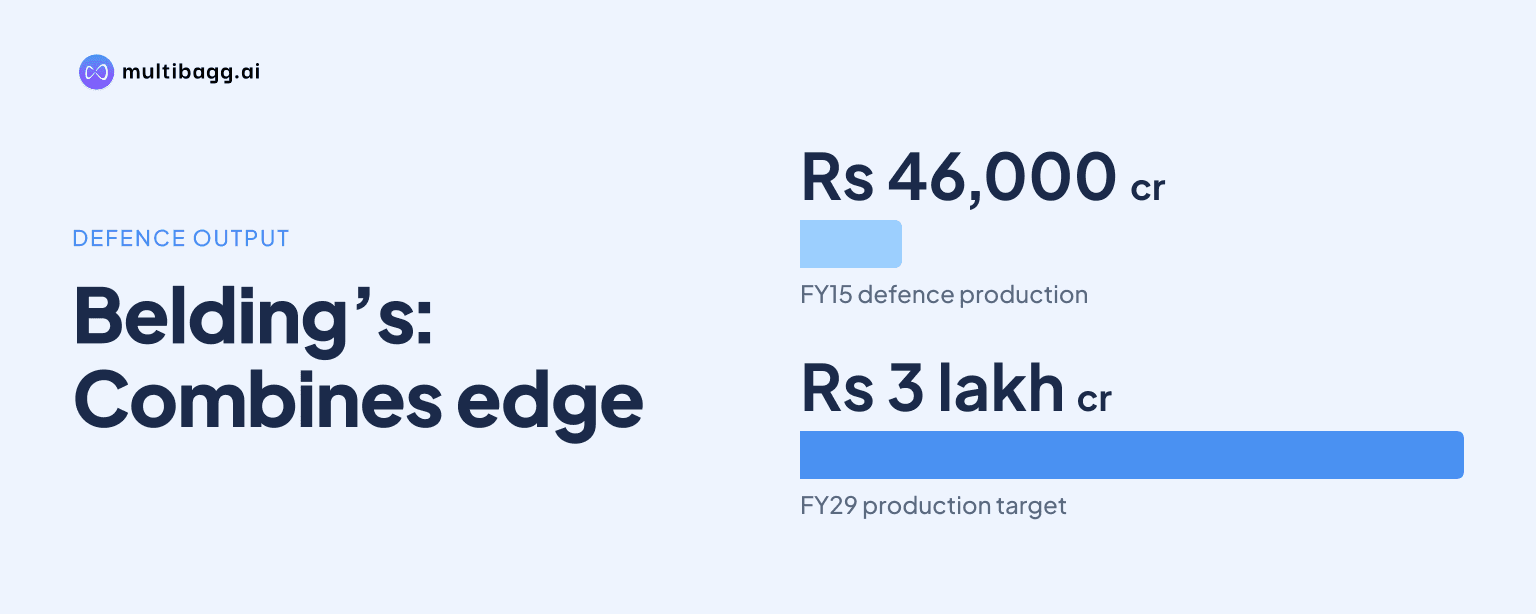
- The cited FY29 defence-production target is Rs 3 lakh crore, versus Rs 46,000 crore in FY15.
powered by IRIS
In its presentation, Belding says its defence platform combines four named aerial systems, including the Aeroattack loitering munition and Aerostrike precision-strike platform, with rugged edge data centres, battery energy storage systems and private 5G for remote and mission-critical operations. The presentation positions these elements as an integrated, rapidly deployable offering.
Know Belding India inside out
Results, valuation, peers and who's buying, in one view.
What does Belding’s defence platform include?
Belding’s defence platform includes edge computing, power resilience, dedicated connectivity and emerging unmanned aerial systems for strategic applications. Its infrastructure layer combines ruggedised edge data centres with modular battery energy storage systems, or BESS, to provide computing and power in remote, border and mission-critical operations. Private 5G is the dedicated connectivity element, while containerised modular systems are intended to support faster mobilisation.
The stated application set extends beyond conventional communications infrastructure. Belding identifies defence establishments, border locations, remote operations, disaster response, telecom networks and strategic infrastructure as use cases. The platform’s four stated design features are integrated edge data centres and BESS, private 5G, rapid deployment and indigenous capability, indicating that the proposition combines hardware systems rather than presenting a standalone connectivity product.
Which aerial systems does Belding list?
Belding lists four aerial platforms: Aeroeye for surveillance, Aerostrike for precision strike, Aeroattack as a loitering munition and Aerointel for intelligence and reconnaissance. The presentation characterises the group as rapidly deployable unmanned systems for surveillance, intelligence and mission support. Unmanned aerial systems, or UAS, are described on the prior platform page as an emerging capability within the wider infrastructure and connectivity proposition.
Belding divides the stated aerial roles across observation, information gathering and strike-related functions. Aeroeye is specifically labelled a surveillance platform, while Aerointel is designated intelligence and reconnaissance. Aerostrike is called a precision-strike platform and Aeroattack a loitering munition, making the presentation materially broader than an offer limited to field computing, energy storage and network equipment.
How is Belding’s infrastructure designed for field deployment?
Belding describes its rugged infrastructure as field-ready command, computing and data equipment engineered for demanding environments. The four named elements are a military-grade console for command and control, a military-grade edge data centre for compute at the edge, a military-grade container for modular deployment, and a military-grade cabinet for power and environmental control.
The operating model relies on containerised and modular architecture. Belding says rapid deployment is intended to get systems operational faster, field reliability is engineered for tough environments, and modular configuration is designed to scale with mission requirements. In the core platform description, the same approach links edge data centres and modular BESS to resilient power and computing at border, remote and other mission-critical sites.
The infrastructure proposition also includes private 5G, which Belding identifies as dedicated connectivity for mission-critical and remote environments. This places communications alongside local computing and power rather than treating it as the entire defence product. Belding’s presentation does not specify spectrum arrangements, throughput, site numbers or the duration of BESS backup, so those operational measures remain undisclosed.
Got a follow-up? Ask IRIS
What has Belding disclosed about commercial status?
Belding has not disclosed production volumes, customer contracts, revenue, certification status or deployment dates for its four aerial products or rugged infrastructure systems. The presentation instead describes an integrated platform and lists intended operating applications, so the disclosed evidence establishes the scope of the offering rather than its commercial scale.
Belding also does not disclose aircraft endurance, payload, range, autonomy, navigation systems, weapons configuration or procurement status for Aeroeye, Aerostrike, Aeroattack or Aerointel. It gives no timetable for commercialisation or identifies no defence customer, leaving the aerial portfolio’s operating specifications and order position undisclosed.
What defence-market backdrop does Belding cite?
Belding cites an Indian defence backdrop that includes Rs 2.19 lakh crore of FY27 capital outlay, up 21.8% year on year, and Rs 1.78 lakh crore of FY26 defence production, up 15.6% year on year. It also cites FY26 defence exports of Rs 38,424 crore, an increase of 62.7%, as part of its stated domestic manufacturing and export environment.
The production comparison in the presentation shows a rise from Rs 46,000 crore in FY15 to Rs 1.54 lakh crore in FY25 and Rs 1.78 lakh crore in FY26. The cited FY29 production target is Rs 3 lakh crore, which the presentation frames as 6.5 times the FY15 level. It further says domestic sourcing accounts for 75% of the FY27 modernisation budget, describing this as an indigenisation tailwind for Indian suppliers.
For drones, Belding cites India’s military drone market as projected to reach US$1.9 billion by 2034, at a 13.8% compound annual growth rate. The presentation characterises that outcome as 2.8 times growth and links it to accelerating drone demand. These figures provide the demand context management associates with the platform; they do not represent Belding forecasts, sales targets or market-share guidance.
Conclusion
Belding presents a defence proposition that joins aerial systems with deployable digital and physical infrastructure. The four-platform aerial portfolio adds surveillance, intelligence, precision-strike and loitering-munition labels to a base of edge data centres, BESS, private 5G, command consoles, containers and cabinets. That combination is positioned for remote, border and mission-critical operations.
What to watch next is whether Belding discloses evidence of execution behind the stated platform, such as technical specifications, trials, customer deployments, orders or manufacturing capacity. The presentation identifies a Rs 3 lakh crore FY29 defence-production target and a US$1.9 billion military-drone market projection for 2034, but it does not state Belding’s revenue target, launch schedule or order pipeline for these systems.