










Arvind SmartSpaces targets ₹6,000 crore bookings by FY30
Key highlights
- ASL targets ₹6,000 crore of bookings in FY30, compared with ₹1,550 crore in FY26.
- ASL estimates FY27 bookings of ₹2,700 crore, versus ₹1,550 crore reported in FY26.
- ASL targets a 22% to 25% EBITDA margin on new sales and a 70:30 JDA-to-outright project mix.
- Net debt to equity was 0.26x at September 2026, against ASL’s 1.0x ceiling.
powered by IRIS
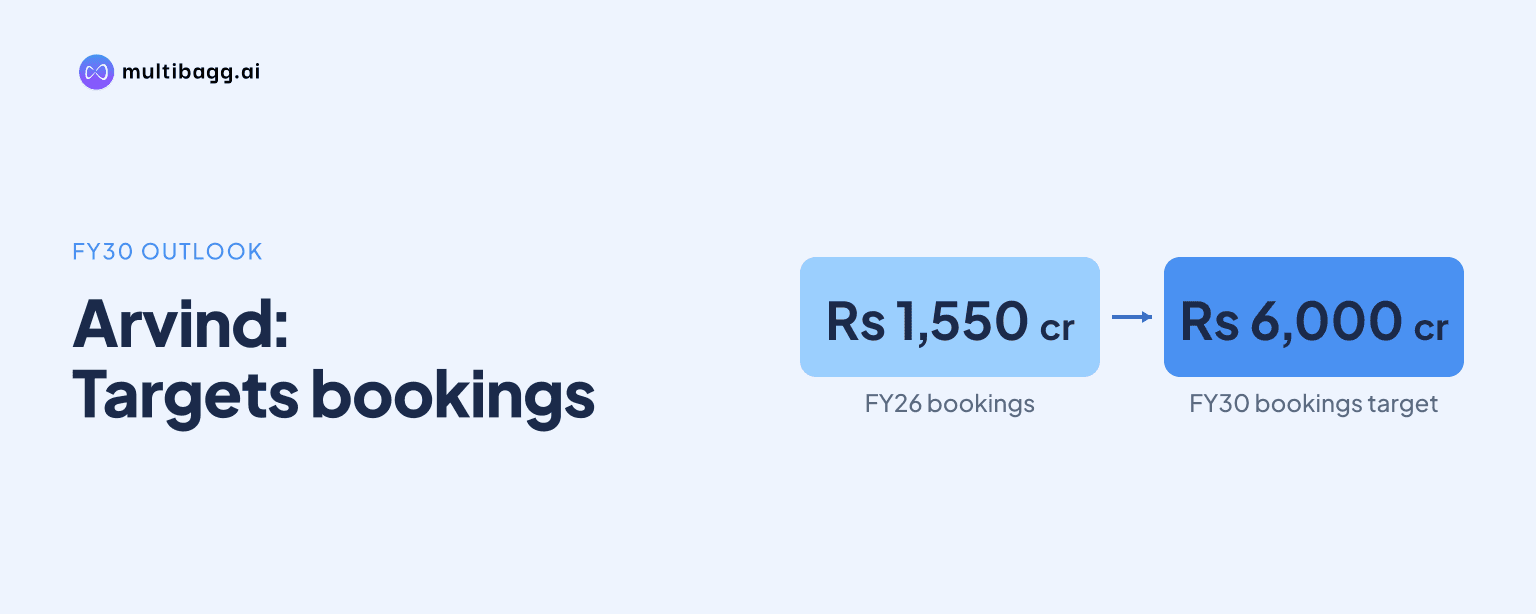
Arvind SmartSpaces targets ₹6,000 crore of bookings in FY30, versus ₹1,550 crore in FY26, and presents a 30% three-year compound annual growth rate from FY27, alongside a 22-25% EBITDA margin target, a 70:30 JDA-to-outright mix and a maximum 1:1 net-debt-to-equity limit.
Know Arvind SmartSpaces inside out
Results, valuation, peers and who's buying, in one view.
What bookings growth is ASL projecting through FY30?
ASL projects ₹6,000 crore of bookings in FY30, after an estimated ₹2,700 crore in FY27 and reported bookings of ₹1,550 crore in FY26. The company’s medium-term outlook specifies a 30% compound annual growth rate, or CAGR, for the three years from FY27 to FY30.
The FY27 estimate represents an increase of ₹1,150 crore from FY26. ASL’s five-year chart gives an FY27 booking estimate range of ₹2,600 crore to ₹2,700 crore, while the medium-term outlook uses the upper end, ₹2,700 crore, as the base for its FY30 projection.
ASL reported that bookings rose from ₹601 crore in FY22 to ₹1,550 crore in FY26, and its chart labels this history as 27% booking CAGR. The same page also carries a separate caption of approximately 35% five-year booking CAGR, so the presentation contains two differently stated historical growth measures.
FY26 was ASL’s record year in the presentation, with approximately 60% of bookings coming from new launches. Net operating cash flow increased to ₹417 crore in FY26 from ₹351 crore in FY25, providing the reported operating base before the company’s estimated ₹2,700 crore FY27 booking outcome.
How does ASL plan to add projects for FY30 growth?
ASL plans to replenish its pipeline annually through well-located land, preferably accessed through partnerships rather than land banking. It added ₹3,100 crore of topline potential in H1 FY27, and all of those additions were structured as joint developments or joint ventures.
The company targets ₹4,000 crore to ₹5,000 crore of topline-potential additions in FY27, after adding ₹3,140 crore in FY26. ASL states that its H1 FY27 additions represented 62% of the FY27 target, measured against the ₹5,000 crore upper end of that range.
A joint development agreement, or JDA, gives ASL partnership-led access to landowners, while joint ventures bring in partners. The company says it holds a 52% to 70% share in every JDA in its planned pipeline, and that its model lowers upfront land cost compared with outright land acquisition.
ASL identifies Gujarat as its established market while expanding in Bengaluru and the Mumbai Metropolitan Region, or MMR. Its presentation cites recent deals in the Sarjapur Road, Whitefield and Goregaon growth corridors, with a dedicated CBO leading each city.
What margin and portfolio mix does ASL expect?
ASL targets an EBITDA margin of 22% to 25% on new sales in the medium term. EBITDA means earnings before interest, tax, depreciation and amortisation, and ASL says outright projects have higher margins while JDA projects have lower margins.
The company’s medium-term sourcing target is a 70:30 mix of JDAs to outright projects. ASL said approximately 70% of its project mix in FY27 so far was through JDAs, matching the stated medium-term proportion even though all ₹3,100 crore of H1 FY27 pipeline additions came through JD or joint-venture structures.
ASL also expects vertical developments to account for 60% to 70% of its portfolio. The presentation does not provide separate booking, cost or margin targets for vertical and horizontal developments, so it identifies the intended portfolio shape without quantifying the earnings contribution of either format.
The FY27 acquisition plan of ₹4,000 crore to ₹5,000 crore of added topline potential follows ₹3,140 crore added in FY26. Management says land is priced bottom-up from target returns, reviewed by a Land Investment Committee and sized to operating cash flow and the company’s debt ceiling.
Got a follow-up? Ask IRIS
What leverage framework supports ASL’s expansion plan?
ASL has set a maximum net debt-to-equity ceiling of 1.0x, compared with a reported ratio of 0.26x at September 2026. Net debt was ₹200 crore at September 2026, down from ₹215 crore in June 2026, while gross debt increased to ₹712 crore from ₹581 crore.
ASL says its gross debt excludes ₹195 crore of OCDs outstanding to the HDFC Capital platform, as well as joint-venture partner infusions. The company notes that gross and net debt figures may differ from figures in its financial statements because of accounting-standard reporting.
The funding framework places operating cash flow first, with 25% to 30% of collections allocated to funding needs. It then lists bank and non-banking financial company debt, non-convertible debentures and platform capital, while stating that annual land spending of ₹800 crore to ₹1,000 crore can be supported by operating cash flow and the debt ceiling.
How has ASL’s balance sheet changed before the FY30 plan?
ASL’s shareholders’ funds increased to ₹766 crore at September 2026 from ₹649 crore at March 2026. Over the same period, inventories increased by ₹477 crore to ₹2,699 crore, while total assets increased to ₹4,247 crore from ₹3,594 crore.
Non-controlling interest declined to ₹77 crore at September 2026 from ₹247 crore at March 2026. Non-current liabilities rose to ₹758 crore from ₹511 crore, and current liabilities rose to ₹2,646 crore from ₹2,187 crore during the six-month period.
India Ratings & Research upgraded ASL to AA-/Stable from A+/Stable in June 2026. ASL also states that no equity raise is needed in FY27, while its funding plan retains operating cash flow, debt instruments and HDFC Capital platform funding as the listed capital sources.
Conclusion
ASL’s stated FY30 plan is built around lifting bookings from ₹1,550 crore in FY26 to ₹6,000 crore, with an estimated ₹2,700 crore in FY27 as the first step. The plan combines partnership-led project additions, a 22-25% new-sales EBITDA margin target, a 70:30 JDA-to-outright mix and a portfolio expected to be 60% to 70% vertical.
The next disclosed markers are delivery of the ₹2,600 crore to ₹2,700 crore FY27 booking estimate and completion of the ₹4,000 crore to ₹5,000 crore FY27 pipeline-addition target after ₹3,100 crore in H1 FY27. Management’s ₹800 crore to ₹1,000 crore annual land-spend framework and 1.0x net-debt-to-equity ceiling will also frame funding execution as the pipeline expands.