










Arvind SmartSpaces raises FY27 booking guidance after Q2 record
Key highlights
- Arvind SmartSpaces raised FY27 booking guidance to Rs 2,600 crore-Rs 2,700 crore, implying 70%-75% growth.
- H1 FY27 bookings rose 120% year on year to Rs 1,338 crore, nearly 90% of FY26 full-year bookings.
- Q2 FY27 bookings exceeded Rs 906 crore, compared with Rs 432 crore in Q2 FY26.
- Arvind Sylva recorded bookings above Rs 500 crore within 30 days, equal to about 60% of inventory by value.
powered by IRIS
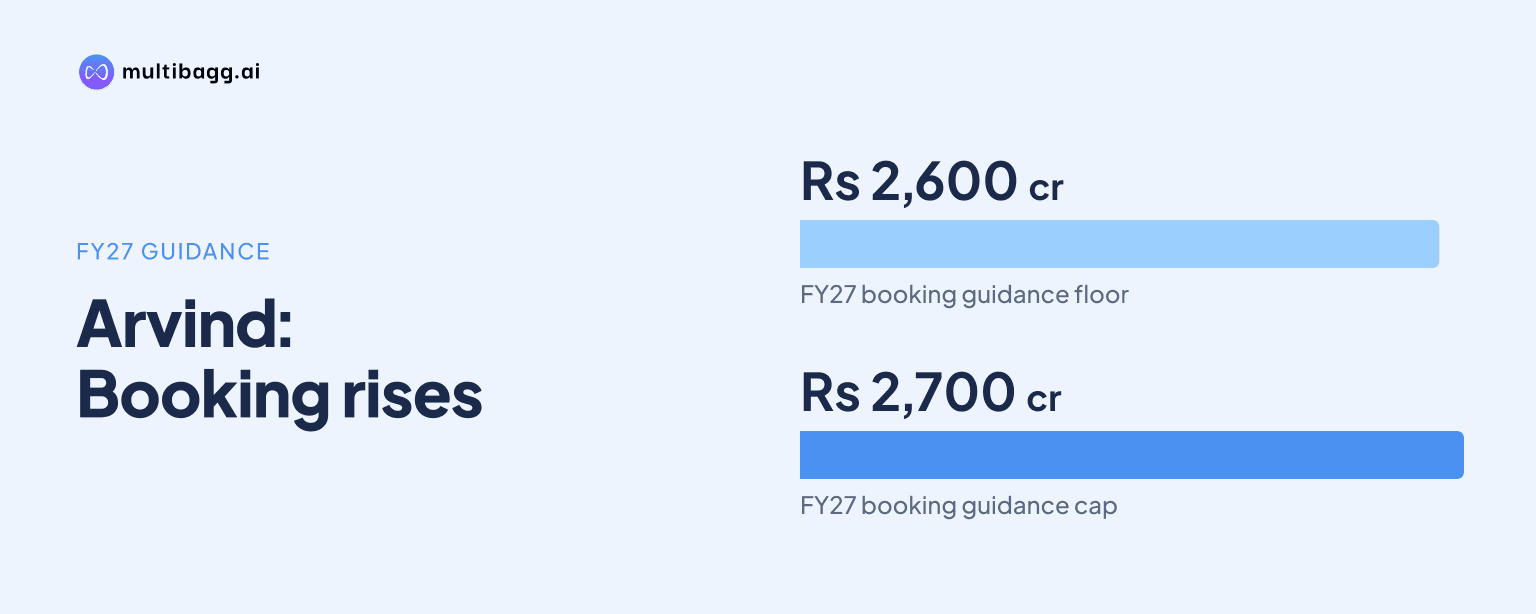
Arvind SmartSpaces Limited raised FY27 booking guidance to Rs 2,600 crore-Rs 2,700 crore, implying 70%-75% growth, after H1 FY27 bookings rose 120% year on year to Rs 1,338 crore and Q2 bookings exceeded Rs 906 crore. Management attributed the upgrade to recent launches, sustenance sales and four planned H2 launches.
Know Arvind SmartSpaces inside out
Results, valuation, peers and who's buying, in one view.
Why did Arvind SmartSpaces raise its FY27 booking guidance?
Arvind SmartSpaces raised its FY27 booking guidance because H1 FY27 bookings of Rs 1,338 crore nearly matched 90% of its full-year FY26 bookings. Management lifted the target to Rs 2,600 crore-Rs 2,700 crore, representing 70%-75% year-on-year growth, from its previous guidance of Rs 2,100 crore-Rs 2,200 crore, or 35%-40% growth.
The revised range leaves Rs 1,262 crore-Rs 1,362 crore of bookings to be secured in H2 FY27. Management said the revision reflected healthy residential absorption across key markets, recent-launch performance, expected sales from existing projects and the launch pipeline. It also reiterated its earnings before interest, tax, depreciation and amortisation, or EBITDA, margin guidance of about 22%-25%.
What drove Arvind SmartSpaces' record Q2 FY27 presales?
Arvind SmartSpaces recorded bookings exceeding Rs 906 crore in Q2 FY27, more than double the Rs 432 crore reported in Q2 FY26. Newly launched projects accounted for about 65% of quarterly bookings, while sustenance sales from the existing portfolio contributed the remaining 35%, giving both new and established projects a role in the record quarter.
Arvind Sylva, the Green Reserve in Bengaluru, was a major Q2 contributor, recording bookings above Rs 500 crore within 30 days of launch. Management said that represented about 60% of the project's inventory by value and supported its move into premium high-rise residential development in Bengaluru. The company also launched one project in Ahmedabad during Q2 FY27.
The two H1 FY27 launches represented about Rs 1,250 crore of inventory. Bengaluru supplied 50% of H1 sales and crossed Rs 600 crore for the first time, management said, compared with FY26 when Ahmedabad represented about 70% of sales and Bengaluru about 30%. The mix changed as the Bengaluru high-rise launch added to continuing plotting and residential sales in Gujarat and Bengaluru.
How did Arvind SmartSpaces' H1 financial performance and cash flow change?
Arvind SmartSpaces reported H1 FY27 revenue of Rs 475 crore, up 96% from Rs 242 crore in the corresponding prior-year period. EBITDA increased 3.5 times year on year to Rs 197 crore, while profit after tax rose fourfold to Rs 120 crore, according to management's earnings-call remarks.
Q2 FY27 revenue was Rs 157 crore, while EBITDA increased 46% year on year to Rs 45 crore and profit after tax rose 25% to Rs 23 crore. The quarterly bookings figure of more than Rs 906 crore was substantially higher than reported revenue of Rs 157 crore; the call did not provide a project-level revenue-recognition schedule.
Collections rose 77% year on year to Rs 754 crore in H1 FY27 and were Rs 418 crore in Q2 FY27. Net operating cash flow was Rs 233 crore for H1 and Rs 152 crore for Q2, while net debt fell to Rs 200 crore on September 30, 2026, from Rs 215 crore on June 30, 2026. Management cited estimated unrealised operating cash flows of Rs 5,197 crore from the existing project pipeline.
Got a follow-up? Ask IRIS
What launches and business-development additions are planned for H2 FY27?
Arvind SmartSpaces plans four further FY27 launches, comprising two Mumbai projects and two Bengaluru projects, with expected inventory of Rs 2,200 crore-Rs 2,500 crore. Management had previously guided for six launches during FY27, and the two projects launched in H1 accounted for about Rs 1,250 crore of inventory.
The precise timing of the four H2 launches remained unresolved on November 6, 2026 because final-stage approvals were pending. Management said some projects could reach the market during the final month of Q3 FY27, although they could instead be launched in Q4 FY27. For Mumbai, it described the intended product positioning as premium homes with ticket sizes of about Rs 2.5 crore-Rs 5 crore.
Arvind SmartSpaces added a residential high-rise project on Sarjapur Road in Bengaluru during Q2 FY27, with estimated top-line potential of about Rs 470 crore. Cumulative business-development potential added in FY27 reached about Rs 3,100 crore as of September 2026. Management said it saw a strong likelihood of achieving the upper end of its Rs 4,000 crore-Rs 5,000 crore gross development value, or GDV, addition aspiration for the year.
How is Arvind SmartSpaces funding its expansion plans?
Arvind SmartSpaces aims to maintain a 70:30 GDV mix between joint-development, or JD, projects and outright acquisitions over the medium term. Management said this is a three-to-four-year portfolio objective rather than an annual requirement because the mix depends on available opportunities. It added that about 78% of current-year business-development volume had come from JD arrangements.
Management said the company could support land outflows of close to Rs 1,000 crore a year using operating cash flow and some debt capacity. It reported debt to equity of 0.26 and cited platform availability with HDFC alongside its own balance sheet. Net debt of Rs 200 crore at September 30, 2026 followed Q2 net operating cash flow of Rs 152 crore.
The company has also established regional leadership across Ahmedabad, Bengaluru and the Mumbai Metropolitan Region, or MMR, covering business development, sales, execution and profitability. Management said the decentralised structure, initiated about a year earlier, was intended to place decisions closer to each market as its FY27 project portfolio expanded.
Conclusion
The guidance increase signals that management expects a broader sales base, rather than a single-project outcome, to support FY27. New launches supplied 65% of Q2 bookings, while existing projects supplied 35%; meanwhile, Bengaluru reached 50% of H1 sales after contributing about 30% in FY26. H1 collections of Rs 754 crore and operating cash flow of Rs 233 crore accompanied the sales acceleration.
The next measure is the timing and sales response of the two Mumbai and two Bengaluru projects planned for H2 FY27, with final-stage approvals still pending on November 6, 2026. Management's progress toward Rs 4,000 crore-Rs 5,000 crore of FY27 GDV additions, the medium-term 70:30 JD-to-outright mix and its stated long-term booking-growth ambition of about 30% a year will also remain relevant.