










Arvind SmartSpaces estimates ₹5,200 crore net operating cash flow
Key highlights
- ASL estimates ₹5,200 crore of net unrealised operating cash flow after ₹200 crore of net debt.
- The estimate begins with ₹12,300 crore of unsold inventory and ₹2,600 crore of booked-unit receivables.
- Ahmedabad contributes ₹2,300 crore and Bengaluru ₹2,150 crore of the ₹5,400 crore pre-debt operating cash-flow estimate.
- ASL reported net debt of ₹200 crore and net debt to equity of 0.26 times at September 2026.
powered by IRIS
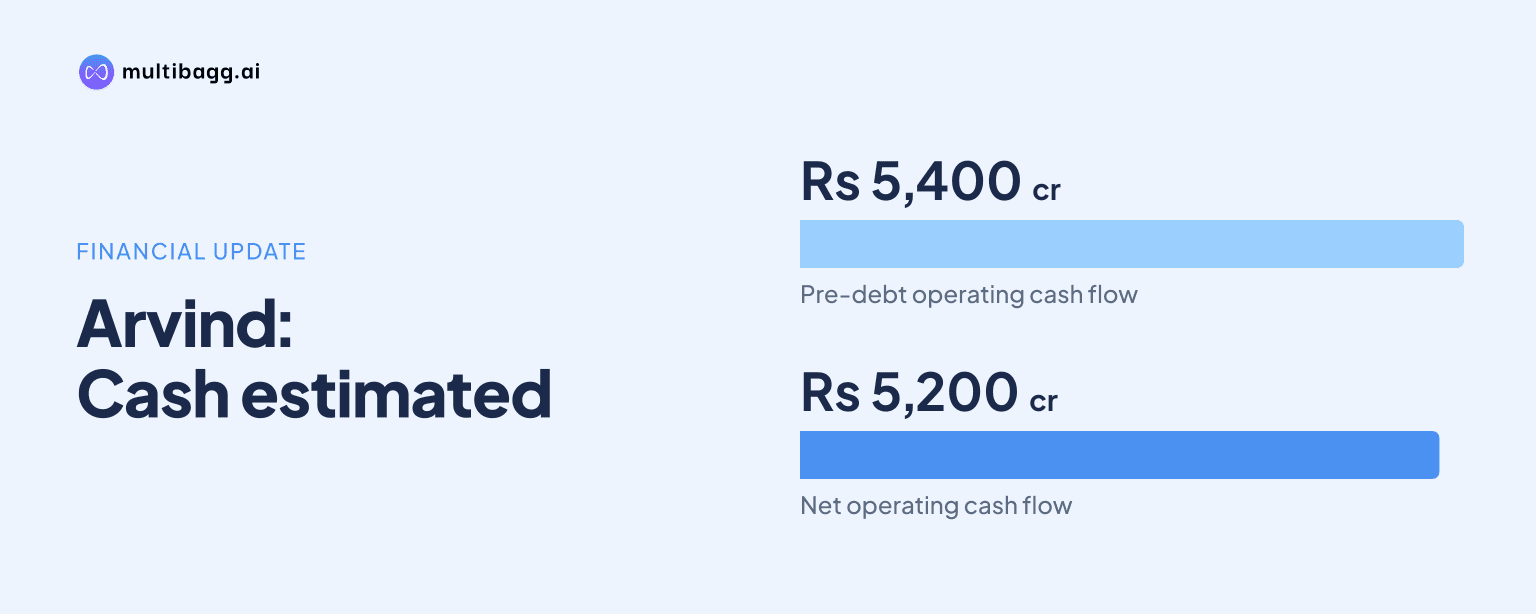
Arvind SmartSpaces estimates ₹5,200 crore of net unrealised operating cash flow from projects with definitive agreements, after ₹9,500 crore of balance costs and ₹200 crore of net debt. Its November 2026 presentation derives the figure from ₹12,300 crore of unsold inventory and ₹2,600 crore of receivables from booked units.
Know Arvind SmartSpaces inside out
Results, valuation, peers and who's buying, in one view.
How does ASL calculate the ₹5,200 crore cash-flow estimate?
ASL calculates the ₹5,200 crore estimate by first arriving at ₹5,400 crore of estimated operating cash flow, then deducting ₹200 crore of net debt. The pre-debt figure is based on ₹14,900 crore of expected inflows, comprising ₹12,300 crore of unsold inventory and ₹2,600 crore of receivables, less ₹9,500 crore of balance cost still to be incurred.
The presentation describes the estimate as operating cash flow at the earnings before interest, tax, depreciation and amortisation, or EBITDA, level after corporate-overhead allocation. It represents ASL’s share only and includes land cost payable to land partners. Development-management projects are grossed up for revenue and cost, although ASL says its net operating cash flow from that model is limited to development-management fees.
Which cities generate ASL's estimated operating cash flow?
ASL identifies Ahmedabad as the largest contributor to the ₹5,400 crore estimated operating cash flow, at ₹2,300 crore, followed by Bengaluru at ₹2,150 crore and the Mumbai Metropolitan Region, or MMR, at ₹950 crore. Ahmedabad exceeds Bengaluru by ₹150 crore, while Ahmedabad and Bengaluru together contribute ₹4,450 crore, or more than four-fifths of the city total before net debt.
The city mix corresponds with ASL’s three-market portfolio as of September 2026. Gujarat had ₹10,000 crore of estimated portfolio booking value, Bengaluru had ₹6,800 crore and MMR had ₹4,200 crore. MMR, which ASL entered in 2025, had three planned projects, including the approximately ₹2,400 crore Sigma, Goregaon redevelopment, but its current cash-flow estimate remains below the other two cities.
What portfolio is included in ASL's cash-flow calculation?
ASL’s wider portfolio comprises 54 projects across 100 million square feet, with estimated booking value of ₹21,100 crore. It includes 17 completed projects with ₹3,300 crore of estimated booking value, 19 ongoing projects with ₹8,800 crore and 18 planned projects with ₹9,000 crore. Bookings to date across completed and ongoing projects were approximately ₹8,800 crore.
The ₹12,300 crore inventory figure is an estimate of value yet to be sold rather than a measure of near-term collections. The ₹2,600 crore receivables figure relates to units already booked, while the presentation states that the cash-flow calculation includes only projects where definitive agreements have been signed. That condition excludes prospective opportunities that have not reached definitive agreements.
ASL’s land-access model primarily uses joint development, or JD, alongside selective outright acquisitions. It targets JD at about 70% of its medium-term mix, and all ₹3,100 crore of topline potential added in the first half of fiscal year 2027, or H1 FY27, came through JD or joint ventures. The cash-flow bridge nevertheless includes land costs payable to land partners, rather than treating partnership structures as cost-free.
Got a follow-up? Ask IRIS
How does ASL's estimate compare with debt and funding plans?
ASL reported net debt of ₹200 crore at September 2026, down from ₹215 crore at June 2026 but above ₹167 crore at March 2026. Its net-debt-to-equity ratio was 0.26 times at September 2026, unchanged from March 2026 and below its stated maximum of 1.0 time. Gross debt rose from ₹462 crore at March 2026 to ₹712 crore at September 2026.
The presentation says gross debt excludes ₹195 crore of optionally convertible debentures outstanding with the HDFC platform and excludes joint-venture partner infusions. Over the same March-to-September 2026 period, shareholders’ funds increased from ₹649 crore to ₹766 crore, while inventories rose from ₹2,222 crore to ₹2,699 crore. It also notes that gross-debt and net-debt figures may differ from financial-statement reporting under accounting standards.
ASL reported net operating cash flow of ₹417 crore in FY26, compared with ₹351 crore in FY25. That reported annual figure differs from the ₹5,200 crore multi-year unrealised estimate, which incorporates future sales of inventory, booked-unit receivables, remaining project costs and September 2026 net debt. ASL says operating cash flow is the first call on funding, with 25% to 30% of collections allocated under its funding order.
Management says ₹800 crore to ₹1,000 crore of annual land spend can be supported by operating cash flow and debt, within the 1.0-times net-debt-to-equity ceiling. It has set an FY27 business-development target of ₹4,000 crore to ₹5,000 crore of topline potential, of which ₹3,100 crore, or 62%, was achieved in H1 FY27. Management also states that no equity raise is needed in FY27.
Conclusion
ASL’s ₹5,200 crore net unrealised operating cash-flow estimate links its signed-project portfolio to future funding capacity after costs and net debt. The calculation starts with ₹14,900 crore of inventory value and booked-unit receivables, reduces this by ₹9,500 crore of balance costs, and then deducts ₹200 crore of net debt. Ahmedabad and Bengaluru account for ₹4,450 crore of the ₹5,400 crore operating estimate before debt.
The next measures to watch are sales conversion of ₹12,300 crore of unsold inventory, collection of ₹2,600 crore from booked units and delivery of projects within the ₹9,500 crore remaining-cost estimate. Management’s disclosed FY27 plan also calls for ₹4,000 crore to ₹5,000 crore of new topline potential, while retaining a maximum 1.0-times net-debt-to-equity ratio and funding annual land spend of ₹800 crore to ₹1,000 crore from cash flow and debt.