










Asahi Songwon Colors Ltd sees API growth from 40% Chhatral use
Key highlights
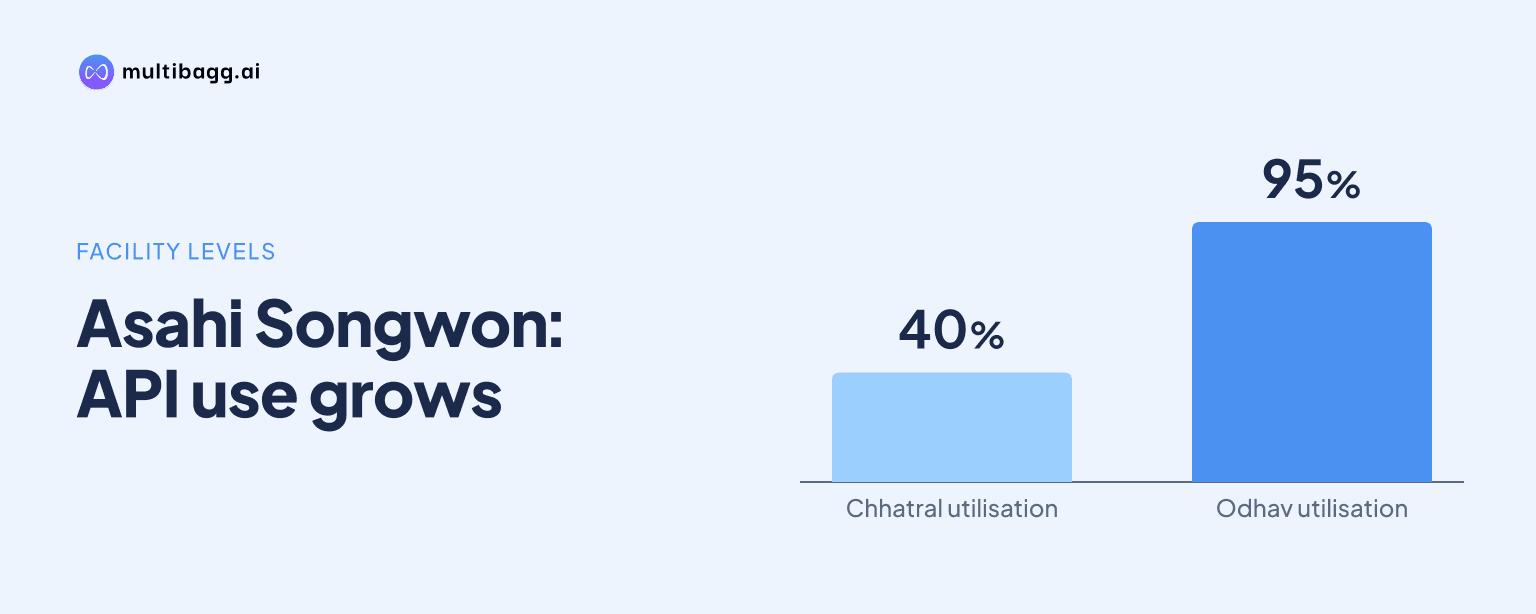
- Asahi said Chhatral API facility utilisation is around 40%, versus about 95% at Odhav.
- Management hopes to receive a Pregabalin CEP by March for access to Europe and semi-regulated markets.
- Dahej AZO pigment utilisation is about 70%-75%, with management seeing scope for 85%-90%.
- Asahi is hopeful of breaching Rs 1,000 crore of revenue within the next two years.
powered by IRIS
Asahi Songwon Colors Limited said growth in its active pharmaceutical ingredient (API) business will rely on lifting Chhatral API utilisation from about 40% and obtaining a Pregabalin CEP by March, steps management expects to support incremental volumes and improved pricing in Europe and semi-regulated markets.
Know Asahi Songwon Colors inside out
Results, valuation, peers and who's buying, in one view.
How much unused API capacity does Asahi have at Chhatral?
Asahi has substantial unused API capacity at Chhatral, where management put utilisation at around 40%, compared with about 95% at its Odhav API facility. The Chhatral intermediate operation is running at a higher level than the API operation because Asahi is backward integrated for its key molecule and no longer depends on an outside party for that intermediate.
The utilisation gap makes Chhatral an internal growth lever rather than an immediately disclosed case for a major new plant. Management said the Chhatral API greenfield facility was constructed with buildings sized for a much larger capacity than its present output. It expects a later, smaller capital allocation to raise capacity there to have a higher investment-to-turnover ratio than the group-level or initial-stage investment ratio.
Asahi’s disclosed capacity positions also show different constraints across its operations. Odhav has limited stated room to lift volumes because it is already at about 95%, while Chhatral has about 60 percentage points of utilisation headroom based on management’s approximation. Dahej has a separate pigment opportunity, with management identifying a move from 70%-75% to 85%-90% utilisation.
What would a Pregabalin CEP change for Asahi’s API business?
A Pregabalin CEP could broaden Asahi’s accessible markets, according to management, which said it hoped to receive the certification by March. It said CEP certification could open doors not only in Europe but also in several semi-regulated countries where buyers can procure products on the basis of the certification.
Management linked the expected approval to two commercial effects: incremental volume growth and improved pricing for additional API business. It did not quantify potential sales, pricing gains, margins or profit contribution from Pregabalin. The commercial outcome therefore depends on both obtaining the CEP and converting the resulting market access into customer orders.
Asahi said API volumes take longer to build than pigment volumes because products intended for human consumption require testing, approvals and compliance with legislation. Management described those long lead times as a key learning from operating the API business during the past two to three years. That process means installed capacity at about 40% utilisation does not by itself establish the timing of a production increase.
Can existing assets take Asahi towards Rs 1,000 crore revenue?
Management said existing underutilised assets can help Asahi pursue its Rs 900 crore to Rs 1,000 crore revenue objective over the next few years without significant capital allocation. It cited Chhatral’s roughly 40% utilisation and scope to raise Dahej AZO pigment utilisation from 70%-75% to 85%-90% as the main operating headroom.
This plan differs from an immediate large greenfield build. Asahi said it had reached the end of a capital-expenditure cycle in which it had been significantly leveraged a few years earlier, and was now generating free cash and reducing debt. Management also said its two newer businesses were positive on earnings before interest, tax, depreciation and amortisation (EBITDA) and cash, while it worked to make them meaningful contributors to revenue and profit over the next few years.
Management later said it was hopeful of breaching Rs 1,000 crore of revenue within the next two years. That statement was an aspiration, not formal financial guidance: Asahi gave no annual revenue bridge, Chhatral output target, or quantified contribution from the planned Pregabalin CEP. It also said performance in the coming two quarters should improve over the prior corresponding period, particularly at Atlas and in the AZO business.
Got a follow-up? Ask IRIS
How does Asahi’s API plan compare with its pigment opportunity?
Asahi’s API opportunity is concentrated on lifting Chhatral from approximately 40% utilisation, while its AZO pigment opportunity is to improve Dahej from 70%-75% toward 85%-90%. Odhav is already at about 95%, leaving it with comparatively less disclosed scope for volume growth without further capacity work.
Management said it entered APIs to diversify beyond its long-standing pigment business and participate in a sector it regards as large. It also said India remains reliant on outside countries, including China, for several APIs. At the same time, management acknowledged that regulatory approvals and longer development cycles make API execution different from pigments, placing emphasis on market access and approval timelines.
For pigments, Asahi separated price movements from the margin profile it aims to maintain. Management said it could not forecast pigment prices even for the following week because external events can move prices, though it expressed confidence in sustaining its targeted margin profile over the next few years. This distinction matters because turnover can vary with pricing even if plant utilisation or operating discipline improves.
What capital spending is Asahi planning after this cycle?
Asahi has not decided whether its next major capital allocation will be an acquisition, a greenfield project or another opportunity with a higher return on capital employed, management said. For the current Rs 900 crore to Rs 1,000 crore revenue ambition, it said significant new capital allocation should not be necessary because unused capacity already exists at Chhatral and Dahej.
Management said the balance sheet was strengthening as debt declined faster than it had expected, and it was actively examining opportunities to deploy capital for the next stage of growth. That evaluation is separate from the near-term utilisation programme. During the call, Asahi gave no acquisition target, project location, capital budget or timetable for its next major investment.
Conclusion
Asahi’s disclosed plan combines unused API capacity, potential CEP-led market access and further pigment utilisation gains rather than a large immediate expansion project. Chhatral is the largest stated operating lever at about 40% utilisation, while Dahej offers a separate path from 70%-75% toward 85%-90%, and Odhav is already operating at about 95%.
The next disclosed milestone is management’s hoped-for Pregabalin CEP receipt by March. Investors can watch for evidence that the certification produces European or semi-regulated-market orders, whether Chhatral utilisation rises from about 40%, and whether Asahi identifies an acquisition, greenfield project or other capital-deployment option as it works toward its stated Rs 1,000 crore revenue aspiration within two years.