










Asahi Songwon Colors Limited keeps FY27 AZO breakeven goal intact
Key highlights
- AZO revenue was Rs 28.82 crore in Q2 FY27 and Rs 47.35 crore in H1 FY27.
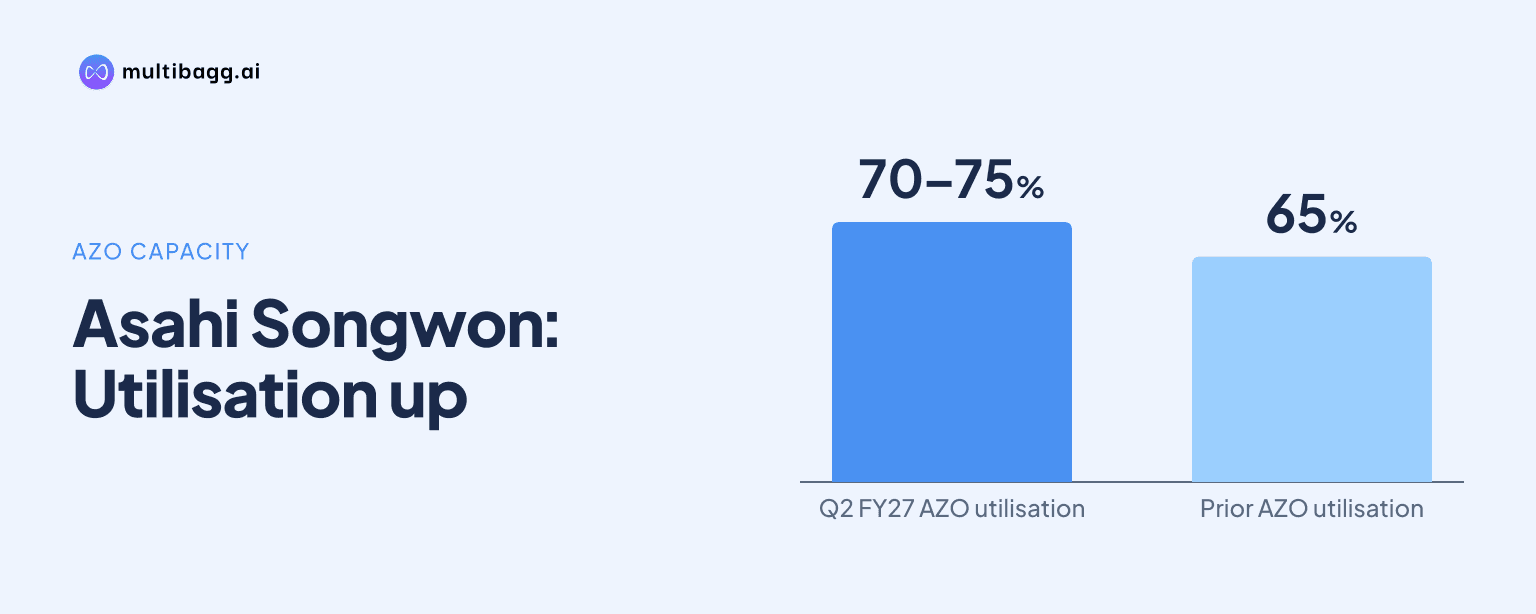
- Asahi said AZO utilisation reached about 70% to 75% in Q2 FY27, versus roughly 65% previously discussed.
- Management retained its FY27 AZO PBT breakeven goal despite pricing pressure and Chinese competition.
- Asahi reduced gross borrowings by about Rs 49 crore during H1 FY27.
powered by IRIS
Asahi Songwon Colors Limited retained its FY27 AZO profit-before-tax, or PBT, breakeven goal after AZO revenue reached Rs 47.35 crore in H1 FY27, including Rs 28.82 crore in Q2, although management said Chinese competition, lower global demand and pricing pressure left the quarter below expectations.
Know Asahi Songwon Colors inside out
Results, valuation, peers and who's buying, in one view.
What did Asahi report for AZO in Q2 FY27?
Asahi reported AZO revenue of Rs 28.82 crore in Q2 FY27, after a difficult Q1 in which a steep rise in raw-material costs led customers to defer purchases. H1 FY27 AZO revenue was Rs 47.35 crore, meaning Q2 accounted for more than half of the first-half total as sales returned to earlier levels. Management said AZO volumes grew, but difficult pricing continued to weigh on realisations.
The AZO operation remained earnings before interest, tax, depreciation and amortisation, or EBITDA, positive and cash positive, according to management, but Asahi did not disclose segment EBITDA or margin. Management described Q2 FY27 as below expectations because the revenue recovery did not remove the effect of competitive pricing and lower demand in global markets.
The wider group reported consolidated Q2 FY27 revenue of Rs 201 crore, up 66.5% year on year from Rs 120 crore, while EBITDA rose 142% to Rs 26.96 crore. For H1 FY27, consolidated EBITDA reached Rs 59.56 crore, exceeding the Rs 56 crore reported for all of FY26, giving Asahi a stronger group earnings base while AZO works toward PBT breakeven.
Is Asahi's Q2 AZO revenue a sustainable run rate?
Management said the Rs 28.82 crore Q2 FY27 AZO revenue level should be more sustainable than Q1 and was not simply a one-time catch-up from deferred purchases. Responding to an investor who cited Q1 revenue of about Rs 17 crore to Rs 19 crore, management said it hoped to maintain a run rate similar to Q2 during H2 FY27.
That view is based on sales returning to earlier levels after Q1 customer deferrals, rather than on a disclosed order-book value or contract pipeline. Management expects H2 FY27 AZO performance to be better than H1 FY27, when revenue was Rs 47.35 crore, but that remains an outlook dependent on demand, pricing and conversion of customer approvals.
AZO plant utilisation was about 70% to 75% in Q2 FY27, up from the roughly 65% level discussed on the FY26 earnings call. The operation has therefore lifted throughput, but remains below the 75% to 85% range management had previously expected within three to four quarters. Management linked higher production to a lower cost per kilogram, making utilisation relevant to the profit plan.
Why is Asahi's AZO profitability still under pressure?
Asahi said AZO profitability remains under pressure because global demand is lower, pricing is difficult and Chinese suppliers remain highly competitive. Management said the anticipated China Plus One shift has not yet played out as expected, although it has won large-customer approvals and continues to build its customer pipeline.
The gap between volumes and realisations explains why higher sales have not yet delivered the desired profit level. Management said AZO volumes have grown while pricing has weighed on realisations, leaving the business EBITDA and cash positive. An investor cited FY26 AZO revenue of Rs 78 crore and a PBT loss of Rs 2.42 crore; management reaffirmed that FY27 PBT breakeven remains its goal.
Management said some Chinese suppliers have recently raised prices, which it characterised as relatively uncommon even when their raw-material costs increase. Asahi is using that development to work with customers on faster product testing and approvals. Management hopes that sustained Chinese price increases and their pass-through could improve global pricing opportunities, but it gave no timetable or quantified benefit.
Got a follow-up? Ask IRIS
What could move Asahi AZO toward PBT breakeven?
Asahi said winning and expanding business with larger customers, widening the product base, improving product quality and reducing production costs are its main levers toward FY27 PBT breakeven. Management also plans to cut overheads where possible and said higher output can reduce cost per kilogram, linking the 70% to 75% utilisation level to future economics.
Management said its longer-term objective is eventually to reach AZO margins around 13%, but did not disclose the current AZO margin or say that the level would be achieved in FY27. It contrasted AZO with the Blue pigments business, where it expects EBITDA margins of 13% to 15% to be sustainable over the longer term. AZO and active pharmaceutical ingredients, or API, have only recently become EBITDA and cash positive.
Capacity expansion remains under evaluation rather than approved. An investor referred to a potential AZO line addition requiring Rs 10 crore to Rs 15 crore and adding about 1.5 tonnes of capacity, with 85% utilisation as the trigger. Management said it would consider such expenditure only when clearly justified, while stating that a small addition could generate additional profit with limited capital expenditure.
Asahi's balance sheet has become less restrictive as it pursues that plan. Gross borrowings fell by about Rs 49 crore in H1 FY27, and management said total debt could move substantially below one time EBITDA as deleveraging continues during FY27. Management also indicated a potential net-worth-to-debt ratio of about 0.15 to 0.20 times, while saying that any new capital allocation would be assessed for return on capital employed.
Conclusion
Asahi has restored AZO quarterly revenue to Rs 28.82 crore after Q1 FY27 purchase deferrals and increased utilisation to about 70% to 75%, but the sales recovery has not yet neutralised Chinese competition or pricing pressure. The business is EBITDA and cash positive, while group EBITDA of Rs 59.56 crore in H1 FY27 and a Rs 49 crore reduction in gross borrowings provide a more supportive backdrop for the turnaround.
The next disclosures should show whether H2 FY27 exceeds the Rs 47.35 crore H1 AZO revenue base and progresses toward management's FY27 PBT breakeven objective. Other disclosed milestones include conversion of larger-customer approvals, the durability of Chinese suppliers' price increases, movement toward 85% utilisation and any decision on the Rs 10 crore to Rs 15 crore capacity addition under evaluation.