










Asahi Songwon H1 EBITDA Beat FY26 as Blue Margins Reset
Key highlights
- Asahi Songwon reported Rs 59.56 crore of EBITDA in H1 FY27, above Rs 56 crore in full-year FY26.
- H1 FY27 consolidated EBITDA margin increased to 15.15% from 8.45% in H1 FY26.
- Q2 FY27 revenue reached a record Rs 201 crore and EBITDA margin was 13.25%.
- Asahi Songwon reduced gross borrowings by about Rs 49 crore in H1 FY27.
powered by IRIS
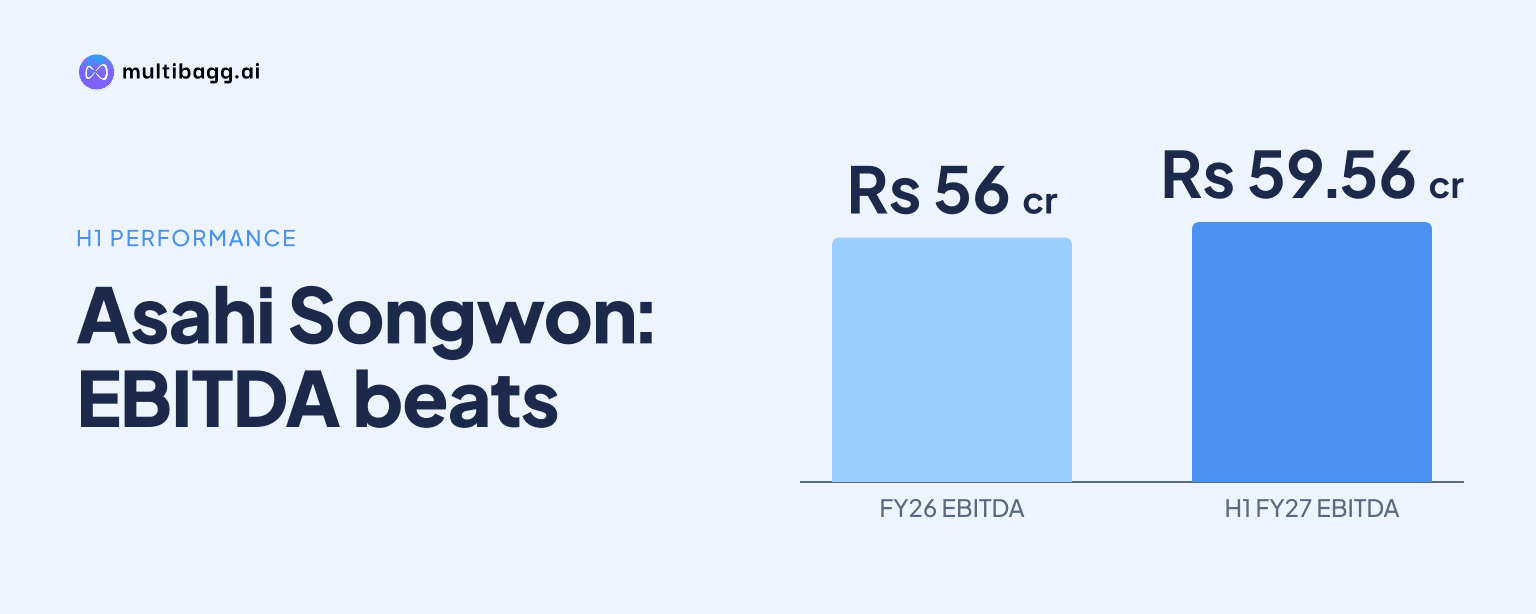
Asahi Songwon Colors Limited reported consolidated EBITDA, or earnings before interest, tax, depreciation and amortisation, of Rs 59.56 crore in H1 FY27, exceeding the Rs 56 crore recorded in all of FY26. Management attributed the result to structural supply-chain, engineering and cost changes, and said Blue pigments can sustain 13% to 15% long-term EBITDA margins.
Know Asahi Songwon Colors inside out
Results, valuation, peers and who's buying, in one view.
Why did Asahi Songwon’s H1 FY27 EBITDA exceed FY26’s full-year result?
Asahi Songwon generated Rs 59.56 crore of EBITDA on Rs 390 crore of revenue in H1 FY27, compared with Rs 56 crore of EBITDA in FY26. EBITDA increased 157% year on year, while the consolidated margin expanded to 15.15% from 8.45% in H1 FY26, a 670-basis-point change.
Net profit was Rs 33.92 crore in H1 FY27, versus Rs 17.70 crore for the full FY26. Management described the half year as the company’s strongest and said the improvement came from work over several quarters on procurement, engineering efficiencies and cost control, rather than one favourable quarter or a single price movement.
Q2 FY27 also produced the company’s highest quarterly revenue of Rs 201 crore, up 66.5% from Rs 120 crore in Q2 FY26 and 6.6% from Q1 FY27. Q2 EBITDA was Rs 26.96 crore, up 142% year on year, while net profit rose to Rs 14.89 crore from Rs 2 crore.
Was Asahi Songwon’s Q2 FY27 profit lifted by inventory gains?
Management said Q2 FY27 was a cleaner measure of underlying earnings because it did not include the inventory gains that benefited Q1 FY27. Q2 EBITDA margin was 13.25%, compared with 7.18% in Q1 FY27 and 9% in Q2 FY26, even after the business absorbed raw-material price volatility.
The 6.07-percentage-point sequential margin increase was based on the disclosed Q2 and Q1 figures, although management said Q1 Blue-business margins were above its long-term sustainable level because of inventory gains. It said Q2’s 13.25% margin was above any level reported during FY26.
Q2 net profit of Rs 14.89 crore was 610% above the Rs 2 crore reported a year earlier, while earnings per share reached Rs 12.78 from Rs 1.91. Alongside record Rs 201 crore revenue, management cited the absence of Q1’s stated inventory benefit as the reason Q2 better represented current earning power.
What changed in Asahi Songwon’s Blue pigments business?
Asahi Songwon said H1 FY27 revenue from its Phthalocyanine, or Blue pigments, business increased about 47% from H1 FY26. Longstanding supplier relationships and its procurement structure enabled the company to keep the plant operating and customers supplied through disruptions in raw-material availability and pricing.
Management also attributed the Blue pigments outcome to energy efficiencies and ground-level cost discipline across expenditure heads. It said the measures were developed over several quarters and expected a substantial part of the benefit to continue in coming quarters and years, rather than treating H1 FY27 as solely a price-driven gain.
Management said the Phthalocyanine business can sustain EBITDA margins of 13% to 15% over the longer term. That statement applies to Blue pigments, not necessarily to the 15.15% consolidated H1 FY27 margin, which includes the AZO and active pharmaceutical ingredient businesses.
Asahi Songwon expects Q3 FY27 demand softness because export customers typically tighten inventory toward the end of the calendar year. Management nevertheless expects Q3 FY27 to be significantly better than Q3 of the previous year, with quality, reliability, existing-asset efficiency and margin protection remaining the Blue pigments priorities.
Got a follow-up? Ask IRIS
How are Asahi Songwon’s AZO and API businesses performing?
Asahi Songwon said AZO had a challenging Q2 FY27 after higher raw-material costs in Q1 caused customers to defer purchases. Q2 AZO revenue recovered to Rs 28.82 crore and H1 revenue reached Rs 47.35 crore, while volumes grew but competitive pricing continued to affect realisations.
AZO utilisation was around 70% to 75% in Q2 FY27, compared with about 65% cited in the FY26 call. Management said the segment remained EBITDA-positive and cash-positive, and expects H2 FY27 to improve on H1 through larger customers, quality upgrades, a broader product base and lower production costs.
In response to an investor question, management said the Rs 28.82 crore Q2 AZO revenue level was sustainable rather than merely catch-up from deferred Q1 orders. It was hopeful of maintaining a similar quarterly run rate, despite global demand challenges, Chinese competition and a China-plus-one benefit that management said had not developed as expected.
Atlas Life Sciences, Asahi Songwon’s wholly owned active pharmaceutical ingredient, or API, subsidiary, reported revenue growth of about 33% in Q2 and H1 FY27 versus H1 FY26, according to management. API volumes have grown about 18% annually for three years, but selling-price declines constrained financial results and management expects H2 improvement if price pressure eases.
How much debt has Asahi Songwon reduced and what is the plan?
Asahi Songwon reduced gross borrowings by about Rs 49 crore in H1 FY27, supported by first-half cash generation. Management said deleveraging had progressed faster than expected after borrowings of Rs 200 crore, and lower debt was already reducing finance costs.
Management expects combined long-term and short-term debt to be substantially below one times EBITDA by the end of FY27. It also indicated a net-worth-to-debt ratio of about 0.15 to 0.20 times, while saying any capital allocation would be assessed carefully against return on capital employed.
Asahi Songwon is evaluating opportunities for the group’s next growth phase, but management disclosed no project, investment amount or timetable. The stated position is an evaluation process enabled by lower debt, rather than a commitment to a specific expansion or acquisition.
Conclusion
Asahi Songwon’s H1 FY27 result marked a material change in reported earnings, with Rs 59.56 crore of EBITDA surpassing FY26’s Rs 56 crore and net profit of Rs 33.92 crore nearly twice FY26’s Rs 17.70 crore. Management linked the change principally to Blue pigments supply security, energy efficiency and cost discipline, while AZO and API remained EBITDA-positive and cash-positive.
The next disclosed test is Q3 FY27, when management expects seasonal export-customer inventory tightening but still anticipates performance significantly ahead of Q3 of the prior year. Investors can monitor whether AZO maintains revenue near Rs 28.82 crore per quarter, whether API price pressure eases in H2 FY27, and whether debt reaches management’s below-one-times-EBITDA objective by FY27 end.