










Ashutosh Fibre targets 29% EBITDA via fabric processing
Key highlights
- Ashutosh Fibre expects overall EBITDA margin of 29%, compared with 24%-25% currently, after processing begins.
- The December unit has dyeing capacity of about 70,000 metres and targets 40,000-50,000 metres monthly in its first three months.
- Initial processing is expected to use 10,000 kg of yarn monthly against the 4 lakh kg total output cited by management.
- Ashutosh Fibre expects 70% of processed-fabric buyers to be existing customers and 30% to be import-dependent customers.
powered by IRIS
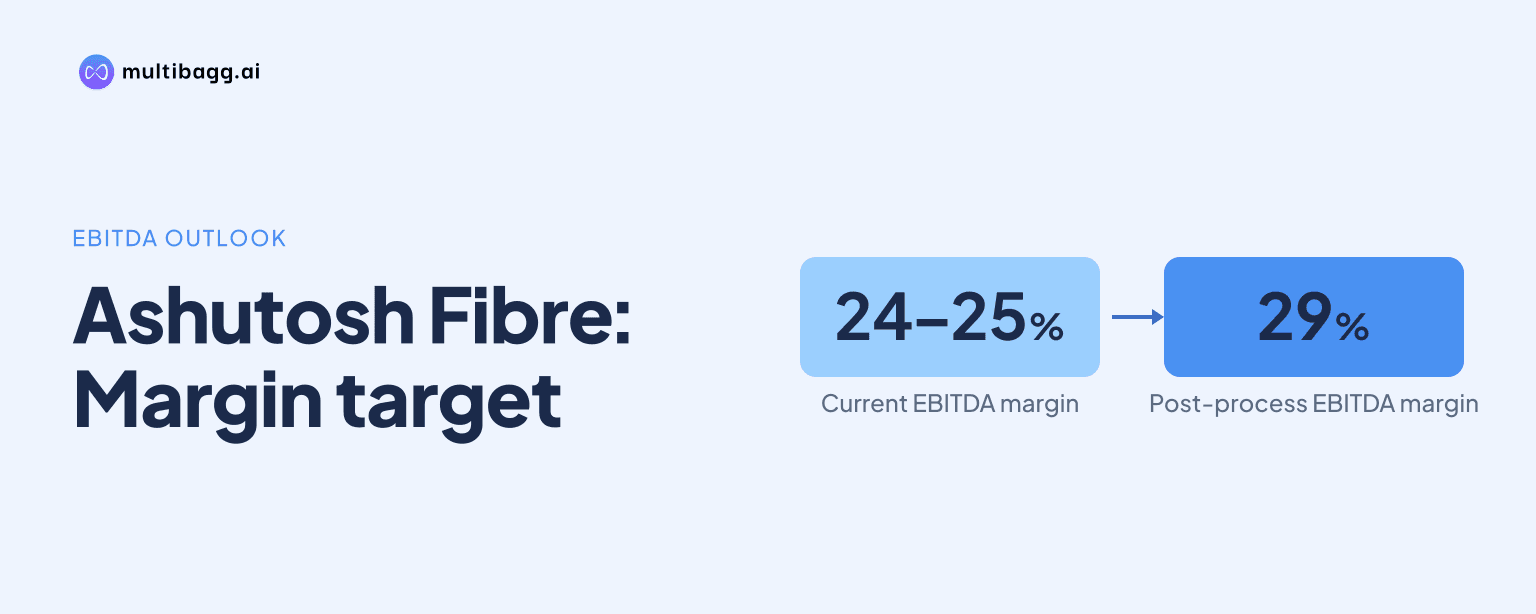
Ashutosh Fibre Ltd. expects its December fabric-processing launch to lift overall earnings before interest, tax, depreciation and amortisation, or EBITDA, margin to 29% from 24%-25%, management said. The initial operation is expected to process 40,000-50,000 metres a month for its first three months while consuming about 10,000 kg of yarn monthly.
Know Ashutosh Fibre inside out
Results, valuation, peers and who's buying, in one view.
When will Ashutosh Fibre start fabric processing?
Ashutosh Fibre said its fabric machinery will be installed in December, while the plant planned for June is a spinning expansion rather than the fabric project. The December installation adds dyeing and processing to a business that currently produces yarn and does not dye yarn or fibre.
The processing machine has dyeing capacity of about 70,000 metres. Management expects output of 40,000-50,000 metres a month in the first three months, meaning the unit would initially operate below its stated capacity while the company establishes the new product flow.
Ashutosh Fibre expects the initial processing activity to consume around 10,000 kg of yarn each month, compared with the 4 lakh kg of total yarn production cited by management. That starting quantity is equivalent to 2.5% of the cited output, so the first phase would leave most yarn production available for existing sales.
The fabric unit will be installed inside the existing plant through selected machinery rather than at a separate site. Management said this is a forward-integration step from yarn into woven, dyed and processed fabric, with weaving initially carried out by partners.
How does Ashutosh Fibre expect processing to affect EBITDA?
Ashutosh Fibre expects overall EBITDA margin to increase to 29% from the current 24%-25% after processing begins. This is management's forward-looking estimate, rather than a reported post-launch result, and represents a planned improvement of 4-5 percentage points.
Management used an average fabric realisation of Rs 700 per metre in its calculation, while also describing a range of Rs 650-Rs 700 per metre. It said realisation will depend on the quality of the fabric, with meta-aramid fabric potentially priced above or below that illustrative average.
The call did not provide a fabric price for a specified quantity or value of yarn, so a yarn-to-fabric realisation multiple cannot be derived. Management instead disclosed the 29% margin target, the Rs 650-Rs 700 per-metre indication and initial output of 40,000-50,000 metres a month.
Fabric processing has an expected payback period of around 2-2.5 years, according to management. That compares with about 3-4 years for weaving machinery and around four years for spinning expansion, while Mobiltech machinery was described as having a payback period of hardly one year.
Who will Ashutosh Fibre sell processed fabric to?
Ashutosh Fibre expects 70% of processed-fabric customers to be existing customers and 30% to be customers that currently import, mostly from China. Management said the importing customers already buy yarn from Ashutosh Fibre but obtain the related fabric from overseas suppliers.
The company said it has customers for processing and can reach full capacity in that activity, although it did not disclose customer names, contracts or order values. Its plan is to supply woven and dyed fabric to those buyers, making import substitution the stated commercial rationale for the December launch.
Ashutosh Fibre sells mostly directly to end customers, with only 1%-2% of sales moving through dealers, according to management. That route is relevant because 70% of the proposed processed-fabric customer base is expected to come from relationships that already purchase its yarn.
Management described engineered fabrics as its ultimate focus and said defence fabrics are an area in which it would like to operate. It also said it does not currently have weaving customers, distinguishing the available processing demand from the later ambition to become more fully integrated.
Got a follow-up? Ask IRIS
Why will Ashutosh Fibre outsource weaving at first?
Ashutosh Fibre will initially use partners for weaving and intends to consider in-house weaving next year. Management said it is not setting up a weaving plant now because it has processing customers today, whereas it does not yet have customers for weaving.
Management said technical-fibre weaving is difficult and depends on how the spinning is carried out and how fibres behave in particular environments. Ashutosh Fibre has six spinning lines and said it can run 40 different products at a given time, which management identified as an operational advantage.
The existing yarn platform comprises 23,500 spindles, one open-end spinning machine and one friction-spinning machine. It operates three shifts, plus almost 1.5 shifts on Sundays, and produces about 12,000-13,000 kg of ring-spun yarn, 2,500 kg of DREF yarn and 1,600 kg of open-end yarn per day.
Management identified fibre availability and pricing as the main scaling risks. It cited an instance about one year earlier when a fibre was unavailable after China blocked raw material, and said customers often require a specified brand and type of fibre that cannot simply be replaced.
What constrains Ashutosh Fibre's expansion after processing?
Ashutosh Fibre said the December fabric unit will occupy capacity at its existing 80,000-square-yard plant. After that expansion, management said no further capacity would remain at the site and any additional expansion would require new land and machinery.
That constraint applies to future spinning, processing or weaving additions beyond the current installation. The December project therefore uses the available brownfield space, while a later move into in-house weaving would require a separate land decision if the company pursues it.
Management said entry barriers in its products include the difficulty of spinning polypropylene and other technical fibres, machinery wear and workforce skills. It contrasted conventional cotton and polyester operations, where one worker may handle two ring frames, with its own products, where one worker handles only one side of a ring frame or machine.
It also said designated raw-material suppliers do not supply every spinner and that customers are reluctant to switch suppliers for specialised yarns and fabrics. Those factors were management's explanation for the technical-fibre supply chain, but its disclosed fibre-availability risk remains unresolved.
Conclusion
Ashutosh Fibre's December processing project is a limited-volume first move from yarn into a higher-value fabric stage. Management expects the 29% EBITDA margin target to be supported by initial production of 40,000-50,000 metres a month, even though the 10,000 kg monthly yarn requirement is small compared with the 4 lakh kg output figure it cited.
The next disclosed milestones are the December machinery installation and performance during the first three months, when output is targeted at 40,000-50,000 metres against 70,000 metres of dyeing capacity. Management's plan to consider in-house weaving next year, and its statement that new land would be required after the existing site is used, will determine the next stage of engineered-fabric expansion.