










Ashutosh Fibre plans 1,250 MT Petlad expansion by June 2027
Key highlights
- Ashutosh Fibre reported 89.52% combined capacity utilisation in 2026, up from 80.24% in 2024.
- Ashutosh Fibre plans to add 1,250 MT of annual capacity at Petlad by June 2027.
- The IPO objects include Rs 25.5083 crore for new equipment and machinery.
- H1 FY27 revenue from operations rose 7.3% to Rs 65.276 crore.
powered by IRIS
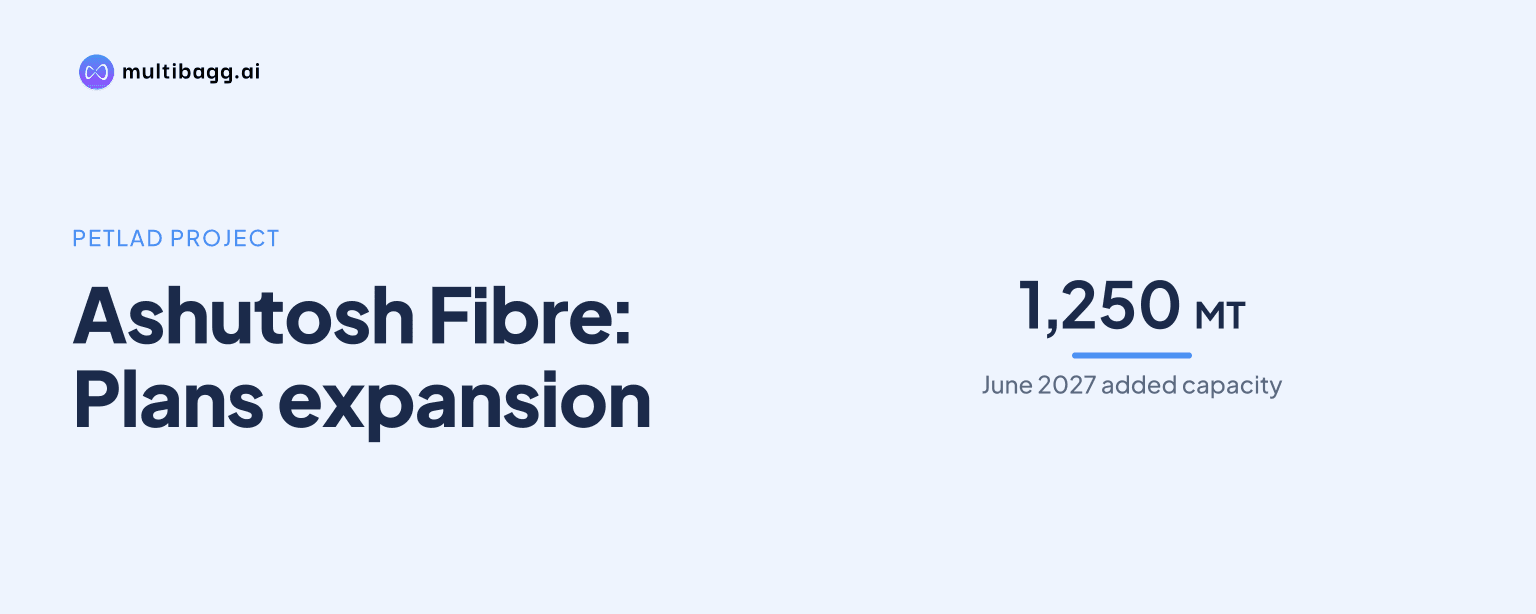
Ashutosh Fibre Limited plans to add 1,250 metric tonnes (MT) of annual capacity at Petlad, with commercialisation expected by June 2027, after combined utilisation reached 89.52% in 2026 on 4,775 MT of installed capacity. Management also identifies Rs 25.5083 crore of recent initial public offering (IPO) proceeds for equipment and machinery.
Know Ashutosh Fibre inside out
Results, valuation, peers and who's buying, in one view.
Why is Ashutosh Fibre expanding Petlad capacity?
Ashutosh Fibre is expanding because reported installed-capacity utilisation increased to 89.52% in 2026 from 86.58% in 2025 and 80.24% in 2024. Management said the 1,250 MT annual addition is intended to strengthen manufacturing capability and cater to growing demand, with the new capacity expected to be commercialised by June 2027.
Production growth accompanied the higher utilisation rate, although the two yarn categories moved differently. Synthetic yarn production rose from 2,809 MT in 2024 to 3,619 MT in 2026, while 100% polypropylene yarn output declined from 680 MT to 656 MT over the same period. Total installed capacity increased by 250 MT between 2024 and 2025, then remained at 4,775 MT in 2026.
The utilisation figures cover synthetic yarn of up to 50 Number English count (NE) and 100% polypropylene yarn of up to 2 NE. The presentation defines NE as Number English count, a yarn-count measure. The 9.28-percentage-point rise in combined utilisation from 2024 to 2026 provides the reported operating context for the planned 1,250 MT addition.
What will Ashutosh Fibre add at the Petlad facility?
Ashutosh Fibre plans to add 1,250 MT of annual capacity at Petlad through advanced spinning machinery and related equipment, with commercialisation expected by June 2027. Its stated production strategy also includes scaling the facility with compact spinning systems and Pinter Hard Core equipment to manufacture core-spun and specialty yarns.
Ashutosh Fibre says it intends to increase installed capacity across ring-spun, DREF and open-end technologies for domestic and international markets. DREF is listed alongside ring-spun and open-end as a production technology in the presentation, while the strategy page links the planned equipment to product diversification and export-led growth rather than providing a technology-by-technology capacity split.
Ashutosh Fibre’s product-development plan extends beyond the announced machinery. Management said it is developing modacrylic-based technical fabrics, while the strategy presentation identifies milled acrylic and milled carbon yarns for fire-resistant, composite and advanced industrial applications. The company’s primary focus is on Protech, or protective technical textiles, and Mobiltech, or automotive technical textiles.
Those end markets include firefighter personal protective equipment, oil and gas protective gloves, brake pads and clutch facings. The broader portfolio also serves Indutech applications such as filter cloth, geotextiles and process-industry textiles, as well as Hometech uses including carpets and upholstery. The presentation links the Petlad project to specialty-yarn capabilities but does not disclose the 1,250 MT allocation by product, customer or segment.
Got a follow-up? Ask IRIS
How does Ashutosh Fibre plan to finance the expansion?
Ashutosh Fibre has earmarked Rs 25.5083 crore from the recently concluded IPO for capital expenditure on new equipment and machinery, while management describes the 1,250 MT Petlad expansion as being supported by advanced spinning machinery. The investment-rationale page rounds this intended machinery capital expenditure to Rs 25 crore and says it will expand capacity in Indutech and Protech.
The IPO objects page lists total estimated uses of Rs 56.3482 crore. Of that total, Rs 20 crore is designated for repayment or prepayment of certain borrowings, while general corporate purposes are also listed; the presentation says this use will not exceed 25% of gross proceeds. It does not state a separate total project cost for the Petlad expansion.
The disclosed use of proceeds distinguishes machinery funding from debt repayment in the stated financing framework. However, the presentation does not specify how much of the Rs 25.5083 crore is assigned to compact spinning, Pinter Hard Core equipment, advanced spinning machinery or other equipment at Petlad.
What operating factors could support the planned capacity addition?
Ashutosh Fibre’s operating plan combines the June 2027 capacity addition with technical-yarn diversification, automation and energy initiatives. The company has commissioned a 380 kilowatt rooftop solar system and a 4 megawatt solar power plant for captive consumption, which it says are intended to reduce electricity expenses and carbon emissions.
Management reported H1 FY27 revenue from operations of Rs 65.276 crore, up 7.3% from Rs 60.8298 crore in H1 FY26. Earnings before interest, tax, depreciation and amortisation (EBITDA) rose 3.6% to Rs 15.4614 crore, while profit after tax increased 6.8% to Rs 8.0236 crore. These figures describe performance before the planned June 2027 commercialisation date.
The company’s strategy also calls for automation, integrated planning, automated inventory management and data-driven tools to improve production control. Its technical yarns are positioned for applications requiring thermal resistance, flame-resistant performance, tensile strength, abrasion resistance and chemical resistance, including industrial filtration, automotive friction materials and specialised defence textiles.
The industry outlook in the presentation estimates India’s technical-textile market at USD 28.5 billion in FY2025, compared with USD 18.9 billion in FY2020, and projects USD 50 billion by FY2030. Ashutosh Fibre attributes the outlook to policy support, industrial adoption and demand from infrastructure, defence, industrial safety and smart-textile segments; these are industry projections cited in the presentation, not company guidance.
Conclusion
Ashutosh Fibre’s expansion case rests on reported utilisation of 89.52% in 2026, rising synthetic-yarn production of 3,619 MT and a plan to add 1,250 MT annually at Petlad. The stated Rs 25.5083 crore equipment-and-machinery allocation from IPO proceeds provides an identified funding route, while product development in modacrylic, milled acrylic and milled carbon points to a specialty-yarn focus.
The next disclosed milestone is commercialisation by June 2027. Investors should watch for updates on commissioning progress, project cost, capacity allocation by spinning technology or product, and utilisation changes from the 4,775 MT installed base reported for 2026.