










Ashutosh Fibre Limited Revenue Reaches ₹117.37 Crore in FY26
Key highlights
- Ashutosh Fibre Limited reported FY26 revenue of ₹117.37 crore, up 2.9% from ₹114.03 crore in FY25.
- FY26 gross profit was ₹54.90 crore, operating income was ₹26.20 crore and net income was ₹16.04 crore.
- Manufactured products contributed 87.66% of Ashutosh Fibre's FY25 business mix, while job work contributed 8.85%.
- Ashutosh Fibre reported 38.05% export sales and 61.14% domestic sales in FY25.
powered by IRIS
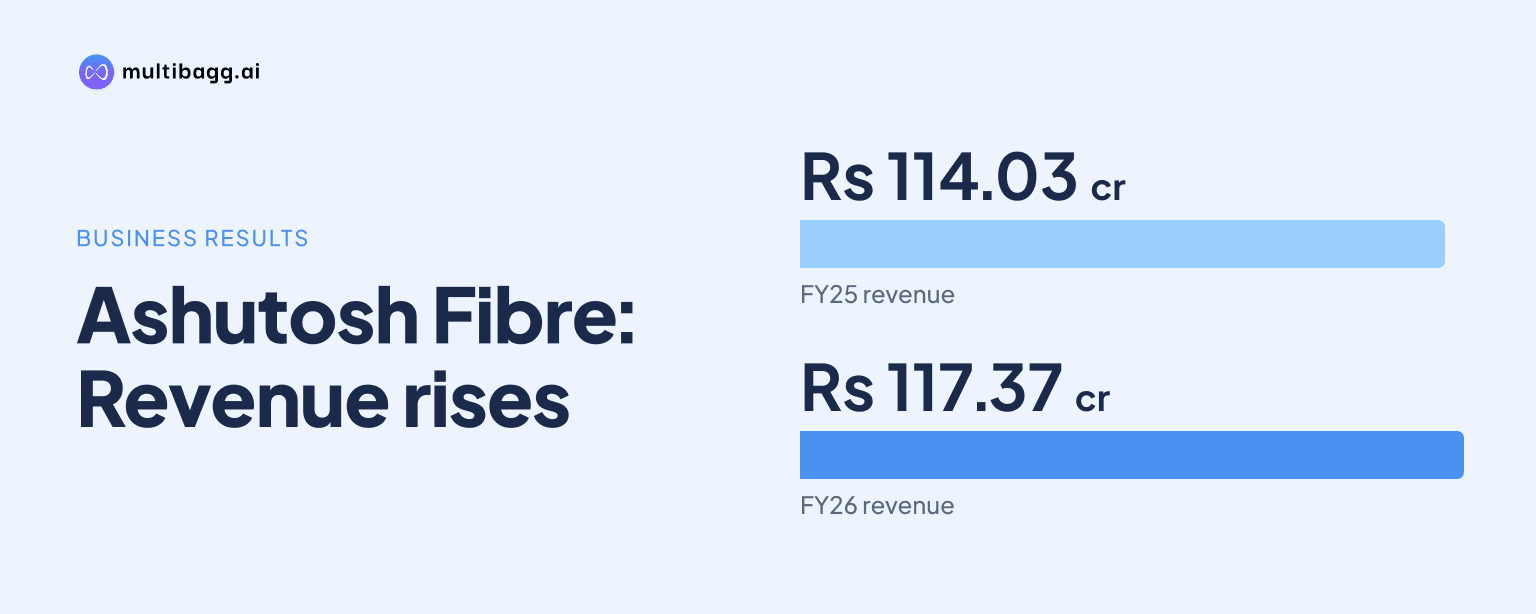
Ashutosh Fibre Limited reported total revenue of ₹117.37 crore for the year ended March 31, 2026, compared with ₹114.03 crore in FY25, representing a 2.9% year-on-year increase. The technical textile yarn maker also reported net income of ₹16.04 crore, gross profit of ₹54.90 crore and operating income of ₹26.20 crore for the fiscal year.
Know Ashutosh Fibre inside out
Results, valuation, peers and who's buying, in one view.
What did Ashutosh Fibre Limited report for FY26?
Ashutosh Fibre Limited reported ₹117.37 crore in total revenue for FY26, its highest revenue figure across the four annual periods provided. Revenue increased from ₹97.93 crore in FY23 to ₹109.87 crore in FY24, then ₹114.03 crore in FY25 and ₹117.37 crore in FY26. All figures refer to financial years ending March 31.
The income statement data for the latest reported fiscal year also shows gross profit of ₹54.90 crore, operating income of ₹26.20 crore and net income of ₹16.04 crore. Based on these reported values, gross profit represented about 46.8% of revenue, while operating income represented about 22.3%. Net income was about 13.7% of FY26 revenue.
The revenue growth rate moderated over the reported period. Revenue grew about 12.2% in FY24 from FY23, followed by about 3.8% in FY25 and 2.9% in FY26. The figures show continued top-line expansion, although the pace of increase was lower in the last two years than in FY24.
What business does Ashutosh Fibre operate?
Ashutosh Fibre manufactures and trades technical textile yarns in India. It supplies yarns used in liquid and gas filtration, heat and flame-retardant applications, abrasion and cut resistance, antistatic applications, aramid-based products, high-tenacity polyester, dyed meta-aramid and antibacterial products.
The company operates as a business-to-business supplier rather than a retail-focused company. Its products serve industrial manufacturers, processors and institutional buyers across Indutech, Protech, Hometech and Mobiltech segments. The stated application areas include filtration, pollution control, construction, infrastructure, automotive components, protective equipment, packaging and home furnishing.
Ashutosh Fibre was incorporated in 1985 and is based in Ahmedabad, India. Its manufacturing facility is located at Petlad, Gujarat. The company has stated that it operates an integrated processing plant that combines fibre recycling with multiple spinning technologies and also provides toll-processing or job-work services.
For FY25, manufactured products accounted for 87.66% of the business mix, job-work services for 8.85% and traded goods for 2.68%. The company reported direct business-to-business sales, with 61.14% of FY25 sales domestic and 38.05% exports. These figures indicate that manufactured products remain the principal source of revenue.
How does the FY26 performance compare with earlier years?
Ashutosh Fibre's FY26 revenue was ₹19.44 crore higher than FY23 revenue, an increase of about 19.9% over three years. The rise from ₹97.93 crore in FY23 to ₹117.37 crore in FY26 provides the available revenue trend, while the latest income-statement figures provide profitability measures only for FY26 in the supplied data.
A separate company snapshot reported FY25 revenue of ₹114.03 crore and profit after tax of ₹8.51 crore, compared with FY23 revenue of ₹97.93 crore and profit after tax of ₹3.30 crore. The FY25 revenue figure matches the annual income-statement data. The FY26 income statement subsequently reported net income of ₹16.04 crore.
The supplied financial information also states revenue per share of 253.25 for the latest quarter, without identifying the reporting quarter or specifying whether the measure is annualised. It should therefore be read as a disclosed per-share data point rather than compared directly with the annual revenue figures.
The reported FY26 margins are relevant because they show the relationship between revenue and profit in the latest available annual period. However, the supplied information does not provide earlier-year gross profit, operating income or net income figures in the same financial-statement table, limiting direct margin comparisons across all four years.
Got a follow-up? Ask IRIS
Why do technical textile markets matter to Ashutosh Fibre?
Ashutosh Fibre operates in technical textiles, where yarn specifications can be linked to industrial performance requirements such as filtration, heat resistance, flame retardance, strength and protection. Its exposure to industrial and protective applications differentiates its product usage from conventional apparel-oriented textile demand.
The company operates in segments connected to infrastructure, pollution-control systems, industrial filtration and automotive uses. Demand conditions in these end markets can influence order volumes and product mix, although the provided information does not disclose customer concentration, order book value or segment-wise financial performance.
The supplied market background says India's technical textiles market is forecast to reach US$50 billion by FY30 and cites infrastructure mandates and import substitution in high-performance fibres as supporting factors. This is industry context rather than a company forecast, and it does not establish a specific future revenue target for Ashutosh Fibre.
Ashutosh Fibre's Gujarat manufacturing presence and mix of manufacturing, trading and job work are also relevant to its operations. Manufactured products formed the largest share of FY25 business, while job work supplied an additional services-led revenue stream. Export sales accounted for 38.05% of FY25 business, making overseas demand relevant to the company's sales mix.
What are investors watching after the FY26 financial update?
Ashutosh Fibre informed the exchange that its board would meet on November 4, 2026, to consider and approve unaudited financial results for the half year ended September 2026. That disclosure identifies the next reported operating period in the supplied material, but it does not contain the half-yearly financial outcome.
The company is listed on the NSE SME platform under the symbol ASHUTOSH. The supplied market snapshot showed a market capitalisation of ₹290 crore, a share price of ₹132, a 52-week high of ₹174 and a 52-week low of ₹118. It also listed a stock price-to-earnings ratio of 17.5, return on equity of 36.6% and return on capital employed of 27.2%.
Shareholding data for September 2026 showed promoters holding 43.05%, foreign institutional investors 2.18%, domestic institutional investors 8.87% and the public 45.90%. The number of shareholders was reported at 873. These ownership figures provide context on the shareholder base but do not indicate future trading activity or price direction.
The company has also disclosed investor-presentation communications to the exchange, including a broadcast dated October 14, 2026. The material provided does not specify new capacity targets, capital expenditure, customer contracts or management guidance. As a result, the reported financial trend and the upcoming half-yearly results remain the clearest disclosed reference points for investors.
Conclusion
Ashutosh Fibre Limited recorded FY26 revenue of ₹117.37 crore, up from ₹114.03 crore in FY25, and reported net income of ₹16.04 crore. The figures place the company within India's technical-textile supply chain, with manufactured technical yarns forming the core of its stated business mix and industrial applications supporting its operating profile.
The next disclosed event is the board's consideration of unaudited results for the half year ended September 2026. Investors can watch for the reported revenue, profitability and any operational disclosures from that period, as the supplied information does not include a forward revenue target, order book or capacity-expansion plan.