










Ashutosh Fibre Ltd sees Rs 280 crore at full utilisation by 2028
Key highlights
- Ashutosh Fibre expects FY27 topline growth of 30%.
- A new spinning line was commissioned at the end of August and began production in September.
- Ashutosh Fibre is undertaking capital expenditure of Rs 65 crore to Rs 70 crore through IPO proceeds and bank loans.
- Management said full utilisation in 2028 could support Rs 280 crore of turnover.
powered by IRIS
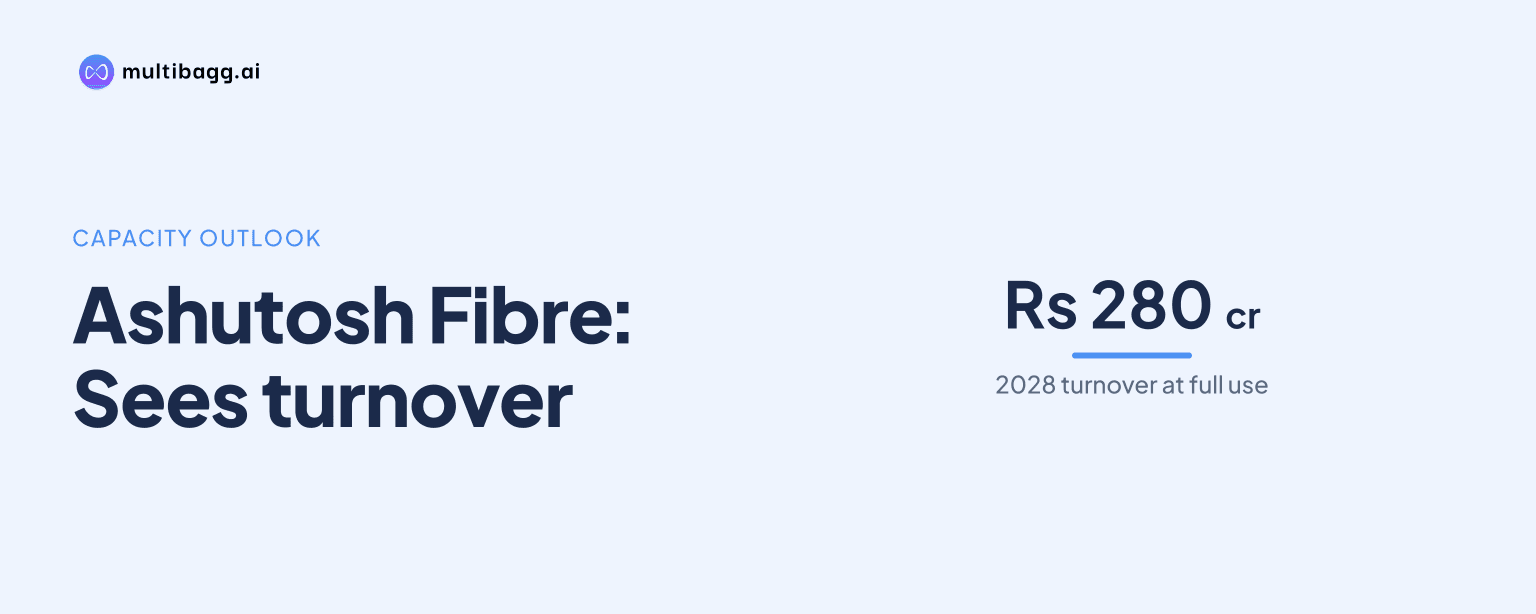
Ashutosh Fibre Ltd expects FY27 revenue to grow 30% and says turnover could reach Rs 280 crore at full utilisation in 2028, conditional on a full year of planned capacity and machinery. Management linked the outlook to a spinning line that began production in September and an expansion programme of Rs 65 crore to Rs 70 crore.
Know Ashutosh Fibre inside out
Results, valuation, peers and who's buying, in one view.
What revenue growth does Ashutosh Fibre expect in FY27?
Ashutosh Fibre expects topline, or revenue, to rise 30% in FY27. Management said earnings before interest, tax, depreciation and amortisation, or EBITDA, margin and net-profit margin should remain broadly similar overall, while absolute profit rises with revenue.
The outlook marks a change from the first half, when an analyst said revenue was more or less flat year on year. The analyst calculated that 30% full-year growth could imply revenue of about Rs 150 crore and second-half revenue of about Rs 85 crore to Rs 90 crore; management called that second-half range realistic but did not itself issue a Rs 150 crore full-year forecast.
Management attributed the expected second-half improvement to capacity that was not fully available in the first half. It said it invested in a new spinning plant at its existing facility in May and June, commissioned it at the end of August, and began production in September.
The September start means the spinning line did not make a full first-half contribution but is now operating for the remainder of FY27. Management did not disclose a quarterly target, monthly run rate or specific revenue contribution from the added line, so the 30% projection remains its topline expectation rather than a product-level forecast.
How does the September spinning line support growth?
The September spinning line supports growth by increasing supply of Protech products, including modacrylic heat- and flame-retardant yarn and high-tenacity polyester yarn. Management said the company installed the unit because it had been unable to fulfil customer demand for these products.
Management cited one customer requirement of 150 tons against its earlier ability to supply only 60 tons. The difference of 90 tons illustrates the capacity constraint that preceded the line's commissioning, although Ashutosh Fibre did not say whether the entire requirement was contracted or give a delivery period.
The new configuration also changes production allocation. Management said it had previously made two products on one spinning line, whereas it now expects one line to be allocated to one product and another line to the next product; it said both products have good margins, with Protech generating higher margins than its other operating areas.
Management said EBITDA margin in the first half was almost the same as last year and expected a similar margin pattern in the second half. It also said a solar plant described as 4 megawatts, or 4.5 megawatts, had reduced production costs, particularly electricity costs, but did not provide a quantified saving.
Got a follow-up? Ask IRIS
What expansion plan underpins the Rs 280 crore target?
Ashutosh Fibre is undertaking capital expenditure of Rs 65 crore to Rs 70 crore, funded through initial public offering proceeds and bank loans. Management said a new plant from this programme is expected to be operational by June in the following year.
After the current year's expected 30% topline growth, management expects turnover to increase by another 50% in the following year. That is management guidance rather than reported revenue, and the transcript did not disclose the precise revenue base, utilisation level or production ramp assumed for the 50% increase.
Management said full utilisation could be achieved in 2028 and revenue could reach Rs 280 crore with a full year of planned capacity and machinery. The Rs 280 crore figure is therefore conditional on both the expanded assets being available and the company operating them at full utilisation.
The stated sequence is capacity-led: the September line supports FY27, the new plant is planned to operate by June in the following year, and full utilisation is expected in 2028. Management did not provide annual production capacity, intermediate utilisation targets or a split of the Rs 65 crore to Rs 70 crore programme by equipment.
What could determine Ashutosh Fibre's progress toward full utilisation?
Ashutosh Fibre's route to Rs 280 crore depends first on the new plant becoming operational by June and then reaching full utilisation in 2028. Management framed the turnover figure as the outcome of a full year with capacity and machinery, rather than as an unconditional annual forecast.
Demand conversion is the second disclosed mechanism. The company said its earlier supply of 60 tons against a customer's 150-ton requirement led to the spinning-line investment, but it did not disclose customer concentration, binding orders, pricing or the timing for converting the indicated volume gap into sales.
The company also plans to move further into processing. Management said it had invested in textile-processing machinery and that customers were ready to buy fabric, while processing has higher EBITDA and profit margins than spinning; it nevertheless declined to quantify the margin effect on FY27 results.
For technical yarns, raw-material sourcing remains part of the operating model. Ashutosh Fibre said para-aramid and meta-aramid raw materials are mostly imported because they are not available in India, naming Teijin and Chinese suppliers, while its yarns are used in heat- and flame-retardant apparel and gloves.
Conclusion
Ashutosh Fibre has presented a staged expansion plan: 30% FY27 topline growth following the September spinning-line start, a further 50% turnover increase expected in the following year, and possible revenue of Rs 280 crore at full utilisation in 2028. The immediate operational evidence is the prior 150-ton customer requirement against 60 tons of available supply.
The next disclosed milestone is the planned June start of the new plant funded by Rs 65 crore to Rs 70 crore of capital expenditure. Management's subsequent target is full utilisation in 2028, while the unresolved items are the pace of capacity ramp-up, conversion of unmet demand into orders, and the unquantified contribution of fabric processing to margins.