










Avience Biomedicals Limited Has 117 CDSCO Licenses, 200+ Pending
Key highlights
- Avience reports 117 CDSCO manufacturing licenses across four diagnostic segments.
- Biochemistry has 43 disclosed licenses, compared with 24 for rapid diagnostic test kits.
- Applications for more than 200 Avience products are under process, with no product-level approval dates disclosed.
- Avience states that CDSCO manufacturing-license approval takes an average nine to 12 months.
powered by IRIS
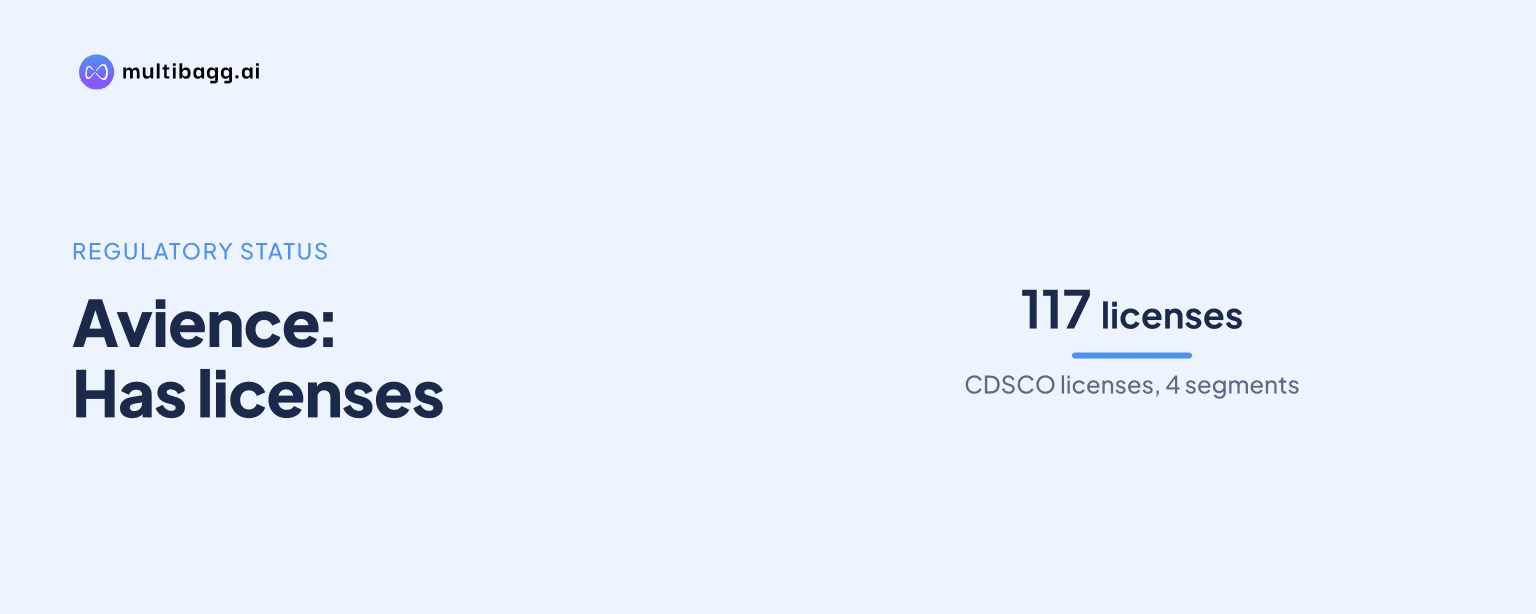
Avience Biomedicals Limited reports 117 CDSCO manufacturing licenses across four diagnostic segments and says applications for more than 200 products are under process, with its stated average approval timeline of nine to 12 months requiring testing, regulatory evaluation and final license issuance before pending products can be manufactured.
Know Avience Biomedicals inside out
Results, valuation, peers and who's buying, in one view.
How many CDSCO licenses does Avience hold?
Avience holds 117 CDSCO manufacturing licenses, according to its portfolio summary, covering four diagnostic segments. The presentation identifies the licensed range as diagnostics, reagents, consumables and medical devices, and says the portfolio supports end-to-end diagnostic solutions.
The 117 licenses are already obtained, whereas applications for more than 200 additional products are under process. This distinction means the figures should not be combined into a total number of approved licenses or products, because the presentation separately measures existing manufacturing licenses and pending product applications.
The source describes the 117 licenses as spanning four diagnostic segments, but it provides detailed numerical counts for only two categories. Biochemistry accounts for 43 disclosed licenses and rapid diagnostic test kits account for 24, leaving no separate license count disclosed for hematology or microbiology.
What products do Avience's licenses cover?
Avience's largest specifically quantified licensed category is biochemistry, with 43 licenses, followed by rapid diagnostic test kits with 24 licenses. The biochemistry portfolio includes analyzers; glucose, urea, creatinine and cholesterol reagents; liver-function and protein-testing reagents; electrolyte analyzers; laboratory consumables; and collection tubes.
Rapid diagnostic kits cover dengue NS1 and combo tests, malaria Pf/Pv and Pf/Pan tests, HIV 1/2 antibody tests, HBsAg tests, HCV antibody tests, typhoid, syphilis and pregnancy test kits. Biochemistry has 19 more disclosed licenses than rapid tests, based on the 43 and 24 license counts presented by Avience.
Avience also lists hematology products including probe cleaner, blood cell diluent and LYSE reagents, alongside viral transport medium in microbiology. However, the presentation gives no individual CDSCO license counts for these two segments, despite stating that its overall portfolio spans four categories.
The manufactured-product material also displays molecular assays, culture media, oxygen concentrators and analyzer products. Yet the CDSCO portfolio page does not provide a manufacturing-license total for every product included in that wider manufactured range, so the disclosed counts cannot be allocated across all listed products.
How long does CDSCO manufacturing approval take?
Avience states that the average CDSCO manufacturing-license process takes nine to 12 months and comprises nine stages from document collection to the issue of a manufacturing license. The process starts with collecting documents for a test license and submitting the test-license application.
The following stages are issue of the test license, product manufacturing, and product testing through accredited laboratories. Product approval follows this testing, after which a manufacturer submits its application for a manufacturing license.
Regulatory evaluation is based on manufacturing track record and a market-standing certificate, according to the presentation. The ninth and final stage is the issue of the manufacturing license, making the disclosed timeline an average process duration rather than a promised decision date for any individual application.
Avience characterizes the testing, compliance and evaluation sequence as an entry barrier for manufacturers. In practical terms, a pending product must proceed through test licensing, manufacturing, laboratory testing, product approval and regulatory evaluation before reaching the final manufacturing-license stage.
Got a follow-up? Ask IRIS
What does Avience's 200-plus product pipeline mean?
Avience says applications are under process for more than 200 additional products, creating a pending product pipeline larger in count than its 117 obtained manufacturing licenses. The presentation does not disclose the category split of these products among biochemistry, rapid diagnostics, hematology and microbiology.
The current portfolio has 43 disclosed biochemistry licenses and 24 rapid-test licenses, while the pending applications could expand the range only after completion of the approval process. Since one figure represents licenses and the other represents products, the source does not establish a one-to-one relationship between each pending product and a future manufacturing license.
Avience also does not identify where individual applications sit within the nine stages. It does not state how many of the 200-plus products have received test licenses, completed accredited-laboratory testing, secured product approval or reached the manufacturing-license application stage.
The stated nine-to-12-month average applies to the overall manufacturing-license process described on the regulatory page. It should therefore not be read as a product-specific timeline, because Avience gives neither individual submission dates nor expected approval dates for the products under process.
How does the proposed factory fit Avience's approval plans?
Avience plans a fully automated biochemistry-analyzer manufacturing facility at Plot No. 70, Sector 28, YEIDA Medical Device Park in Gautam Buddha Nagar, Uttar Pradesh, with commissioning targeted for January 2027. The proposed project has total investment of Rs 30.18 crore and is intended to expand manufacturing infrastructure, production capacity and product diversification.
The Rs 30.18 crore project funding mix comprises Rs 15.95 crore of IPO proceeds, Rs 12.00 crore of SIDBI funding and Rs 2.23 crore of internal accruals. Its manufacturing focus is biochemistry analyzers, aligning with biochemistry's 43 licenses, the largest category for which Avience discloses a license count.
The planned facility does not remove the separate CDSCO approval process for products. The presentation places the capacity project alongside the 117-license portfolio and the 200-plus pending-product pipeline, while continuing to state that manufacturing approvals involve the nine-stage process with an average nine-to-12-month timeline.
Conclusion
Avience has an existing base of 117 CDSCO manufacturing licenses across four diagnostic segments, with disclosed category counts led by 43 biochemistry licenses and 24 rapid-test licenses. Its more than 200 products under process represent a separate expansion pipeline, but the presentation makes clear that applications remain subject to testing, product approval, regulatory evaluation and final manufacturing-license issuance.
The next disclosed milestones to watch are progress in the 200-plus product applications through the stated average nine-to-12-month process and the January 2027 target for commissioning the Rs 30.18 crore YEIDA biochemistry-analyzer facility. Avience does not disclose application-level status, product-specific approval dates or the final category mix of its pending products.