










Bai-Kakaji Polymers finances Rs 43.7452 crore H1 outflow
Key highlights
- Bai-Kakaji Polymers used Rs 23.8208 crore in operating activities in H1 2026-27, versus a Rs 18.2714 crore inflow in the full year ended March 2026.
- Bai-Kakaji Polymers recorded a Rs 43.7452 crore H1 investing outflow, including Rs 44.3773 crore spent on property, plant and equipment.
- Bai-Kakaji Polymers received Rs 71.3496 crore from fresh long- and short-term borrowings in H1 2026-27.
- Bai-Kakaji Polymers' combined long- and short-term borrowings rose to Rs 146.8415 crore at September 30, 2026 from Rs 75.4919 crore at March 31.
powered by IRIS
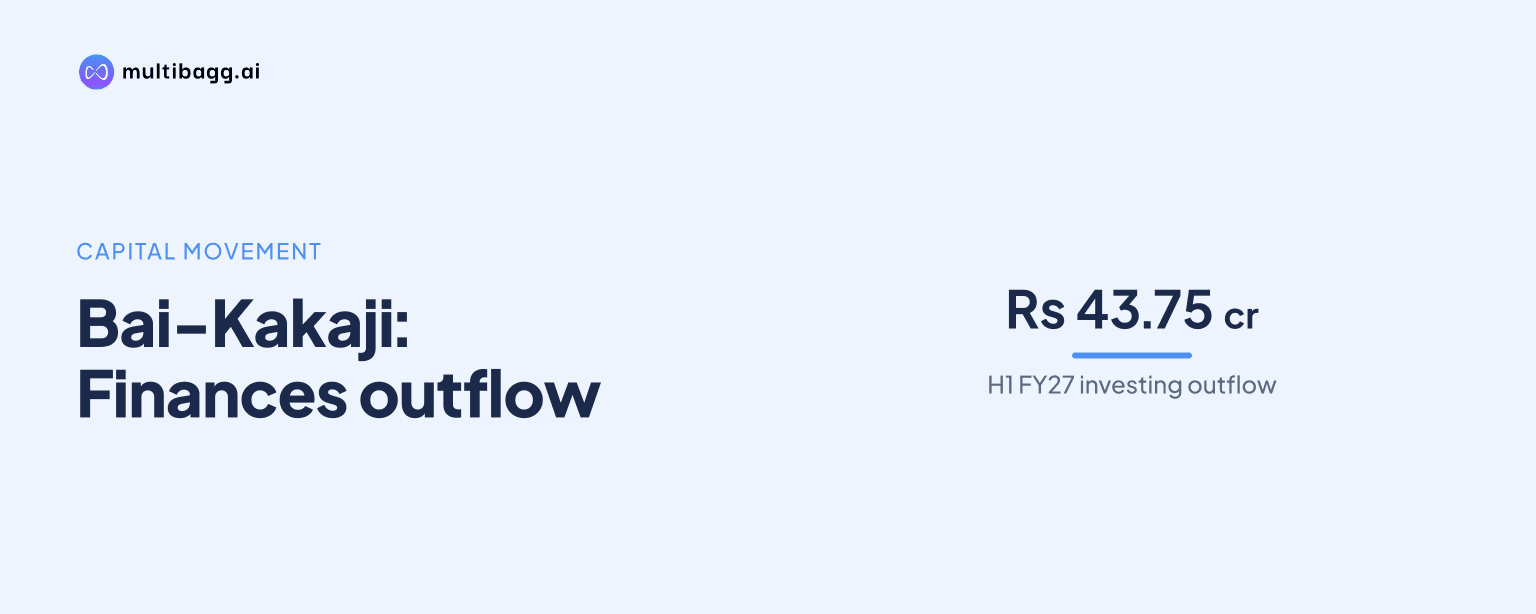
Bai-Kakaji Polymers Limited financed a Rs 43.7452 crore investing outflow in H1 2026-27 with Rs 67.5147 crore of financing cash inflow after operating activities used Rs 23.8208 crore. Fresh long- and short-term borrowing proceeds totalled Rs 71.3496 crore for the half year ended September 30, 2026.
Know Bai-Kakaji Polymers inside out
Results, valuation, peers and who's buying, in one view.
Why did Bai-Kakaji Polymers report negative operating cash flow?
Bai-Kakaji Polymers reported net cash used in operating activities of Rs 23.8208 crore in H1 2026-27, compared with a Rs 18.2714 crore inflow for the full year ended March 31, 2026. The H1 outflow followed operating profit before working-capital changes of Rs 39.2790 crore, including Rs 23.7030 crore of profit before income tax and Rs 12.0132 crore of depreciation and amortisation.
Working-capital movements used Rs 55.4722 crore before tax during H1. Trade receivables absorbed Rs 25.1225 crore, loans and advances used Rs 18.9242 crore, and inventories used Rs 6.5021 crore. Trade payables used another Rs 3.6017 crore, contrasting with a Rs 23.1974 crore cash contribution from payables during the full year ended March 2026, while net taxes paid were Rs 7.6276 crore.
The September 30 balance sheet records the corresponding increases in operating balances. Trade receivables rose to Rs 69.9453 crore from Rs 44.7723 crore at March 31, inventories increased to Rs 57.3731 crore from Rs 50.8709 crore, and short-term loans and advances increased to Rs 26.1034 crore from Rs 18.8603 crore. Long-term loans and advances also rose to Rs 21.5855 crore from Rs 9.7639 crore.
How much did Bai-Kakaji Polymers spend on investments?
Bai-Kakaji Polymers recorded net cash used in investing activities of Rs 43.7452 crore in H1 2026-27, principally due to Rs 44.3773 crore of spending on property, plant and equipment. The outflow was partly offset by Rs 46.04 lakh from term-deposit maturities, Rs 30.71 lakh of interest received and Rs 0.50 lakh of dividend received. Capital advances used Rs 14.05 lakh.
The H1 investing outflow was lower than Rs 72.9669 crore used in the full year ended March 31, 2026, when property, plant and equipment purchases were Rs 65.8787 crore and capital advances used Rs 5.7318 crore. This comparison is between a six-month period and a full year rather than like-for-like half years. The filing does not provide a project-level split for the H1 capital expenditure.
Tangible property, plant and equipment on the consolidated balance sheet increased to Rs 180.9686 crore at September 30 from Rs 144.2934 crore at March 31. Tangible capital work-in-progress declined to Rs 1.9128 crore from Rs 6.2230 crore over the same period. The cash-flow statement separately records Rs 12.0132 crore of H1 depreciation and amortisation.
Got a follow-up? Ask IRIS
How did Bai-Kakaji Polymers fund its cash needs?
Bai-Kakaji Polymers received Rs 71.3496 crore from fresh borrowings in H1 2026-27, comprising Rs 52.7304 crore of short-term borrowing proceeds and Rs 18.6192 crore from long-term borrowings. After Rs 3.8349 crore of interest paid, net cash flow from financing activities was a Rs 67.5147 crore inflow. The H1 financing section does not list repayments of long-term or short-term borrowings.
The financing inflow nearly covered the combined Rs 67.5660 crore used by operating and investing activities. Cash and cash equivalents therefore declined by Rs 5.13 lakh, closing at Rs 46.19 lakh on September 30 from Rs 51.32 lakh at the start of H1. The cash-flow statement shows that borrowings supplied the period's principal funding source rather than cash generated from operations.
The full year ended March 2026 also recorded financing cash inflow of Rs 54.7181 crore, but included Rs 95.1867 crore of share-capital proceeds. H1 2026-27 shows no share-capital proceeds. Bai-Kakaji Polymers' notes state that it issued 58,54,400 fresh equity shares at Rs 186 each in its initial public issue and listed on the BSE SME platform on December 31, 2025.
What changed in Bai-Kakaji Polymers debt and cash balances?
Bai-Kakaji Polymers' long-term borrowings increased to Rs 26.4370 crore at September 30, 2026 from Rs 7.8178 crore at March 31, while short-term borrowings increased to Rs 120.4045 crore from Rs 67.6741 crore. Combined borrowings consequently increased by Rs 71.3496 crore to Rs 146.8415 crore. The increase equals the gross borrowing proceeds stated in the H1 financing cash-flow section.
Cash and cash equivalents in the cash-flow statement were Rs 46.19 lakh at September 30, compared with Rs 51.32 lakh at March 31. The consolidated balance sheet reported Rs 2.0088 crore of cash and bank balances, including Rs 1.5439 crore of deposits with maturities exceeding 12 months and Rs 0.30 lakh of deposits with maturities of more than three months and less than 12 months. These deposits explain the difference between total cash and bank balances and cash equivalents.
Other current liabilities did not rise alongside the borrowing increase. Trade payables to creditors other than micro and small enterprises declined to Rs 31.8638 crore from Rs 35.2299 crore, other current liabilities fell to Rs 10.1979 crore from Rs 11.4989 crore, and short-term provisions declined to Rs 2.8266 crore from Rs 3.9288 crore. Total consolidated assets and liabilities increased to Rs 389.2008 crore from Rs 305.5332 crore.
Conclusion
Bai-Kakaji Polymers used Rs 23.8208 crore in operating activities and Rs 43.7452 crore in investing activities during H1 2026-27, while generating a Rs 67.5147 crore financing inflow. Receivables, loans and advances, and inventory consumed operating cash, while Rs 44.3773 crore of property, plant and equipment spending drove the investing outflow. Borrowing proceeds of Rs 71.3496 crore funded most of these uses.
The next results will show whether the Rs 25.1225 crore receivables outflow, Rs 18.9242 crore use for loans and advances and Rs 6.5021 crore inventory outflow reverse into operating cash generation. The filing gives no debt-reduction target or project-by-project capital-spending plan, leaving subsequent disclosures to clarify the cash returns from the H1 investment and increased borrowing balances.