










Balaji Amines Begins DME Exports, Awaits Domestic LPG Clearance
Key highlights
- Balaji Amines has exported about 7 to 8 bulk ISO tanks of DME for aerosol applications.
- Balaji Amines expects domestic DME road-tanker approval within 3 to 4 weeks.
- Management said DME utilisation could exceed 90% with BPCL LPG-blending approval.
- Balaji Amines stated current DME pricing at about Rs 90 to Rs 100 per kilogram.
powered by IRIS
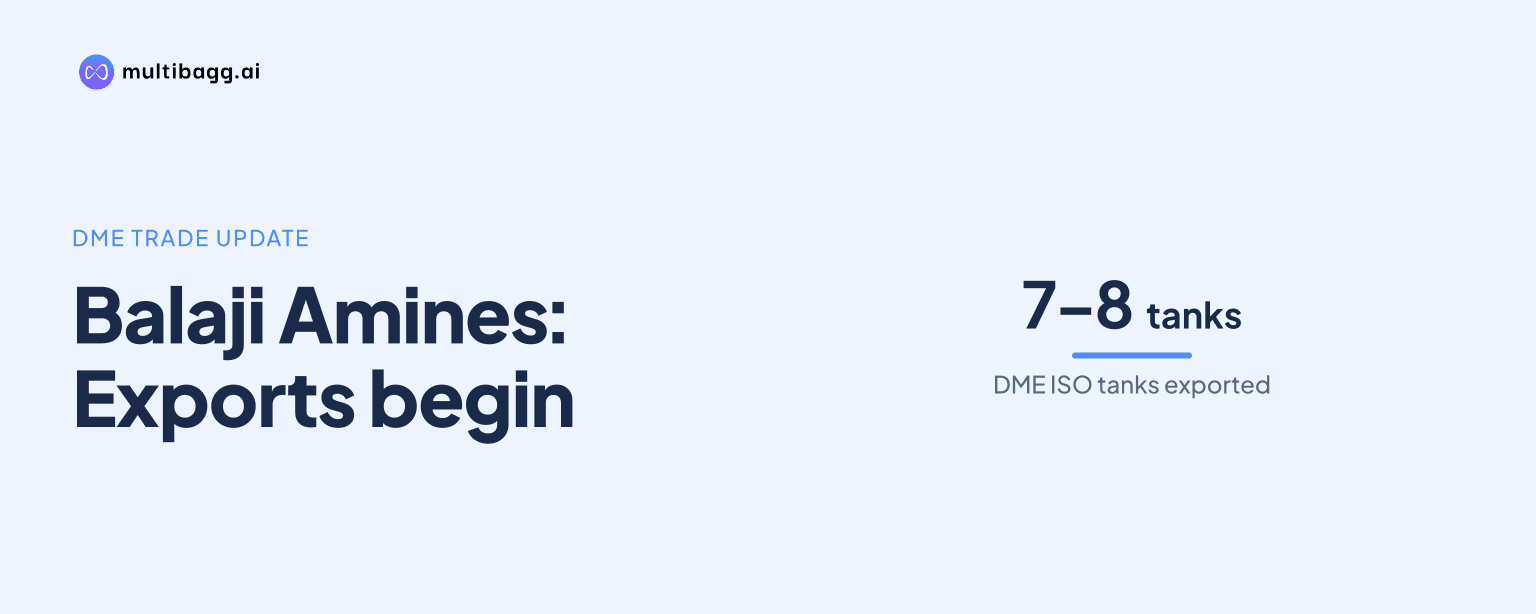
Balaji Amines Limited has begun commercial dimethyl ether, or DME, exports, shipping seven to eight bulk ISO tanks for aerosol applications, while domestic bulk sales for liquefied petroleum gas, or LPG, blending await road-tanker clearance and Bharat Petroleum Corporation Limited, or BPCL, receiving government approval. Management expects the tanker clearance within three to four weeks.
Know Balaji Amines inside out
Results, valuation, peers and who's buying, in one view.
How much DME has Balaji Amines exported?
Balaji Amines has exported about seven to eight bulk ISO tanks of DME for aerosol applications and is receiving repeat export orders, according to management. These shipments are commercial supplies, rather than only samples, and provide an initial outlet while the larger domestic LPG-blending channel remains pending.
Management confirmed that Balaji Amines is commercially supplying DME for aerosol-based applications. International sales can proceed because overseas markets already use DME and have the relevant approvals in place, management said. The disclosed export count establishes early commercial activity, although the call did not state the tonnage, revenue or profit from these shipments.
Domestic aerosol supplies are following a different route from exports. Balaji Amines said major aerosol manufacturers have received DME in cylinders for trials because cylinder approvals are already available. Once trials are completed, management said individual customers could receive 10 cylinders of 540 kilograms each, before any wider domestic bulk distribution develops.
What approvals remain for domestic DME bulk sales?
Balaji Amines needs final road-tanker approval for domestic bulk DME movement, while LPG blending additionally requires BPCL to obtain approval from the Government of India. Management said DME tanker-valve approval had been received from the PESO Nagpur office during the quarter after testing, and the remaining tanker approval was at an advanced stage.
Management expects road-tanker approval within three to four weeks. It said the valve approval had been the remaining prerequisite in the tanker process, but final clearance is still needed before domestic bulk supplies can begin. This makes the expected tanker decision distinct from BPCL's separate approval process for using DME in LPG blending.
Balaji Amines said its plant and BPCL's facility are in the same industrial area, about 1 kilometre to 1.5 kilometres apart. Management said bulk DME supplies for LPG blending could begin once BPCL receives government permission. The short distance may support local deliveries, but does not change the pending regulatory condition.
The company is also testing smaller domestic commercial uses. Management said it had given samples to local users for hotel cooking and industrial heating, alongside the aerosol-cylinder trials. No customer names, contracted volumes or dates for converting those samples into recurring domestic sales were disclosed on the call.
What DME utilisation does Balaji Amines expect next year?
Balaji Amines said DME utilisation could exceed 90% next year if BPCL obtains LPG-blending permission. Management estimated utilisation of 50% to 55% if that permission does not arrive, showing that the LPG route is expected to have a materially larger effect on plant loading than the initial commercial channels.
Without BPCL approval, management said exports and domestic aerosol business together could support at least 50% to 60% utilisation next year. It cited Indian aerosol consumption of more than 50,000 metric tonnes and said it was in discussions with several overseas customers. These are management estimates, rather than reported utilisation or confirmed orders.
Management also referred to a possible 70% to 80% share of the aerosol opportunity, but did not disclose customer contracts supporting that outcome. The range between 50% to 60% utilisation without the LPG channel and more than 90% with it highlights the unresolved role of BPCL's approval in the DME ramp-up.
Got a follow-up? Ask IRIS
What price and cost factors affect Balaji Amines DME rollout?
Balaji Amines said current DME pricing is about Rs 90 to Rs 100 per kilogram, reflecting elevated methanol prices. Management said DME would become more competitive against LPG if methanol prices fell below Rs 80 per kilogram, linking DME economics to a raw material whose price it described as affected by geopolitical conditions.
Management did not provide a DME margin, production cost or quarterly revenue contribution at the Rs 90 to Rs 100 per kilogram pricing range. It said methanol prices were high because of the current geopolitical situation, meaning both DME realisations and its relative competitiveness against LPG can change with raw-material prices.
The pricing discussion came as Balaji Amines reported consolidated sales volume of 24,491 metric tonnes in Q2 FY27. That was up from 21,587 metric tonnes in Q1 FY27, a sequential increase of about 13.5%, but below 26,165 metric tonnes in Q2 FY26, a decline of about 6%.
How does DME fit Balaji Amines FY27 commercialisation plan?
Balaji Amines is commercialising DME alongside its expanded acetonitrile facility as part of its FY27 product rollout. Management said the immediate priorities for the DME and acetonitrile lines were customer development, operational stabilisation and progressively scaling commercial volumes.
The acetonitrile plant began commercial production during the quarter and has expanded capacity of 1,440 metric tonnes per month. Management expected it to reach full operating flow in two to three weeks and said it could produce at least 1,000 to 1,200 metric tonnes a month from December, subject to market acceptance.
The two launches face different ramp-up conditions. Acetonitrile was described as a production and customer-acceptance ramp-up, while DME requires further transport clearance and, for the LPG opportunity, BPCL's government approval. Management did not separately disclose DME volume within Q2 FY27 sales across amines, amines derivatives and specialty chemicals.
Balaji Amines reported Q2 FY27 volumes of 6,525 metric tonnes in amines, 8,974 metric tonnes in amines derivatives and 8,992 metric tonnes in specialty chemicals. As DME was not disclosed as a separate segment, the seven to eight ISO-tank exports show commercial progress but do not yet quantify DME's contribution to quarterly sales or earnings.
Conclusion
Balaji Amines has moved DME into commercial export sales with seven to eight bulk ISO tanks supplied for aerosol use and repeat orders reported. Domestic customer trials in 540-kilogram cylinders provide additional routes, but the larger potential LPG-blending channel remains dependent on approvals outside the company's direct control.
The next matters to watch are the road-tanker approval management expects within three to four weeks, the outcome of domestic aerosol trials and BPCL's government approval process for LPG blending. Management's utilisation outlook ranges from 50% to 60% without the BPCL route to more than 90% if it is approved, making these milestones central to the next phase of DME commercialisation.