










Balaji Specialty Chemicals puts brownfield products into January
Key highlights
- BSCL expects Unit-1 brownfield products to enter the market from January after staged modifications.
- Unit-2 products could be available from January, but equipment delays may push them to February or the first week of March.
- BSCL alternated about 10 to 15 days of Unit-1 production with 10 to 15 days of modification work.
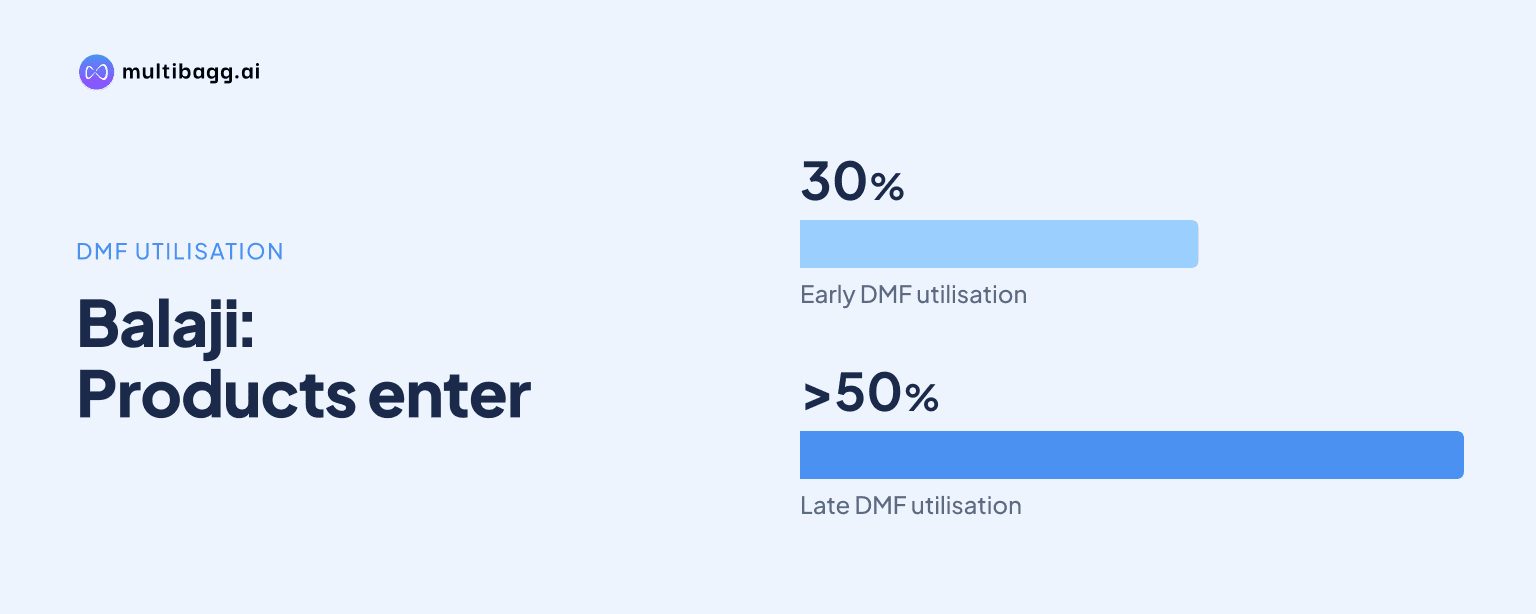
- BSCL said DMF utilisation increased from about 30% to 40% to more than 50%.
powered by IRIS
Balaji Specialty Chemicals expects Unit-1 brownfield products to reach the market from January after alternating 10 to 15 days of production with 10 to 15 days of modifications. BSCL said this approach retained sales during available demand, while Unit-2 products could slip to February or the first week of March if equipment logistics are delayed.
Know Balaji Amines inside out
Results, valuation, peers and who's buying, in one view.
Why did BSCL move the Unit-1 brownfield timeline?
BSCL moved the Unit-1 timeline because it chose to continue manufacturing during the modification programme rather than close the plant completely. Management said a chemical plant cannot ordinarily undertake manufacturing and expansion work together, so it ran Unit-1 for roughly 10 to 15 days before using another 10 to 15 days for brownfield work. A full shutdown, management said, could have completed the work by July or August but would have eliminated plant sales during that period.
An analyst said the expected completion date had moved from July-end, discussed during a June 5 site visit, to October-end on an August 21 call, and then to the end of the financial year in a press release. Management said the changing timetable reflected the decision to respond to market demand rather than follow a continuous shutdown plan. It added that BSCL reported a quarterly profit despite the interrupted production schedule.
Management said only small equipment erections remained at Unit-1 and that these required one or two further work cycles. The plant was in a modification stop, was due to restart manufacturing on the 15th of the month, and would then run until the 10th. BSCL planned a full finishing phase from December 10 to month-end, after which brownfield products should enter the market from January if work proceeds as planned.
How is BSCL retaining sales during the brownfield work?
BSCL is retaining market participation by producing for part of each modification cycle instead of giving up all sales for a quicker project completion. Management said it was balancing two stated objectives: remaining present with customers and completing the plant modifications. The 10-to-15-day operating and modification pattern is therefore the mechanism behind the later January availability date.
The decision coincided with improved operating conditions in selected products. BSCL said dimethylformamide, or DMF, utilisation rose from about 30% to 40% previously to more than 50%, while ethylenediamine, or EDA, was running at about 50% to 60%. Management said DMF basic prices were above Rs 110 to Rs 115, creating an opportunity to keep supplying the market while Unit-1 work continued.
Management did not present those market conditions as permanent. It said it was booking orders carefully because volatile raw-material prices made future input costs uncertain. Management cited methanol at around Rs 61 to Rs 62, against what it described as a normal range of Rs 26 to Rs 30, and ammonia at about Rs 85 to Rs 90, compared with Rs 45 to Rs 50 in normal conditions.
Got a follow-up? Ask IRIS
When could BSCL launch Unit-2 products?
BSCL said Unit-2 products could be available from January if equipment arrives normally, but one or two delayed items could move the timing to February or the first week of March. Management identified logistics obstructions affecting equipment in the pipeline as the risk, rather than citing a change to the disclosed project scope.
The analyst noted that a few Unit-2 products had earlier been expected by December-end. Management's updated response was conditional: both Unit-1 and Unit-2 could be in the commercial phase from January if deliveries proceed normally. Unit-2 therefore carries a wider timing range than Unit-1, where management said only limited equipment erection work remained.
Management grouped both projects within its plan to close all expansions and capital investment by the end of the current financial year. From the first quarter of the following financial year, it said the emphasis would shift to capacity utilisation. Management said plants could reach 80% to 90% utilisation for one product or another, which is an expectation rather than a reported outcome.
What else must happen in BSCL’s expansion plan?
BSCL’s broader expansion plan also depends on ramping up acetonitrile and dimethyl ether, or DME, alongside the brownfield projects. Management said acetonitrile could reach full operating momentum within two to three weeks, with installed capacity of 1,440 metric tonnes a month. From December, subject to market acceptance, it expected output of at least 1,000 to 1,200 metric tonnes monthly.
For DME, BSCL said pending Petroleum and Explosives Safety Organisation, or PESO, road-tanker approval was expected within three to four weeks after valve approval was completed. If Bharat Petroleum Corporation receives government approval for liquefied petroleum gas, or LPG, blending, management said DME could operate above 90% capacity in the following year. Without that approval, it projected 50% to 55% utilisation, supported by aerosol sales and exports.
BSCL said it had exported about seven to eight DME ISO tanks for aerosol applications and sold about 20 to 25 cylinders to domestic aerosol and commercial users. Separately, management said a battery-electrolyte customer’s requests for dimethyl carbonate and propylene carbonate had risen from prior discussions of 20 to 60 tonnes to 500 to 1,000 tonnes. It expected to be able to deliver 500 to 1,000 tonnes from the following month, but said it would wait for customers to come on stream before committing to more carbonate capacity.
Management said its Rs 3,500 crore to Rs 4,000 crore revenue aspiration for 2028-29 depended on acetonitrile, DME, DMF, N-Methyl Morpholine, and subsidiary greenfield and brownfield expansions. It said these capacities were expected to come in place by 2028-29, including calculations at current prices even if prices decline. That range is management’s medium-term aspiration, not guidance for the current financial year.
Conclusion
BSCL has accepted a slower Unit-1 modification schedule to preserve production and sales while management sees an opportunity in current demand and prices for products including DMF and EDA. The resulting trade-off puts Unit-1 brownfield products into the market from January, while Unit-2 remains dependent on equipment deliveries and could enter commercial operations as late as the first week of March.
The next disclosed milestones are Unit-1’s December 10-to-month-end finishing work, delivery of pending Unit-2 equipment, and the expected three-to-four-week PESO road-tanker approval process for DME. Management also expects all expansion and capital-investment work to close by the end of the current financial year before focusing on plant utilisation in the following financial year.