










Balaji recovers 85%-90% of production costs pre-release
Key highlights
- Balaji says its previous six movies recovered an average 85%-90% of production costs before release.
- Balaji plans to make 4-6 films a year with an average ticket size of Rs 60-75 crore.
- Balaji lists 4 theatrical-release films and 4 projects under production.
- Balaji reports a digital order book of more than Rs 350 crore with leading OTT platforms.
powered by IRIS
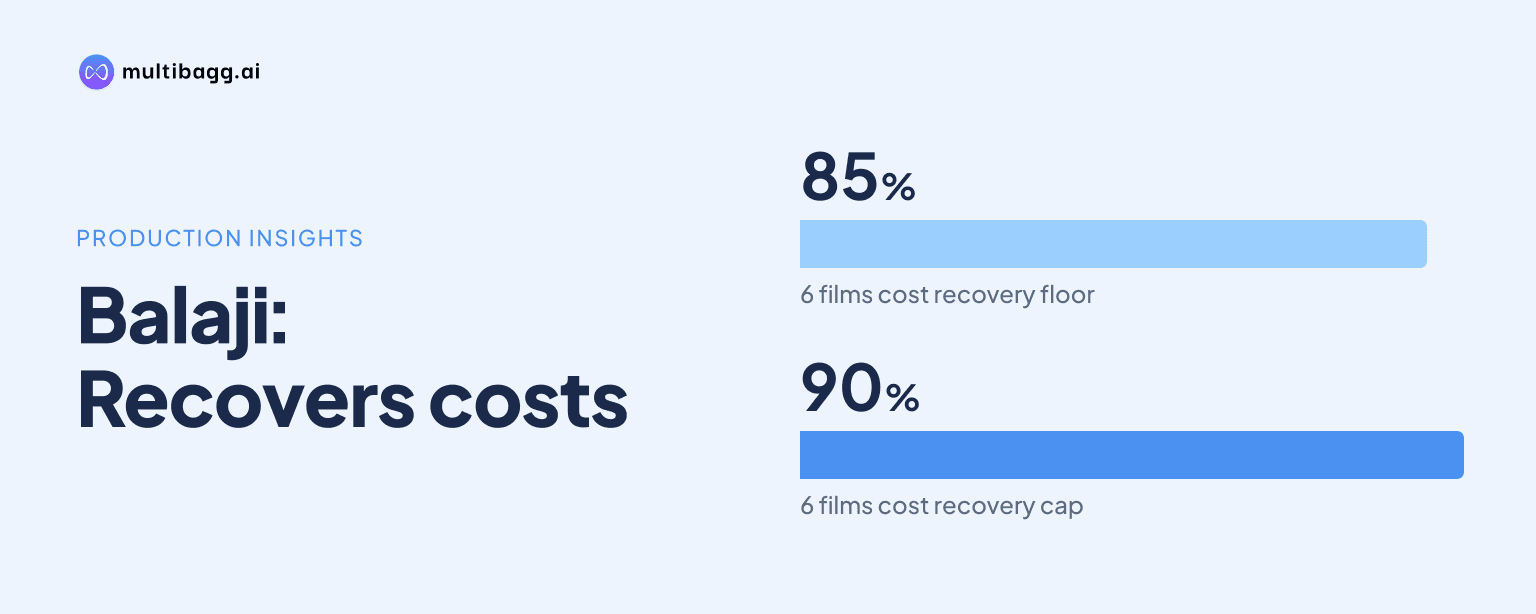
Balaji Telefilms Ltd. says it recovered an average 85%-90% of production costs before release across its previous six movies by selling rights in advance, a model supporting its stated plan to make 4-6 films a year with an average ticket size of Rs 60-75 crore.
Know Balaji Telefilms inside out
Results, valuation, peers and who's buying, in one view.
How does Balaji recover film costs before release?
Balaji recovers a large part of a film’s cost before theatrical release by selling rights before the movie reaches audiences. Management says this structure recovered an average 85%-90% of production cost across the previous six movies. The company identifies pre-sale proceeds from platform owners as a mechanism that reduces the working-capital requirement associated with film production.
The remaining part of the economics is not specified in the presentation, so the 85%-90% figure should be read as an average recovery level rather than a statement that every film recovers the same amount. Balaji also identifies monetisation of music rights as part of the model. The design shifts a meaningful portion of revenue collection to the pre-release period, while theatrical release remains a separate stage in a film’s commercial life.
What is Balaji’s planned annual film production scale?
Balaji’s stated vision is to produce 4-6 movies a year, with an average ticket size of Rs 60-75 crore per film. At the low and high ends of those disclosed ranges, this implies a potential annual production-ticket range of Rs 240-450 crore if the full planned slate is made at the stated average-ticket boundaries. That calculation is an illustration from management’s ranges, not company revenue or spending guidance.
The production plan is paired with a focus on creating intellectual property, or IP, that can support sequels. This differs from a strategy confined to individual theatrical releases because the company explicitly links owned IP to future sequel opportunities. Balaji also says it has a strong pipeline of films under production, providing the project base for the planned 4-6-movie annual slate rather than describing the target as a one-time release schedule.
Which Balaji films are released and under production?
Balaji identifies four theatrical-release titles and four projects under production, so the number of named films is the same at both stages, although their commercial status differs. The theatrical-release group includes The Sabarmati Report, which the company says was released in November 2024, and Vrushabha, a multilingual Pan-India film starring Mohanlal that it says was released in December 2025.
The other two titles in the theatrical-release group are Bhooth Bangla, starring Akshay Kumar and directed by Priyadarshan, and Vvan, made with TVF and starring Sidharth Malhotra and Tamannaah Bhatia. Balaji’s listing separates these four released films from the four under-production projects, showing a pipeline that extends beyond completed theatrical titles.
The under-production slate comprises Ragini 3, starring Tamannaah Bhatia and Junaid Khan; Hero ki Herroin, starring Yashvardhan Ahuja and directed by Sajid Khan; Heer Ranjha, starring Rohit Saraf with Imtiaz Ali as creative director; and Obsessive Lover, starring Janhvi Kapoor and Sree Leela. This is a change in project stage, not an indicated change in slate size: Balaji lists four films as released and four as under production.
Got a follow-up? Ask IRIS
How do Balaji’s television and digital businesses support its content pipeline?
Balaji places the film strategy within a broader TV and digital content operation rather than presenting movies as its only production business. In television, 2 shows contributed 85 production hours in Q2 FY27, and the presentation says overall demand for TV content remained stable. The listed running shows for Jiostar India Private Ltd are Kyunki Saas Bhi Kabhi Bahu Thi 2 and a capsule show described as “Because relationships too change forms.”
In digital, Balaji reports an order book of more than Rs 350 crore with leading over-the-top, or OTT, platforms. It says Lock Upp has been released on Netflix, while Kohinoor Season 1 and Pact of Silence are in the pipeline and an Amazon show is in development. The Rs 350 crore-plus order book concerns digital platform work, whereas the Rs 60-75 crore figure is the stated average ticket size for each planned film, separating the scale measures for the two segments.
Balaji’s digital plan also includes a shift from subscription video on demand, or SVOD, to a hybrid SVOD and advertising video on demand, or AVOD, model. It has launched AstroGuide, which recorded 2.5 lakh downloads in 24 hours, and Kuting, a platform for vertical short episode-based content. The company also cites YouTube content using IP it owns, regional distribution including ETV and Aha, advertiser-funded programmes, and business-to-business free ad-supported streaming television, or FAST, channels that redeploy library assets.
What does the pre-sale model mean for Balaji’s film strategy?
Balaji’s disclosed model means the film business is designed to collect rights revenue before release rather than relying solely on box-office performance after release. The 85%-90% average recovery across six movies is the central evidence for that design, while pre-sales to platform owners are the stated working-capital mechanism. Music-rights monetisation provides another named revenue stream within the same film framework.
The approach also connects with the company’s stated objective of making IP that can produce sequels. A 4-6-film annual target, four named projects under production and four named theatrical titles indicate that Balaji is seeking continuity of output across genres and audiences. The presentation does not disclose film-by-film recovery rates, rights-sale values, release dates for every project, or the remaining 10%-15% cost-recovery sources.
Conclusion
Balaji’s film proposition is a pre-sale-led production model: it says rights sold before release enabled average cost recovery of 85%-90% across its last six movies. That model sits alongside a stated annual ambition of 4-6 films at Rs 60-75 crore each, an equal count of four listed released and four under-production titles, and digital work with an order book above Rs 350 crore.
The next items to watch are execution of the four under-production films, including Ragini 3, Hero ki Herroin, Heer Ranjha and Obsessive Lover, and whether the company delivers its planned 4-6 movies a year. Management’s digital plans also point to upcoming milestones around Kohinoor Season 1, Pact of Silence, the Amazon show in development, and expansion of the hybrid SVOD and AVOD model.