










Balaji Telefilms Ltd. targets 4-6 films, pre-sells 85-90% costs
Key highlights
- Balaji Telefilms reports average pre-release recovery of 85-90% of production costs across its previous six movies.
- Balaji Telefilms targets 4-6 movies a year with an average ticket size of Rs 60 crore to Rs 75 crore.
- Balaji Telefilms lists four under-production films: Ragini 3, Hero ki Herroin, Heer Ranjha and Obsessive Lover.
- Balaji Telefilms says two television shows generated 85 production hours in Q2 FY27.
powered by IRIS
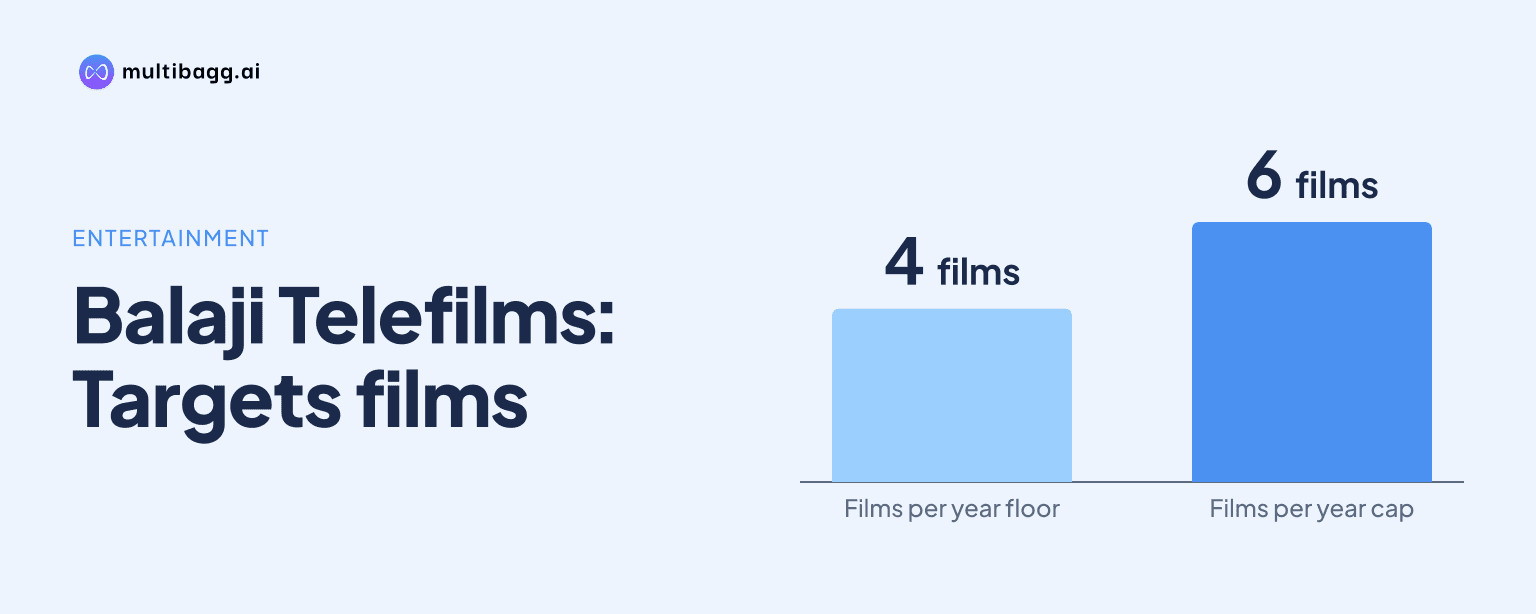
Balaji Telefilms says pre-release rights sales recovered an average 85-90% of production costs across its previous six movies, supporting its stated plan to make 4-6 films a year with an average ticket size of Rs 60 crore to Rs 75 crore. The presentation also lists four films under production.
Know Balaji Telefilms inside out
Results, valuation, peers and who's buying, in one view.
How does Balaji Telefilms reduce film-release risk?
Balaji Telefilms reduces film-release risk by selling rights before a movie is released, recovering an average 85-90% of production costs before release across its previous six movies. The company presents this pre-sale model as the central mechanism of its film business, shifting a large part of cost recovery to the period before a theatrical release.
Balaji Telefilms says proceeds from pre-sales to platform owners help reduce working-capital requirements, while monetisation of music rights provides another revenue stream. The presentation does not identify the individual rights sold, platform owners, or proceeds by title. It also does not disclose how the remaining 10-15% of costs were recovered for the previous six movies.
The 85-90% figure is a historical average for six movies rather than a forecast for every future release. Balaji Telefilms does not provide a year-by-year comparison of this recovery rate, individual movie budgets, or profitability data. The disclosed model therefore establishes the claimed pre-release recovery mechanism but not title-level economics.
What film volume and ticket size is Balaji Telefilms targeting?
Balaji Telefilms has set out a vision of producing 4-6 movies in a year, with an average ticket size of Rs 60 crore to Rs 75 crore. The presentation does not define ticket size or allocate the stated range among individual films, so it represents a production plan rather than disclosed budgets for named projects.
The annual plan differs from the reported 85-90% recovery measure in both period and purpose. The 4-6-film figure is forward-looking, while the 85-90% figure covers the previous six movies. Balaji Telefilms does not say whether films made under the planned annual slate have already achieved comparable pre-release recoveries.
Balaji Telefilms also says it is focused on creating intellectual property, or IP, that can support more sequels. No numerical sequel target is disclosed. The company describes its pipeline as spanning genres and targeting audiences in domestic and international markets, while presenting the pre-sale model as a way to support revenue stability.
The film strategy sits alongside television production. Balaji Telefilms says two television shows contributed 85 production hours in Q2 FY27, or the second quarter of financial year 2027. That production-hours measure is not comparable with the target of 4-6 films a year, but it shows that the company’s disclosed content operation covers both television and movies.
Got a follow-up? Ask IRIS
Which Balaji Telefilms films are listed as theatrical releases?
Balaji Telefilms lists The Sabarmati Report, Vrushabha, Bhooth Bangla and Vvan as theatrical released movies. The presentation says The Sabarmati Report, starring Vikrant Massey and Raashii Khanna, was released in November 2024 and received a favourable audience response.
Vrushabha is described as a multilingual pan-India film starring Mohanlal and released in December 2025. For Bhooth Bangla, Balaji Telefilms identifies Akshay Kumar and credits Priyadarshan as director on one page. Its theatrical-release table instead uses the name “Priyadarshini”, so the supplied presentation contains inconsistent director naming.
For Vvan, Balaji Telefilms identifies TVF and names Siddharth Malhotra and Tamannaah Bhatia in its theatrical-release table. A separate page styles the film as VVAAN, gives it the subtitle Force of the Forest, and identifies TVF Motion Pictures. The presentation gives no release date, box-office figure, pre-sale value or profit figure for Bhooth Bangla or Vvan.
The slate is split evenly between four titles classified as theatrical releases and four projects classified as under production. The Sabarmati Report and Vrushabha have stated release months, November 2024 and December 2025 respectively, while the presentation provides no release dates for the under-production slate. This comparison shows disclosed release status, rather than financial performance by film.
Which Balaji Telefilms projects are under production?
Balaji Telefilms lists Ragini 3, Hero ki Herroin, Heer Ranjha and Obsessive Lover as under-production projects. The presentation names Tamannaah Bhatia and Junaid Khan for Ragini 3, Yashvardhan Ahuja and director Sajid Khan for Hero ki Herroin, and Rohit Saraf with Imtiaz Ali as creative director for Heer Ranjha.
Obsessive Lover is listed with Janhvi Kapoor and Sree Leela. Balaji Telefilms does not disclose production budgets, completion dates, release dates, distribution arrangements or pre-sale proceeds for any of the four projects. As a result, the source supports their inclusion in the pipeline but not their expected financial contribution.
An earlier project page uses some different titles and status descriptions. It calls Ragini 3 “Ragini MMS 3”, spells Hero ki Herroin as “Hero Ki Horroin”, and says Heer Ranjha is “filming soon”. The later table groups all four projects as under production, including Obsessive Lover, which does not appear on the earlier project page.
The differing descriptions mean the four projects should not be assumed to be at identical production stages. In particular, “filming soon” for Heer Ranjha indicates a stage that may differ from a completed shoot, although the later table places it within the under-production group. Balaji Telefilms has not linked any of these titles to its historical 85-90% pre-release recovery average.
Conclusion
Balaji Telefilms presents a movie model centred on selling rights before release, reporting average recovery of 85-90% of production costs across its previous six movies. That historical measure accompanies a plan for 4-6 films a year at an average ticket size of Rs 60 crore to Rs 75 crore, with four theatrical-release titles and four projects listed as under production.
The next disclosed items to watch are progress on Ragini 3, Hero ki Herroin, Heer Ranjha and Obsessive Lover, particularly because the presentation gives no release dates, production budgets or pre-sale values for them. Balaji Telefilms’ stated plan also makes future disclosures on the 4-6-film annual slate and whether pre-release recoveries remain within the reported 85-90% historical range relevant.