










Balaji Telefilms Ltd. retains IP in 200-episode YouTube deal
Key highlights
- Balaji retains IP and creative control for five original YouTube shows comprising 200 episodes.
- Balaji reported more than 11 million YouTube subscribers, with 650,000 added in the prior 2 to 3 months.
- Balaji disclosed an OTT order book of more than Rs 350 crore with leading platforms.
- Standalone Q2 FY27 income from operations was Rs 181.1 crore, versus Rs 48.8 crore in Q2 FY26.
powered by IRIS
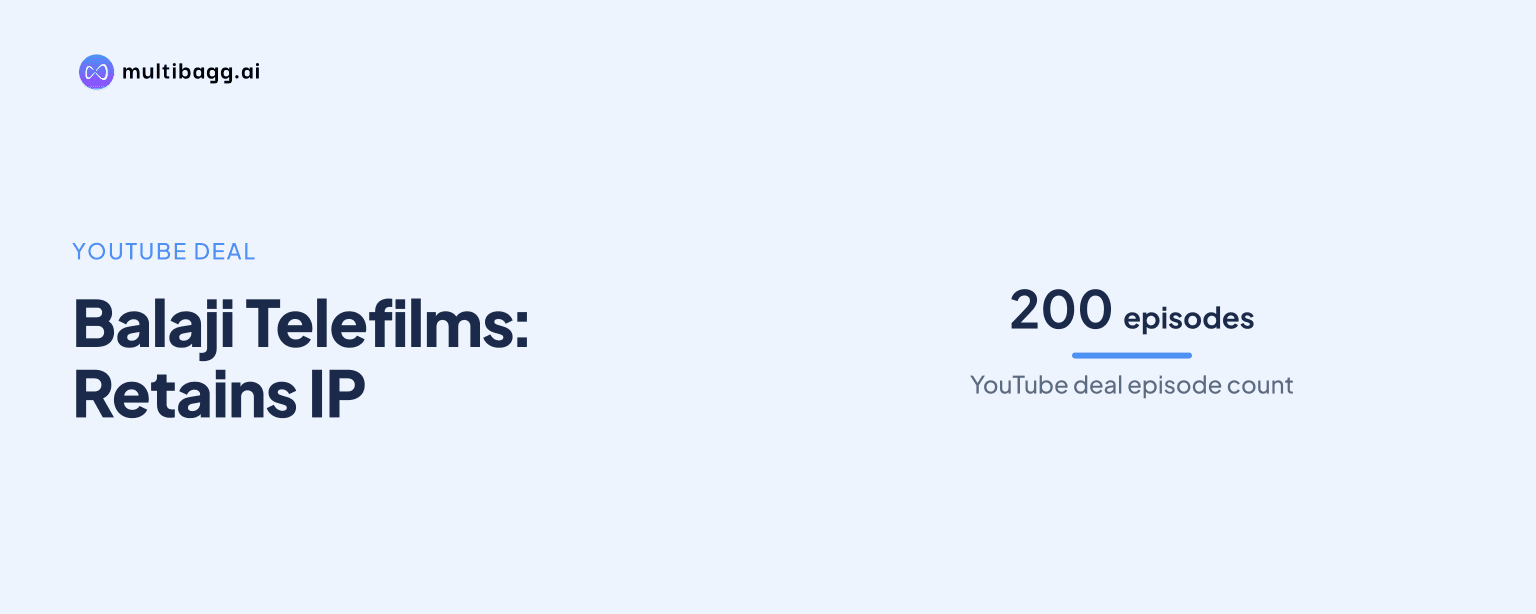
Balaji Telefilms Ltd. said in its FY27 investor presentation that it will retain intellectual property and creative control in a YouTube arrangement for five original shows and 200 episodes, while YouTube distributes and monetises the content through advertising and brand partnerships. Balaji cited more than 11 million subscribers.
Know Balaji Telefilms inside out
Results, valuation, peers and who's buying, in one view.
What does Balaji's YouTube collaboration cover?
Balaji's YouTube collaboration covers five original shows and 200 episodes for audiences in India and around the world. The presentation does not name the five programmes, specify their genres, give release dates or disclose the duration of the arrangement. It places the partnership within Balaji 3.0, the company's strategy phase beginning in 2026.
The 200-episode commitment makes the agreement a multi-show slate rather than a single-title release. Balaji reported more than 11 million YouTube subscribers when the presentation was prepared, including 650,000 subscribers added over the prior two to three months. The company identifies that existing channel audience as the distribution base for the planned originals.
Balaji's wider digital overview identifies YouTube and Meta as channels for growing its digital and subscriber base through curated long-form fiction and non-fiction. The same overview reports more than 10 million followers, more than 1.8 million downloads and an active subscriber base of more than 100,000. The presentation does not disclose the overlap, if any, between the 11 million-plus YouTube subscribers and those other measures.
Who controls the shows and how will YouTube monetise them?
Balaji retains intellectual property, or IP, and creative control, while YouTube provides distribution and monetisation through advertising and brand partnerships. The disclosed structure separates ownership and editorial authority over five shows from the platform's role in reaching viewers and generating advertising-linked income.
The presentation identifies Balaji, rather than YouTube, as the holder of IP and creative control for the 200 episodes. It does not disclose revenue-sharing percentages, minimum guarantees, production budgets, exclusivity provisions, advertising rates, brand-partnership commitments or rights outside YouTube. Without those terms, expected revenue per show or episode cannot be calculated from the presentation.
The arrangement differs from a rights-transfer model because Balaji explicitly says it keeps both IP and creative control. It also differs from a subscription-only release because YouTube's stated monetisation methods are advertising and brand partnerships. The deck does not say whether any of the five shows will also appear on subscription video on demand, or SVOD, services, or advertising video on demand, or AVOD, services.
Got a follow-up? Ask IRIS
How does YouTube fit Balaji's hybrid digital plan?
YouTube is part of Balaji's stated shift from SVOD to a hybrid SVOD-plus-AVOD model, alongside a plan to focus more closely on content for which it owns IP. Management says the shift is intended to increase the business-to-consumer subscriber base and subscription-based revenue, while the YouTube plan includes revised existing content and new content made specifically for the platform.
The five-show agreement sits alongside other disclosed digital projects. Balaji said Lock Upp had been released on Netflix, while Kohinoor S1 and Pact of Silence were in the pipeline and an Amazon show was in development. It also reported an order book of more than Rs 350 crore with leading over-the-top, or OTT, platforms, without allocating that figure among Netflix, Amazon, YouTube or individual programmes.
Balaji separately lists advertiser-funded programmes, defined as branded content produced on behalf of corporates. That activity is related to, but not described as identical to, YouTube brand partnerships. Management expects multifold top-line growth from online channels, primarily through content diversification, but did not give a revenue target, timeline or forecast for the five-show YouTube collaboration.
The digital plan also includes products serving formats other than the planned 200-episode slate. AstroGuide, Balaji's astrology application, recorded 2.5 lakh downloads within 24 hours of launch, while Kutingg was launched for vertical short episode-based content. The presentation places YouTube within its long-form fiction and non-fiction content curation strategy.
What reported results and pipeline figures provide context?
Balaji reported standalone income from operations of Rs 181.1 crore in Q2 FY27, compared with Rs 48.8 crore in Q2 FY26, while profit after tax was Rs 34.9 crore against a Rs 4.4 crore loss. These are company-level financial results rather than disclosed income from YouTube, and the presentation does not attribute any Q2 FY27 revenue or profit to the five-show arrangement.
For H1 FY27, income from operations rose to Rs 421.4 crore from Rs 121.6 crore in H1 FY26, and profit after tax moved to Rs 51.3 crore from a Rs 9.7 crore loss. The period-on-period improvement provides financial context for the broader content strategy, but it cannot establish the commercial contribution of YouTube because the deck provides neither YouTube revenue nor a partnership start date.
Balaji's FY27-to-FY31 content pipeline lists more than 10 shows on YouTube, alongside more than 25 OTT series, more than 500 micro-dramas, more than 30 movies and more than 15 television shows. The five originals in the YouTube collaboration are consistent with that planned output, although the presentation does not identify which of the 10-plus YouTube projects comprise the announced 200 episodes.
Conclusion
Balaji has disclosed a model in which it retains IP and creative control for five original YouTube shows comprising 200 episodes, while YouTube handles distribution, advertising and brand-partnership monetisation. The structure supports management's stated hybrid SVOD-plus-AVOD direction and uses a channel that had more than 11 million subscribers, without transferring the identified creative rights to the platform.
The next disclosures to watch are the titles, release timetable and commercial terms for the five shows, none of which are specified in the presentation. Balaji's stated FY27-to-FY31 pipeline includes more than 10 YouTube shows, while the wider plan includes an OTT order book of more than Rs 350 crore, Kohinoor S1 and Pact of Silence in the pipeline, and an Amazon show in development.