










Balaji maps FY27-FY31 pipeline of 580-plus content projects
Key highlights
- Balaji’s FY27-FY31 pipeline exceeds 580 projects, including 500-plus micro-dramas.
- Balaji disclosed an OTT-platform order book of more than Rs 350 crore.
- Two Balaji TV shows contributed 85 production hours in Q2 FY27.
- AstroGuide recorded 2.5 lakh downloads within 24 hours of launch.
powered by IRIS
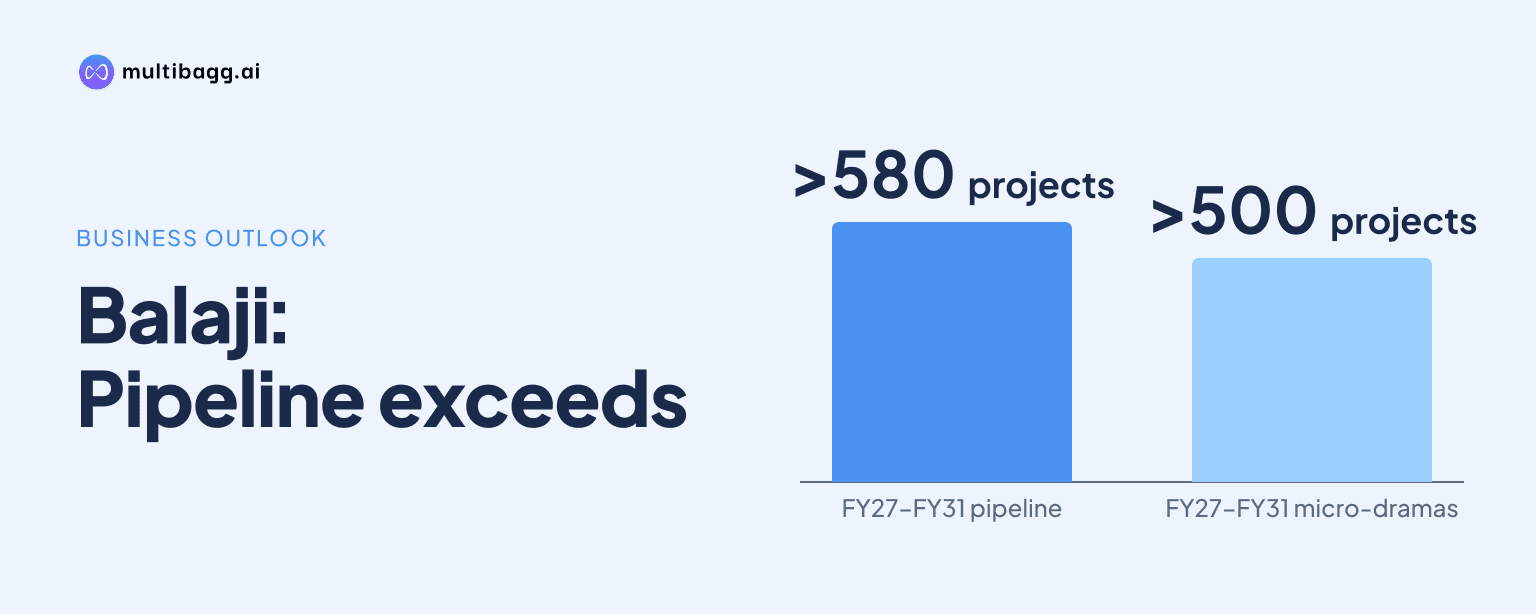
Balaji Telefilms Ltd. has outlined a FY27-FY31 content pipeline of more than 580 projects, led by 500-plus micro-dramas, alongside 30-plus movies, 25-plus OTT series, 15-plus television shows and 10-plus YouTube shows. The plan positions short-form output at the centre of Balaji’s integrated content-studio model.
Know Balaji Telefilms inside out
Results, valuation, peers and who's buying, in one view.
What is Balaji’s FY27-FY31 content pipeline?
Balaji’s stated FY27-FY31 pipeline comprises 30-plus movies, 15-plus TV shows, 25-plus OTT series, 500-plus micro-dramas and 10-plus shows on YouTube. Taken together, the disclosed minimum volumes exceed 580 projects over FY27-FY31. Micro-dramas account for more than 86% of that minimum count, making vertical short episodes the largest defined output category.
The pipeline is presented under “Balaji 3.0”, which describes Balaji as an integrated content studio for the new age. The company frames the model as a content flywheel, moving from current releases to a diversified slate. Its presentation says the pipeline is built to support sustained output across formats, rather than relying only on theatrical movies or conventional television commissions.
How does Balaji plan to connect films and television?
Balaji says movies will lead while television anchors the studio, with one production platform behind both businesses. In movies, it describes a pipeline spanning genres and targeting domestic and international audiences, alongside what it calls a de-risked model intended to provide revenue stability. The disclosed movie slate of 30-plus titles is twice the 15-plus TV-show pipeline for FY27-FY31.
Television remains an operating base within that strategy. Balaji reported that two shows generated 85 production hours in Q2 FY27: Kyunki Saas Bhi Kabhi Bahu Thi 2 and the capsule show Kyunki rishton ke bhi roop badalte hain, both listed with Jiostar India Private Ltd. The company says it will use its prime-time presence through new and existing shows, while overall demand for TV content remains stable.
The wider movie roster shows projects and releases identified in the presentation. The Sabarmati Report, starring Vikrant Massey and Raashii Khanna, was released in November 2024, while Vrushabha, a multilingual Pan India film starring Mohanlal, was released in December 2025. Ragini 3, Hero ki Herroin, Heer Ranjha and Obsessive Lover are listed as under production, while Bhooth Bangla and Vvan appear in the theatrical released-movies panel.
What role will OTT and the amalgamation play in Balaji’s plan?
OTT is a 25-plus-series component of Balaji’s FY27-FY31 slate, supported by an order book of more than Rs 350 crore with leading OTT platforms. Balaji identifies Lock Upp as released on Netflix, lists Kohinoor S1 and Pact of Silence in the pipeline, and says an Amazon show is in development. The order book is the largest specifically quantified revenue-related item disclosed alongside the digital plan.
Balaji also proposes amalgamating ALT and MFPL with Balaji. Management says the purpose is to consolidate content-production operations, improve operational efficiencies and solidify market dominance. The presentation does not disclose a completion date, transaction terms or financial effects of the amalgamation.
The digital approach extends beyond subscription video-on-demand, or SVOD. Balaji says it is shifting toward a hybrid model that combines SVOD with advertising video-on-demand, or AVOD, with the stated aim of expanding its business-to-consumer subscriber base and subscription revenue. It also plans advertiser-funded programmes, under which it produces branded content for corporates, creating a revenue mechanism separate from platform commissioning.
Got a follow-up? Ask IRIS
Why are micro-dramas and YouTube central to Balaji’s strategy?
Micro-dramas are central because Balaji has set a 500-plus target for FY27-FY31, compared with 30-plus movies and 25-plus OTT series. The company has launched Kutingg as a platform for vertical, short episode-based content. That target indicates that the planned volume of short-form projects exceeds the combined disclosed minimum pipeline of movies, TV shows, OTT series and YouTube shows by more than six times.
Balaji also plans 10-plus YouTube shows and says it is increasing focus on YouTube for content where it owns intellectual-property rights. Its measures include reorganising existing content and making new content specifically for YouTube. This focus is tied to ownership: Balaji identifies its ability to own stories as part of the integrated-studio proposition, rather than describing YouTube merely as a distribution outlet.
The company has added other direct digital products. AstroGuide, its astrology app, recorded 2.5 lakh downloads within 24 hours of launch. Balaji says content will target streaming audiences and wider audiences, including regional-language platforms such as ETV and Aha, and management expects multifold top-line growth from online channels primarily through content diversification. The presentation provides no quantified revenue forecast or timing for that expectation.
What market data does Balaji cite for its digital plan?
Balaji’s presentation places its plan against India’s media and entertainment market, which it sizes at Rs 2.78 lakh crore in 2025, up 9% year on year. It projects the market at Rs 3.3 lakh crore by 2028, with a compound annual growth rate above 7% and new media expected to contribute more than half of total revenue. Digital media revenue exceeded Rs 1 lakh crore in 2025, the first media and entertainment segment to cross that level.
The subscription figures show a marked change between 2024 and 2025. Paid OTT video subscriptions rose from 111 million across 47 million subscribing households in 2024 to 216 million subscriptions across 143 million households in 2025. Digital subscription revenue rose 60% to Rs 1.63 lakh crore in 2025, while digital advertising grew 26% to Rs 9.47 lakh crore and represented 63% of total advertising revenue.
Online video audiences also expanded, though at a slower rate than the paid-subscription count. India had 572 million online video viewers in 2025, up 4%, or 22 million, from 551 million in 2024. Connected-TV users rose 85% year on year to 129 million in 2025, while regional-language content represented 56% of all digital content produced that year. These data points align with Balaji’s stated plans for regional programming, streaming releases and short-form mobile content.
Conclusion
Balaji’s blueprint is defined by volume across formats, with 500-plus micro-dramas forming the largest element of a 580-plus minimum FY27-FY31 pipeline. Movies, television and OTT remain material parts of the slate, while Kutingg, YouTube and advertiser-funded programmes broaden the company’s stated routes to audiences and revenue.
The next items to watch are execution against the more than Rs 350 crore OTT order book, releases including Kohinoor S1 and Pact of Silence, development of the Amazon show, and progress on the proposed ALT and MFPL amalgamation. Management’s expected multifold online-channel top-line growth depends on content diversification, but the presentation does not provide a quantified target or timetable for that outcome.