










Behari Lal Engineering targets next-year ICDP and HSS launch
Key highlights
- Behari Lal Engineering expects ICDP and HSS roll production to begin next financial year, subject to commissioning.
- Q2 FY27 revenue rose 21.7% year-on-year to Rs 154.2 crore and profit after tax rose 27.7% to Rs 17.4 crore.
- High-value products accounted for 62.9% of Q2 FY27 revenue, compared with 57.8% in FY26.
- The September 30, 2026 order book was Rs 179.4 crore, representing about three to four months of execution.
powered by IRIS
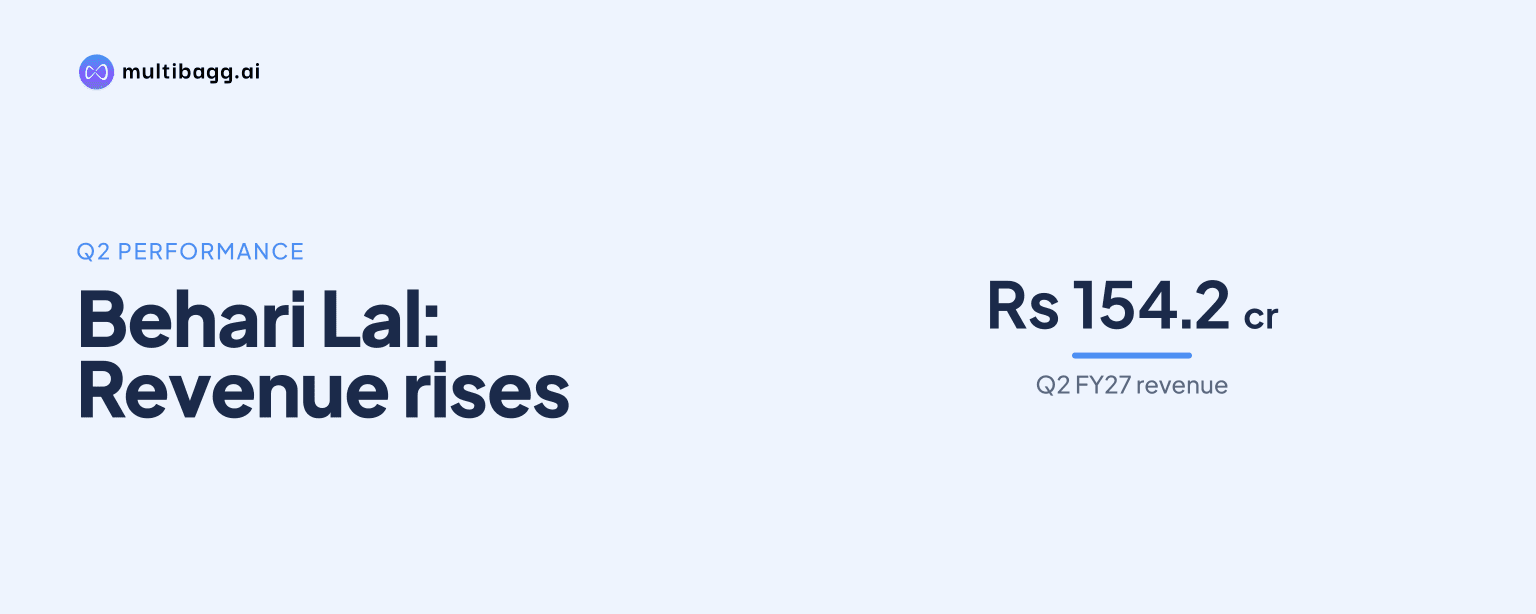
Behari Lal Engineering Limited expects its third unit to start ICDP and HSS roll production next financial year, subject to construction and commissioning, after reporting Q2 FY27 revenue of Rs 154.2 crore, up 21.7% year-on-year. Management said the proposed import-substitute lines have generated numerous customer inquiries and trial lots would follow the start of production.
Know Behari Lal Engineering inside out
Results, valuation, peers and who's buying, in one view.
When will Behari Lal Engineering launch ICDP and HSS rolls?
Behari Lal Engineering expects ICDP and HSS roll production to begin next year, with management indicating the first half of the next financial year as a possible timeframe. The third unit was under construction during the Q2 FY27 call for the quarter ended September 30, 2026, and management did not give a precise commissioning date or FY27 financial guidance.
Behari Lal Engineering said construction was progressing at full speed and that it was assessing the required technologies for the specialised roll lines. The company has raised its single cast-piece size from 20 metric tonnes to 25 metric tonnes, while the new unit forms part of its wider move toward higher-value products and engineered applications.
ICDP means Indefinite Chilled Double Poured roll, which management described as a centrifugally cast product requiring specialised technology. Behari Lal Engineering said both ICDP and HSS rolls are currently imported into India and that it is among the first domestic companies investing in these categories, although it did not disclose planned production capacity.
What customer demand does Behari Lal Engineering see for the new rolls?
Behari Lal Engineering said it has received numerous inquiries for ICDP and HSS rolls, but it did not disclose confirmed customer orders for the new lines. Management said customers were asking for an early plant start, citing demand from rolling mills and steel plants as steel capacity expands in India.
Behari Lal Engineering plans to send initial trial lots as soon as production begins. Management expects repeat orders within one or two months of those trials, but this is a management expectation rather than an order-backed sales forecast. Commercial sales will therefore depend on completion of the third unit, customer trials and product qualification.
The company said its strategy focuses on import substitutes and highly engineered, made-to-order products. Behari Lal Engineering already supplies about 10% to 12% of India’s normal-category metal-roll demand, according to management, and said its relationships with steel plants could help it secure trial orders for the ICDP line.
How could domestic ICDP and HSS production affect margins?
Behari Lal Engineering expects domestic manufacture of ICDP and HSS rolls to increase margins by reducing import-related costs, but management did not quantify the potential improvement. It cited freight and other landed costs for imported products, which it said can move with global trade conditions, as a reason domestic supply could offer a cost advantage.
The company’s existing mix indicates why it is pursuing specialised categories. High-value products accounted for 62.9% of Q2 FY27 revenue, compared with 60.4% in Q1 FY27 and 57.8% in FY26. Management identified the higher-value mix as the principal reason margins held up despite firmer scrap and alloy prices during the September quarter.
Q2 FY27 EBITDA margin, including other income, was 17.9%, up from 17.2% in Q2 FY26 but down from 19.6% in Q1 FY27. Management attributed the sequential decline to higher scrap and alloy costs, a two-to-three-month lag before selling prices reset, and a more favourable product and customer mix in the June quarter. It said realisations could improve in the next quarter but provided no numerical forecast.
Got a follow-up? Ask IRIS
What do Behari Lal Engineering’s results and funding position show?
Behari Lal Engineering reported Q2 FY27 revenue from operations of Rs 154.2 crore, up 21.7% from Rs 126.6 crore in Q2 FY26, while profit after tax rose 27.7% to Rs 17.4 crore. Management attributed revenue growth to volume and richer mix rather than price, while Q2 profit before tax was Rs 23.4 crore and depreciation was Rs 3.8 crore.
For H1 FY27, revenue rose 19.9% to Rs 305.8 crore and EBITDA, including other income, increased 25.1% to Rs 57.4 crore. H1 profit after tax increased 26% to Rs 36.6 crore, while the EBITDA margin rose to 18.8% from 18.0% in H1 FY26. These figures compare with the Q2 margin of 17.9%, reflecting the input-cost and pricing lag cited by management.
At September 30, 2026, Behari Lal Engineering had repaid all term loans and held Rs 114.6 crore in cash and bank balances, with net worth of Rs 427.3 crore. Of Rs 93 crore of fresh issue proceeds, Rs 30.4 crore had been used and Rs 62.6 crore remained unutilised, mainly in bank deposits pending capital expenditure and operating requirements.
The order book was Rs 179.4 crore at the end of September 2026, which management said represented roughly three to four months of execution. H1 FY27 cash generated from operations was Rs 16.9 crore, compared with Rs 1.8 crore a year earlier, while inventory increased by Rs 23.6 crore to cover confirmed orders amid higher raw-material prices. Management expects inventory to normalise from the next quarter.
Conclusion
Behari Lal Engineering’s planned ICDP and HSS line extends its stated focus on specialised, import-substitute products and a higher-value revenue mix. The operating business showed that shift in Q2 FY27, when high-value products represented 62.9% of revenue and revenue rose 21.7% year-on-year to Rs 154.2 crore, despite higher scrap and alloy costs.
The next disclosed milestone is commissioning of the third unit, which management expects next financial year and suggested could occur in its first half. Investors will be watching the timing of initial trials, management’s expectation of repeat orders within one or two months after trials, deployment of Rs 62.6 crore of unutilised issue proceeds, and whether selling-price resets improve realisations after the Q2 pricing lag.