










BLEL rolls and castings deliver 47.3% of Q2 FY27 revenue
Key highlights
- Metal rolls and engineering castings contributed 47.3% of BLEL’s Q2 FY27 product revenue.
- The two product categories represented about 24% of physical sales volume, excluding job work.
- Alloy steel products remained BLEL’s largest Q2 FY27 category at 49.9% of revenue.
- Automotive represented 38.8% of Q2 FY27 revenue, down from 55.6% in FY24.
powered by IRIS
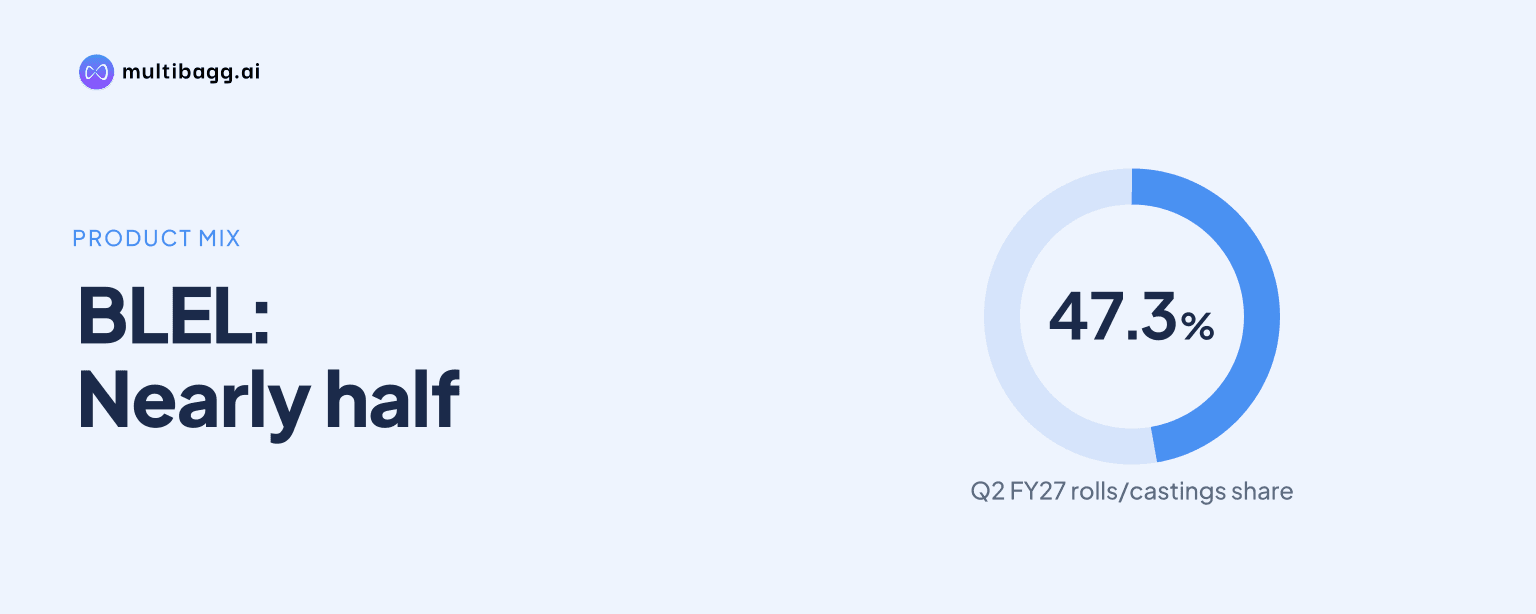
Behari Lal Engineering Limited (BLEL) reported that metal rolls and engineering castings supplied 47.3% of Q2 FY27 product revenue while representing about 24% of physical sales volume, excluding job work. The difference reflects BLEL’s disclosed focus on higher-value consumables, CNC-machined castings and specialty grades alongside alloy steel products.
Know Behari Lal Engineering inside out
Results, valuation, peers and who's buying, in one view.
How much revenue do BLEL’s rolls and castings generate?
BLEL’s metal rolls and engineering castings generated 47.3% of Q2 FY27 product revenue, excluding job-work revenue. Metal rolls contributed 26.6% and engineering castings 20.7%, leaving their combined share only 2.6 percentage points below alloy steel products at 49.9%.
BLEL describes rolls and castings on its product-portfolio page as representing about 24% of physical sales volume and about 46% of total revenue, both excluding job work. The Q2 FY27 revenue-mix page provides the more specific combined revenue figure of 47.3%. BLEL does not disclose individual sales tonnage or revenue per tonne for either vertical.
Why do BLEL’s rolls and castings account for more revenue than volume?
BLEL attributes the mix to its move toward high-value consumables and specialty grades, supported by ladle refining, vacuum degassing, heat treatment and computer numerical control, or CNC, machining. Facility 1 at Village Salani includes a 150-metric-tonne heat-treatment furnace and CNC machining capacity exceeding 20,000 metric tonnes per annum.
Metal rolls are recurring mill consumables that BLEL says wear out every five to 10 weeks in steel mills. Its range includes alloy cast steel, Adamite, graphite steel, spheroidal graphite iron, indefinite-chill and forged rolls, as well as indefinite chilled double pour, or ICDP, and high-speed steel, or HSS, grades. BLEL says it holds 10% to 12% of India’s roll demand, citing CRISIL.
Engineering castings are custom consumables exposed to abrasion and frequent replacement, according to BLEL. The company supplies fully CNC-machined, ready-to-assemble parts rather than only raw castings, including crusher jaw plates, mantles, bowl liners, cement mill liners, thermal-power nozzle-ring segments and bearing housings. Its process can produce no-bake sand castings of up to 25 metric tonnes in a single piece.
How does BLEL’s Q2 FY27 revenue mix compare across markets?
BLEL’s Q2 FY27 product mix was concentrated in alloy steel, metal rolls and engineering castings, which together represented 97.2% of revenue. While alloy steel was the largest individual vertical at 49.9%, rolls and castings together contributed 47.3%; forging ingots and forged shafts accounted for 1.0% and other products for 1.8%.
The end-user mix changed from FY24, when automotive represented 55.6% of revenue. Automotive accounted for 38.8% in Q2 FY27, down 16.8 percentage points, while infrastructure, engineering industrial equipment and aggregate-crusher manufacturers together contributed 55.4%.
BLEL reported domestic revenue of 94.9% and export revenue of 5.1% in Q2 FY27. It exports precision castings and rolls to 24 countries across five continents and holds One Star Export House recognition from the Directorate General of Foreign Trade, or DGFT. The presentation identifies ready-to-assemble engineering castings as supporting exports but does not split export revenue by product.
Got a follow-up? Ask IRIS
What is BLEL changing within its alloy-steel business?
BLEL is retaining alloy steel as its largest reported category while rotating standard alloy-bar volume toward valve steel and tool-and-die steel. The company states that valve steel carries a price premium of more than 2.5 times standard alloy bars and tool-and-die steel carries an approximately 105% premium; it does not disclose Q2 FY27 volumes or realised prices for these products.
BLEL lists F9, F11, F22, F91, 21-4N and 23-8N among its valve-steel grades, alongside H13 tool-and-die steel and creep-resistant steel for temperatures up to 650 degrees Celsius. These products serve automotive, oil-and-gas valves, refineries, railways, aerospace and defence, in addition to core bearing, spring, nitriding and stainless-steel grades.
At Unit 2, BLEL has a 15,000-metric-tonne-per-annum forging expansion under way. Its proposed in-house forging press is described as a project under process intended to remove job-work outsourcing and enable forged rolls and die blocks. BLEL gives no commissioning date, project cost or revenue target for either project.
What operating capability supports BLEL’s higher-value product mix?
BLEL operates two owned manufacturing units in Mandi Gobindgarh, Punjab, with a third unit under construction. Facility 1 combines a melt shop, heavy foundry, heat treatment and machine shop, while Facility 2 contains rolling mills and polymer quenching. The integrated setup supports four verticals: metal rolls, engineering castings, specialty alloy steel products, and forging ingots or forged products.
Facility 1 melting capacity rose from 35,589 metric tonnes in FY24 to 54,690 metric tonnes in FY26, while utilisation increased from 86% to 95%. For Q2 FY27, BLEL reported 13,481 metric tonnes of melting capacity and 89% utilisation. Rolling capacity remained 65,000 metric tonnes in FY24, FY25 and FY26, while utilisation moved from 86% in FY24 to 88% in FY25 and 82% in FY26.
BLEL says it uses 100% recycled steel scrap before induction melting, ladle refining and vacuum degassing. The refining process controls chemical composition and removes dissolved gases for valve, tool-and-die and boiler steels. It can also produce forging ingots of up to 15 metric tonnes and machine rolls and castings in a machine shop exceeding 100,000 square feet.
Conclusion
BLEL’s Q2 FY27 mix shows that metal rolls and engineering castings contributed 47.3% of product revenue despite representing about 24% of physical sales volume. Alloy steel remained the largest vertical at 49.9%, but the disclosed portfolio combines roll replacement demand, CNC-machined castings and premium specialty alloy grades.
Investors can watch execution of the 15,000-metric-tonne-per-annum forging expansion at Unit 2, progress on the in-house forging press and development of ICDP and HSS rolls. Management said in Q2 FY27 that its order book had reached Rs 179.4 crore and identified project completion and a higher share of value-added products as priorities for coming quarters.