










BLEL order book reaches Rs 179.4 crore, retention hits 75.4%
Key highlights
- BLEL's executable order book reached Rs 179.4 crore in Q2 FY27, up from Rs 102.4 crore in FY26.
- BLEL reported a 75.4% customer retention rate in Q2 FY27, compared with 63.0% in FY26.
- BLEL's metal rolls and castings revenue was Rs 70.9 crore in Q2 FY27, up from Rs 69.2 crore in Q1 FY27.
- BLEL's high-value product share rose to 62.9% in Q2 FY27 from 57.8% in FY26.
powered by IRIS
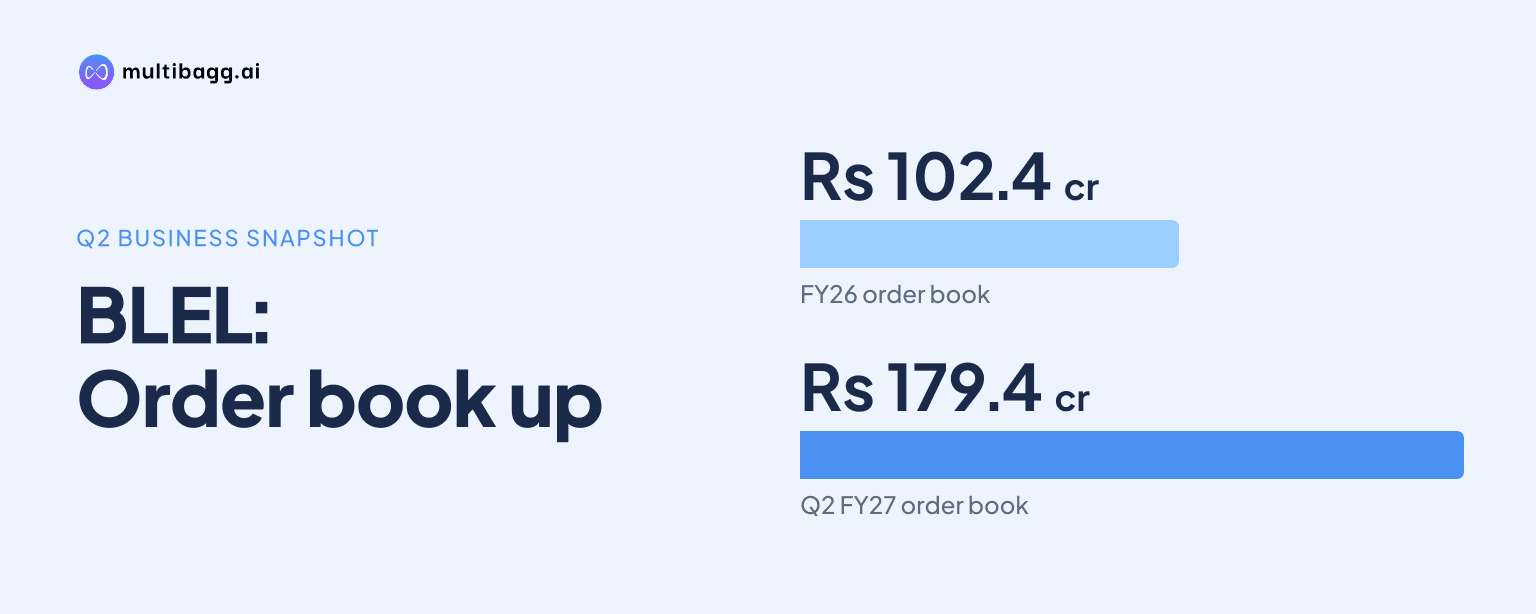
In Q2 FY27, Behari Lal Engineering Ltd. reported an executable order book of Rs 179.4 crore and a customer retention rate of 75.4%, compared with Rs 102.4 crore and 63.0%, respectively, in FY26. BLEL links the operating visibility to recurring metal rolls and engineering castings that require regular replacement.
Know Behari Lal Engineering inside out
Results, valuation, peers and who's buying, in one view.
What changed in BLEL's executable order book?
BLEL's executable order book increased to Rs 179.4 crore in Q2 FY27, up Rs 17.4 crore from Rs 162.0 crore in Q1 FY27 and Rs 77.0 crore from Rs 102.4 crore in FY26. The presentation labels the metric “Executable Order Book (Rs crore / MT)” but reports only monetary values, without an accompanying tonnage figure.
The Q2 FY27 balance was 10.7% higher than the Q1 FY27 balance, based on the reported values. It also exceeded Q2 FY27 revenue from operations of Rs 154.2 crore, although BLEL does not disclose the delivery schedule, cancellation conditions or revenue-recognition timing for the Rs 179.4 crore order book.
How did BLEL's customer retention rate change?
BLEL reported a customer retention rate of 75.4% in Q2 FY27, compared with 63.0% in FY26 and 63.4% in FY25. The Q2 FY27 measure was 12.4 percentage points above FY26, following a 0.4-percentage-point decline between FY25 and FY26.
BLEL's investment rationale separately describes 75.4% as repeat customer revenue, while its operational metrics table labels it customer retention rate. The presentation links the measure to metal rolls and crusher engineering plates, described as non-discretionary consumables with replacement cycles of five to 10 weeks and purchases funded from customers' operating expenditure budgets.
BLEL also cites an average relationship tenure of more than seven years with its top 10 clients. It says multi-year original equipment manufacturer, or OEM, qualifications for customers including Metso, Propel, JSW and SAIL support repeat business, though it does not provide retention data by customer or product line.
Which products support BLEL's recurring order flow?
BLEL identifies metal rolls and engineering castings as the principal recurring product lines behind its order visibility. Metal rolls and castings revenue was Rs 70.9 crore in Q2 FY27, compared with Rs 69.2 crore in Q1 FY27 and Rs 61.3 crore for the FY26 quarterly figure.
BLEL defines the FY26 rolls and castings figure as sales of those products divided by four quarters. On that basis, Q2 FY27 revenue was Rs 9.6 crore higher than the FY26 quarterly figure, while the high-value product share rose 5.1 percentage points from 57.8% to 62.9%.
Separately, BLEL says metal rolls and engineering castings accounted for 47.3% of product revenue in Q2 FY27. The presentation does not state that this product-revenue measure has the same denominator as the 62.9% high-value product share, but both metrics point to increased stated importance of the portfolio during Q2 FY27.
Got a follow-up? Ask IRIS
How is BLEL using its production network for demand shifts?
BLEL says its central melting operation routes liquid steel among metal rolls, engineering castings, specialty bars and forging ingots according to demand. When automotive-bar demand softened in FY26, BLEL says it redirected liquid metal to rolls, where sales rose 14.1% year on year, and castings, where sales rose 13.1% year on year.
Sales volume, including job work, was 22,527 metric tonnes, or MT, in Q2 FY27, compared with 22,095 MT in Q1 FY27. Realisation per MT, excluding job work, increased to Rs 96,588 from Rs 93,487 over the same two quarters.
Blended capacity utilisation was 88.2% in Q2 FY27, down from 90.5% in Q1 FY27 but above FY26's 87.7%. Steel melting shop and foundry utilisation was 89.1% in Q2 FY27, below both 94.0% in Q1 FY27 and 94.5% in FY26, showing that the volume increase occurred alongside lower melting utilisation than the prior quarter.
What expansion and market factors does BLEL disclose?
BLEL says it supplied 10% to 12% of India's metal-roll demand in FY26, citing CRISIL, and is adding roll capacity and grades including indefinite chill double-poured, or ICDP, rolls and high-speed steel, or HSS, rolls. Management describes domestic roll demand as growing at an 8% to 10% compound annual growth rate toward 132,000 to 160,000 MT by FY30, linked to steel capital expenditure.
BLEL also identifies import substitution as an opportunity, stating that India's roll imports increased from 39,000 units in FY20 to about 3.49 lakh units in FY26. The presentation says foreign rolls can be priced at up to four times domestic rates and that BLEL is commercialising ICDP and HSS rolls to substitute German, Japanese and Russian imports.
BLEL's disclosed capacity plans include machined-roll expansion at Unit 1, an additional 15,000 MT per annum of rolling and forging capacity at Unit 2, and Unit 3 under construction. Net initial public offering proceeds of Rs 82.67 crore are identified as funding for these projects and 3.0 megawatt-peak captive solar capacity, which would take solar capacity to 3.86 megawatt-peak; no commissioning dates are provided.
Conclusion
BLEL's Q2 FY27 data combine a Rs 179.4 crore executable order book with a 75.4% customer retention rate, compared with Rs 102.4 crore and 63.0% in FY26. The presentation attributes the visibility to frequently replaced industrial consumables, rising rolls and castings revenue, and the ability to redirect melting capacity among four product lines.
The next disclosures to watch are conversion of the Rs 179.4 crore order book, the durability of the 75.4% retention measure and utilisation after Q2 FY27 blended utilisation declined to 88.2%. BLEL also plans new roll capacity, 15,000 MT per annum of rolling and forging capacity at Unit 2, expanded solar capacity and Unit 3, but its presentation does not specify completion dates for those projects.