










JBIL spends Rs 1,112 crore; commissioning due Q4FY27
Key highlights
- JBIL spent the full Rs 1,112 crore revised capex outlay, including Rs 36 crore deployed in Q2FY27.
- Enhanced blast furnace, sinter and specialised ferro-alloy capacities are scheduled for commissioning by Q4FY27.
- JBIL completed DI pipe capacity expansion to 5.5 lakh TPA, while ferro-alloy capacity is expected to reach 1.9 lakh TPA.
- Net term debt declined to Rs 145 crore in H1 FY27 from Rs 169 crore in FY26.
powered by IRIS
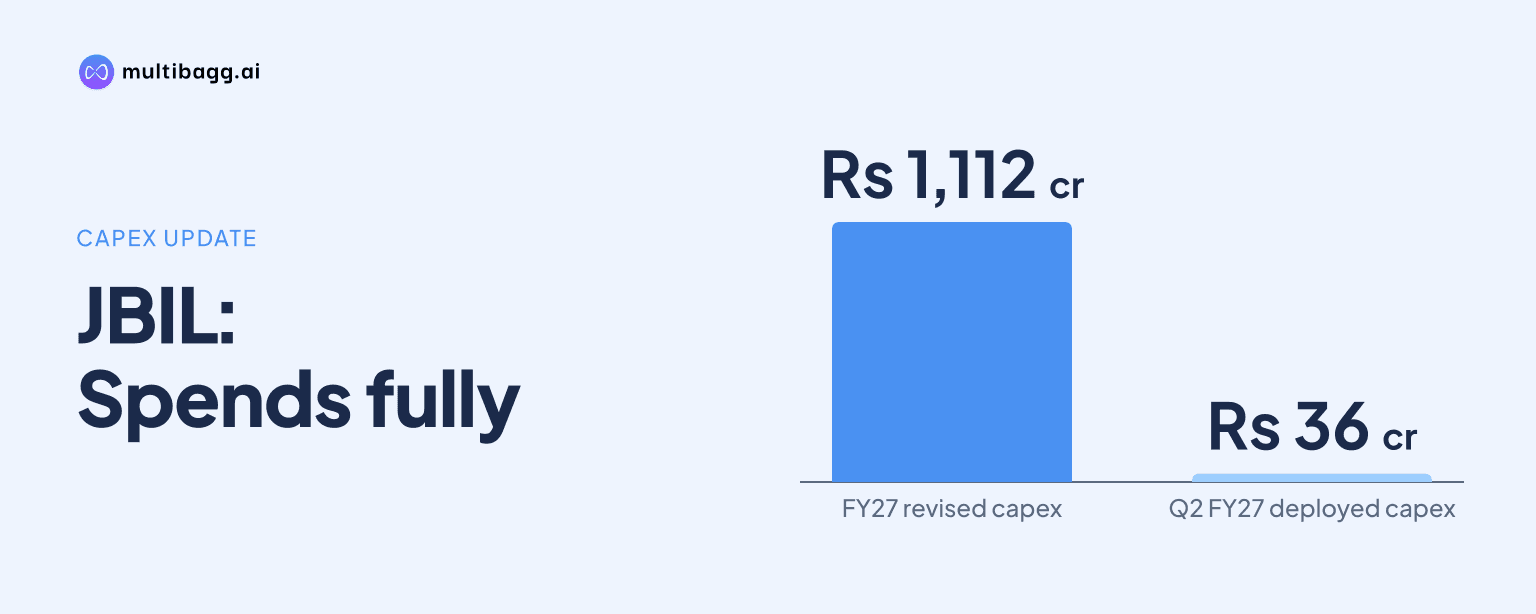
In Q2FY27, Jai Balaji Industries Ltd. said it had spent the full Rs 1,112 crore revised expansion outlay, mostly through internal accruals, with enhanced blast furnace, sinter and specialised ferro-alloy capacities scheduled for commissioning by Q4FY27. The company expects physical capex work to finish by the end of Nov 26.
Know Jai Balaji Industries inside out
Results, valuation, peers and who's buying, in one view.
What has JBIL completed under the Rs 1,112 crore expansion?
JBIL has completed spending under its revised Rs 1,112 crore expansion plan, but it had not yet described the enhanced blast furnace, sinter and specialised ferro-alloy facilities as operational in Q2FY27. The company had spent about Rs 1,076 crore before Q2FY27 and deployed the remaining Rs 36 crore during the quarter.
The revised programme increased from an initial outlay of Rs 1,000 crore to Rs 1,112 crore, a rise of Rs 112 crore. JBIL said capex work would be completed by the end of Nov 26, while commissioning of the expanded facilities was scheduled by Q4FY27. The presentation does not disclose tonnes-per-annum capacity figures for the blast furnace or sinter additions.
How did JBIL fund the expansion?
JBIL said the full Rs 1,112 crore capex had been funded mostly through internal accruals, identifying cash generated within the business as the principal source. The presentation does not state the exact rupee amount funded by internal accruals or identify the source of the remaining portion.
The capex funding update coincided with lower net term debt, which fell to Rs 145 crore in H1 FY27 from Rs 169 crore in FY26. Net term debt had been Rs 3,408 crore in FY21, meaning the H1 FY27 balance was Rs 3,263 crore lower than five years earlier. JBIL reported a FY26 net term debt-to-equity ratio of 0.06 times.
JBIL also disclosed sanctions of Rs 395 crore for a working-capital loan and Rs 137 crore from HDFC Bank for working-capital or term-loan facilities. The company said these facilities should support working-capital limits, lower costs and increased operations, rather than identifying them as the stated funding source for the Rs 1,112 crore expansion.
Which capacities will JBIL commission by Q4FY27?
JBIL expects enhanced blast furnace, sinter and specialised ferro-alloy capacities to be commissioned by Q4FY27. Separately, it said its ductile iron, or DI, pipe capacity expansion to 5.5 lakh tonnes per annum, or TPA, had been successfully completed, while ferro-alloy capacity is expected to increase to 1.9 lakh TPA.
DI pipes and specialised ferro alloys currently account for about 40% to 45% of JBIL revenue, according to the presentation. The company has five manufacturing units in West Bengal and Chhattisgarh, integrated greenfield steel manufacturing capacity of 1.1 million tonnes, and power capacity of 101.1 megawatts.
Near-term DI pipe demand remains an unresolved issue. Management said the DI pipe market was experiencing softness, although it expects the completed 5.5 lakh TPA capacity to support a utilisation ramp-up when demand improves. It cited Jal Jeevan Mission 2.0 and AMRUT 2.0 as government-led water-infrastructure initiatives that could support demand, without providing a volume or timing forecast.
Got a follow-up? Ask IRIS
What did JBIL report before the new capacity commissioning?
JBIL reported Q2FY27 revenue of Rs 1,652 crore, up 22% from Rs 1,353 crore in Q2FY26, before the planned Q4FY27 commissioning. Adjusted earnings before interest, tax, depreciation and amortisation, or EBITDA, rose 93% year on year to Rs 135 crore, while profit after tax, or PAT, rose 192% to Rs 77 crore.
Adjusted EBITDA margin rose to 8% in Q2FY27 from 5% a year earlier, while PAT margin increased to 5% from 2%. In H1 FY27, revenue reached Rs 3,335 crore against Rs 2,711 crore in H1 FY26, adjusted EBITDA rose to Rs 289 crore from Rs 176 crore, and PAT increased to Rs 162 crore from Rs 97 crore. JBIL attributed the improvement to volumes, realisations and operating efficiencies; adjusted EBITDA excludes non-cash items.
Operational trends varied across products in Q2FY27. Pig iron production rose to 137,000 tonnes from 131,000 tonnes and sales increased to 90,000 tonnes from 88,000 tonnes. DI pipe production increased to 37,000 tonnes from 35,000 tonnes and sales reached 41,000 tonnes from 34,000 tonnes, while ferro-alloy production rose to 36,000 tonnes from 35,000 tonnes but sales fell to 23,000 tonnes from 31,000 tonnes.
Conclusion
JBIL has moved its Rs 1,112 crore revised expansion from the spending phase into final project completion and planned commissioning. The outlay was Rs 112 crore above the initial plan and was funded mostly through internal accruals, while Q2FY27 revenue rose to Rs 1,652 crore and adjusted EBITDA reached Rs 135 crore before the new facilities are due to come on stream.
The next disclosed milestones are completion of capex work by the end of Nov 26 and commissioning of the blast furnace, sinter and specialised ferro-alloy enhancements by Q4FY27. Investors can also watch utilisation of the completed 5.5 lakh TPA DI pipe capacity, as management has identified near-term market softness despite citing water-infrastructure programmes as potential demand support.