










Jai Balaji Q2 FY27 PAT rises 192% as EBITDA margin reaches 9%
Key highlights
- Jai Balaji reported Q2FY27 PAT of Rs 77 crore, up 192% from Rs 26 crore in Q2FY26.
- Jai Balaji's Q2FY27 revenue rose 22% to Rs 1,652 crore and reported EBITDA margin increased to 9% from 5%.
- Jai Balaji's ferro-alloy realisation rose 51% year on year to Rs 2.02509 lakh per tonne in Q2FY27.
- Jai Balaji reported net term debt of Rs 145 crore at H1FY27, compared with Rs 169 crore at FY26.
powered by IRIS
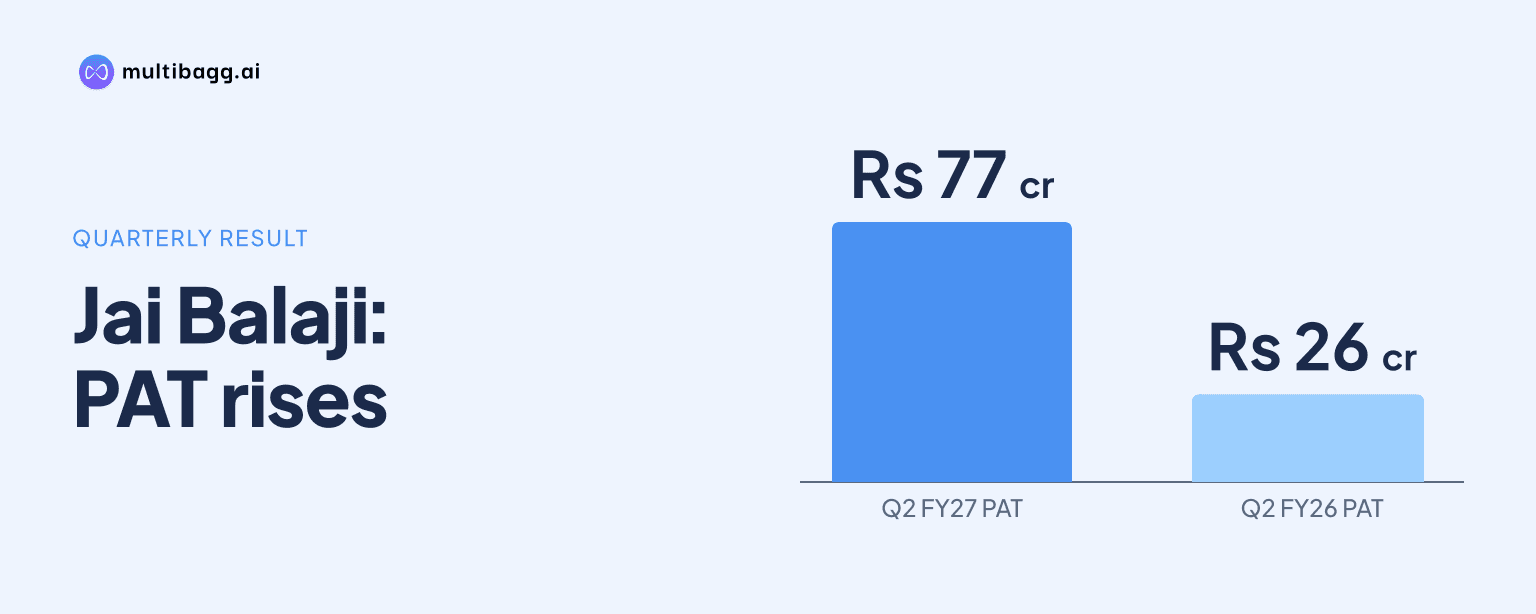
Jai Balaji Industries Limited reported profit after tax (PAT) of Rs 77 crore in Q2FY27, up 192% year on year, as revenue from operations rose 22% to Rs 1,652 crore and reported earnings before interest, tax, depreciation and amortisation (EBITDA) margin increased to 9% from 5%.
Know Jai Balaji Industries inside out
Results, valuation, peers and who's buying, in one view.
How did Jai Balaji perform in Q2FY27?
Jai Balaji increased revenue from operations to Rs 1,652 crore in Q2FY27 from Rs 1,353 crore in Q2FY26, while reported EBITDA rose 110% to Rs 147 crore from Rs 70 crore. The EBITDA margin expanded by four percentage points to 9%, although revenue was 2% below Rs 1,683 crore in Q1FY27.
PAT was Rs 77 crore, compared with Rs 26 crore a year earlier, and the PAT margin rose to 5% from 2%. PAT was 9% below Rs 85 crore in Q1FY27, while basic and diluted earnings per share were each Rs 0.85, compared with Rs 0.29 in Q2FY26 and Rs 0.93 in Q1FY27.
The sequential comparison shows that reported EBITDA and PAT margins remained at 9% and 5%, respectively, despite revenue declining by Rs 31 crore from Q1FY27. Reported EBITDA fell 5% from Rs 155 crore and PAT fell 9% from Rs 85 crore over the same period.
Why did Jai Balaji's profit grow faster than revenue?
Jai Balaji attributed its year-on-year revenue increase to improved realisations across key products and its profitability increase to operational efficiencies. Revenue grew 22%, while cost of goods sold increased 18% to Rs 1,156 crore from Rs 980 crore, alongside the reported EBITDA margin increase to 9% from 5%.
Employee benefits expense rose 20% to Rs 49 crore and other expenses increased 21% to Rs 314 crore. Depreciation was Rs 32 crore against Rs 31 crore in Q2FY26, while finance cost was Rs 15 crore in both periods, and profit before tax increased 150% to Rs 100 crore from Rs 40 crore.
Adjusted EBITDA, which Jai Balaji defines as adjusted for non-cash items, was Rs 135 crore in Q2FY27, up 93% from Rs 70 crore in Q2FY26 but below Rs 154 crore in Q1FY27. Its margin was 8%, compared with 5% a year earlier and 9% in the preceding quarter, distinct from reported EBITDA of Rs 147 crore.
Tax expense rose to Rs 22 crore from Rs 13 crore, while other income was Rs 14 crore against Rs 13 crore a year earlier. Other income was also higher than Rs 3 crore in Q1FY27, even as Q2FY27 operating revenue was 2% lower sequentially.
Which products supported Jai Balaji's Q2FY27 operating performance?
Jai Balaji recorded higher year-on-year production of pig iron, billets and TMT bars in Q2FY27, while ductile iron (DI) pipe production declined sequentially. Pig iron production reached 137,000 tonnes, compared with 131,000 tonnes in Q2FY26 and 132,000 tonnes in Q1FY27, while sales rose to 90,000 tonnes from 88,000 tonnes and 84,000 tonnes, respectively.
TMT production was 61,000 tonnes, up from 42,000 tonnes in Q2FY26 and 60,000 tonnes in Q1FY27. TMT sales increased to 56,000 tonnes from 41,000 tonnes a year earlier and 53,000 tonnes sequentially; Jai Balaji identified TMT, DI pipes, billets and pig iron as drivers of strong offtake.
Billet output was 51,000 tonnes, up from 40,000 tonnes in Q2FY26 and unchanged from Q1FY27, while sales were 15,000 tonnes against 14,000 tonnes a year earlier. Sponge iron production fell to 64,000 tonnes from 66,000 tonnes a year earlier and 72,000 tonnes sequentially, and sales declined to 44,000 tonnes from 50,000 tonnes and 46,000 tonnes.
DI pipe production was 37,000 tonnes, compared with 35,000 tonnes in Q2FY26 but below 41,000 tonnes in Q1FY27; sales were 41,000 tonnes against 34,000 tonnes and 44,000 tonnes. Ferro-alloy production was 36,000 tonnes, down from 40,000 tonnes sequentially, while sales fell to 23,000 tonnes from 25,000 tonnes.
Got a follow-up? Ask IRIS
How did Jai Balaji's product realisations change in Q2FY27?
Jai Balaji's largest disclosed year-on-year realisation increase was in ferro alloys, where realisation rose 51% to Rs 2.02509 lakh per tonne in Q2FY27 from Rs 1.34106 lakh per tonne in Q2FY26. The Q2FY27 figure was also above Rs 1.87642 lakh per tonne in Q1FY27 despite ferro-alloy sales declining sequentially to 23,000 tonnes.
Pig iron realisation rose 19% year on year to Rs 37,778 per tonne from Rs 31,838 per tonne, although it was below Rs 38,217 per tonne in Q1FY27. Higher pig iron sales of 90,000 tonnes and the year-on-year realisation increase align with Jai Balaji's statement that improved realisations supported revenue growth.
Other product trends were mixed. Sponge iron realisation was Rs 26,883 per tonne, close to Rs 26,935 per tonne in Q1FY27 and above Rs 25,526 per tonne a year earlier, while billet realisation was Rs 40,070 per tonne, below Rs 40,772 per tonne sequentially.
DI pipe realisation declined to Rs 56,587 per tonne from Rs 59,117 per tonne in Q2FY26 and Rs 57,581 per tonne in Q1FY27. TMT realisation was Rs 44,872 per tonne, compared with Rs 44,140 per tonne a year earlier and Rs 47,268 per tonne in Q1FY27.
What do Jai Balaji's H1FY27 results and capex plan show?
Jai Balaji reported H1FY27 revenue of Rs 3,335 crore, up from Rs 2,711 crore in H1FY26, while adjusted EBITDA increased to Rs 289 crore from Rs 176 crore. Adjusted EBITDA margin improved to 8% from 6%, and H1FY27 PAT rose to Rs 162 crore from Rs 97 crore, lifting the PAT margin to 5% from 4%.
The company said it had spent the entire Rs 1,112 crore revised capital-expenditure outlay, mostly through internal accruals, including Rs 36 crore in Q2FY27 for the project balance. Jai Balaji said the capex would be completed by the end of November 2026 and enhanced blast furnace, sinter and specialised ferro-alloy capacities were being commissioned by Q4FY27.
Net term debt was Rs 145 crore at H1FY27, down from Rs 169 crore at FY26 and Rs 221 crore at FY25. Jai Balaji also disclosed sanctions of a Rs 395 crore working-capital loan and Rs 137 crore from HDFC Bank as working-capital or term funding, which management said should help lower cost and support increased operations.
Conclusion
Jai Balaji's Q2FY27 result combined 22% revenue growth with a 110% increase in reported EBITDA and a 192% increase in PAT. The rise in reported EBITDA margin from 5% to 9% occurred alongside higher year-on-year pig iron and ferro-alloy realisations, while cost of goods sold grew more slowly than revenue.
The next disclosed milestones are completion of the Rs 1,112 crore capex programme by the end of November 2026 and commissioning of the expanded blast furnace, sinter and specialised ferro-alloy capacities by Q4FY27. Future disclosures can show the effect of those projects on volumes, realisations, margins and net term debt, which stood at Rs 145 crore at H1FY27.