










Jai Balaji Industries Limited Files Q1 FY27 Presentation
Key highlights
- JBIL filed its Q1 FY27 investor presentation on 14 August 2026 for the quarter ended 30 June 2026.
- JBIL stated an integrated ductile iron pipe capacity of 5.5 lakh tonnes per annum.
- JBIL reported historical Q3 FY24 EBITDA of Rs 246.80 crore, up 250.57% year-on-year.
- JBIL's nine-month FY24 EBITDA was Rs 665.46 crore, up 245.15% year-on-year.
powered by IRIS
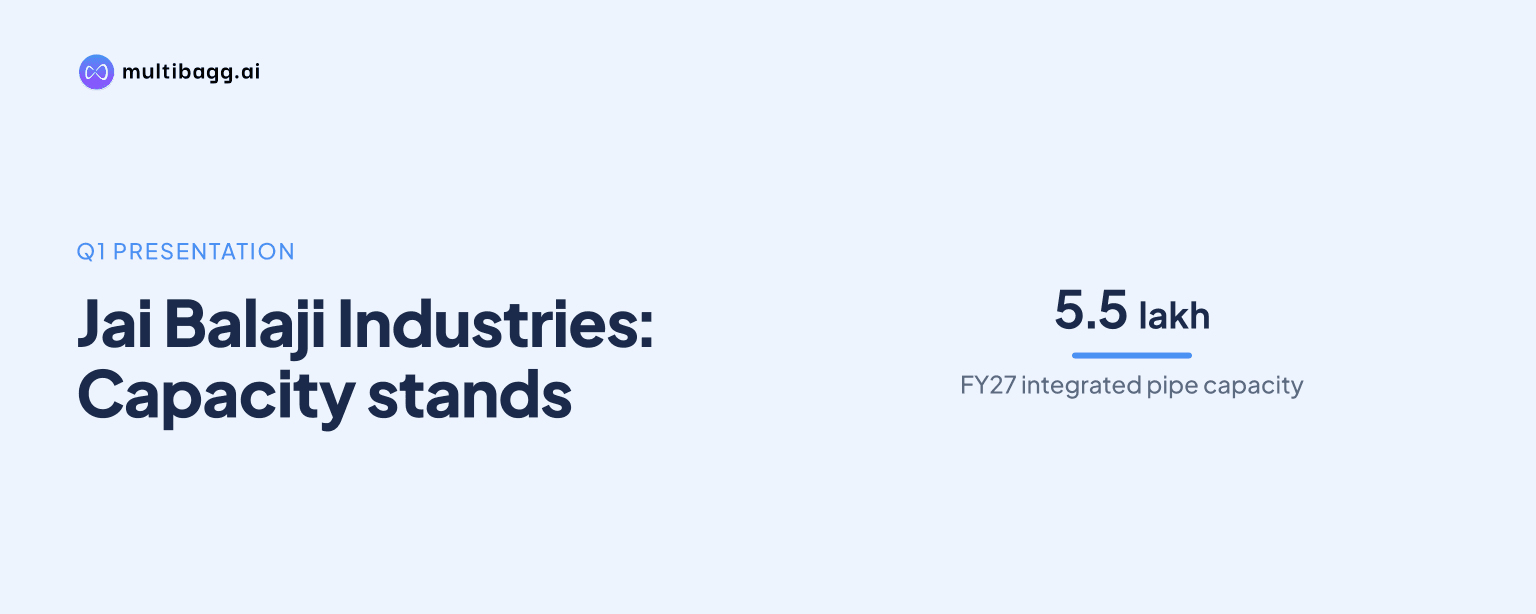
Jai Balaji Industries Limited filed its Q1 FY27 investor presentation on 14 August 2026 for the quarter ended 30 June 2026, highlighting its value-added products business and an integrated ductile iron pipe capacity of 5.5 lakh tonnes per annum. The filing matters because it formally updates exchange investors on JBIL's business positioning and management outlook.
Know Jai Balaji Industries inside out
Results, valuation, peers and who's buying, in one view.
What did JBIL disclose on 14 August 2026?
JBIL disclosed that it had shared its Q1 FY27 investor presentation with the stock exchanges under Regulation 30 of the Securities and Exchange Board of India Listing Obligations and Disclosure Requirements Regulations, 2015. The disclosure, dated 14 August 2026, relates to the quarter ended 30 June 2026 and was also stated to be available on the company website.
The investor presentation is a formal market communication rather than a separate financial result announcement in the material provided. It describes the company's business strategy, operating profile and future outlook. JBIL also disclosed an intimation regarding the schedule of analysts' and institutional investors' meetings, indicating its engagement with the investment community following the presentation.
What does the Q1 FY27 presentation say about JBIL's operations?
JBIL describes itself as one of the larger private-sector manufacturers of value-added products in eastern India, with a focus on ductile iron pipes and specialised ferro alloys. The presentation identifies these products as central to the company's operating strategy, alongside its integrated steel manufacturing base.
The supplied presentation extract cites an integrated ductile iron pipe capacity of 5.5 lakh tonnes per annum. It also refers to 1.1 MT in its business-at-a-glance section, although the extract does not clearly specify the exact capacity category associated with that figure. Therefore, the filing provides no basis to treat the 1.1 MT figure as a specific product capacity without the full underlying slide context.
JBIL has manufacturing operations across West Bengal and Chhattisgarh. Earlier company material described it as a fully integrated steel producer with four integrated manufacturing units in these states, while the August 2026 presentation highlights its presence in eastern India and its emphasis on higher-value products.
How was the presentation filed under market disclosure rules?
JBIL submitted the presentation pursuant to Regulation 30 of the SEBI Listing Regulations, which requires listed entities to disclose specified material events and information to stock exchanges. The company's letter to the National Stock Exchange of India stated that a copy of the investor presentation was enclosed with the filing.
The August 2026 disclosure follows the same regulatory route used by JBIL for earlier investor presentations. A July 2024 filing, for example, also referred to Regulation 30 and attached the company's Q1 FY25 investor presentation for market dissemination. Such presentations are intended to give investors management's stated view of operations, strategy and financial direction, but do not themselves constitute an offer or recommendation to purchase securities.
Got a follow-up? Ask IRIS
What is the financial and business background for JBIL?
JBIL's earlier disclosures show that its strategy has increasingly focused on value-added steel products, capacity utilisation and cost control. The company has previously identified ductile iron pipes and specialised ferro alloys as priority areas, rather than relying only on conventional steel products such as sponge iron, pig iron, TMT bars and alloy steel.
In its Q3 and nine-month FY24 communications, JBIL reported record operating performance. The company said quarterly EBITDA for the quarter ended December 2023 was Rs 246.80 crore, up 250.57% year-on-year, while EBITDA for the first nine months of FY24 was Rs 665.46 crore, up 245.15% year-on-year. The supplied material also stated that adjusted EBITDA and profit after tax for that quarter grew 96% and 7.4 times year-on-year, respectively.
Those historical figures should not be read as Q1 FY27 performance, because the August 2026 material supplied does not provide revenue, EBITDA, profit or volume figures for the June 2026 quarter. The current filing is significant primarily as an investor communication on business positioning and capacity, not as a detailed earnings release in the available text.
How does the filing matter for investors and the steel sector?
For investors, the filing provides a current management document to assess JBIL's focus on products that are positioned as value-added within the steel value chain. Ductile iron pipes are used in water supply and distribution networks, while specialised ferro alloys are inputs for particular steelmaking applications. The presentation's product emphasis therefore helps explain the company's stated effort to expand beyond commodity-oriented steel output.
The available announcement does not report a share-price reaction, a new capital expenditure amount, a revised guidance range or a fresh financial target. It also does not disclose Q1 FY27 earnings figures in the supplied text. Investors should consequently distinguish between the capacity and strategy information in the presentation and any later statutory results or exchange filings that may provide period-specific financial data.
For the broader industry, JBIL's communication reflects the importance of integration, product mix and operating efficiency among regional steel producers. Its earlier stated plans included increasing capacity and utilisation, reducing costs, adding green-power generation through new boilers, and becoming net debt free within 18 months. The August 2026 extract does not confirm progress against those earlier objectives, so their latest status remains dependent on subsequent company disclosures.
Conclusion
JBIL's 14 August 2026 filing formally placed its Q1 FY27 investor presentation before the market for the quarter ended 30 June 2026. The key disclosed operating message is the company's focus on ductile iron pipes and specialised ferro alloys, supported by a stated 5.5 lakh tonnes per annum integrated ductile iron pipe capacity.
The next items to watch are JBIL's detailed quarterly financial disclosures, any updates from analysts' or institutional investors' meetings, and further information on capacity utilisation, cost reduction and the earlier net-debt-free objective. The supplied filing does not provide a revised timeline or a new financial target for these matters.