










Berger Paints India Limited targets near 15%-17% EBITDA margin
Key highlights
- Berger Paints' standalone EBITDA margin was 10.8% in Q2 FY27, versus 14.4% for H1 FY27.
- Berger Paints incurred Rs 22 crore of additional spending for the Rang Bana Rahe campaign in Q2 FY27.
- Industrial coatings gross margin fell about 5%-5.5% in Q2 FY27, while automotive coatings grew about 31%.
- Berger Paints expects to recover almost 90% of planned industrial price increases by end-November 2026.
powered by IRIS
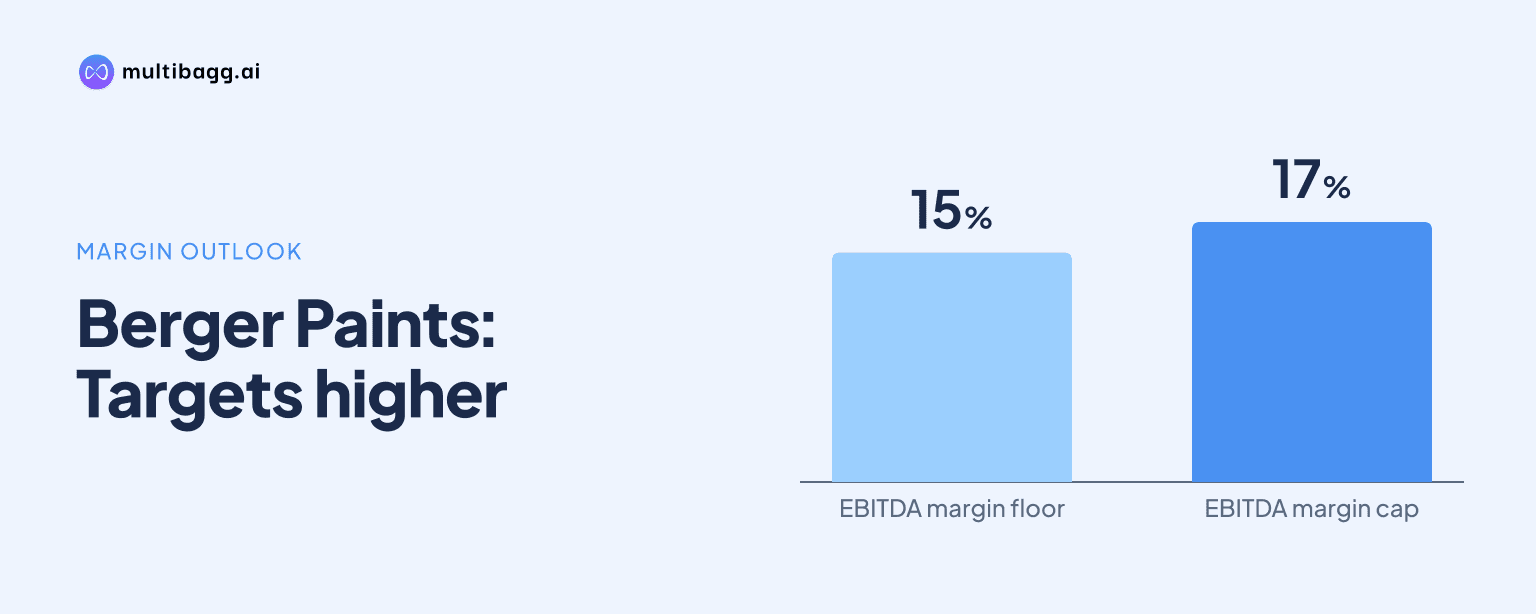
Berger Paints India Limited expects to get close to its 15%-17% earnings before interest, tax, depreciation and amortisation (EBITDA) margin band in the third quarter (Q3) of FY27 and possibly the fourth quarter (Q4), after standalone EBITDA margin fell to 10.8% in the second quarter (Q2), supported by pricing, softer crude-linked inputs and cost actions.
Know Berger Paints India inside out
Results, valuation, peers and who's buying, in one view.
Why did Berger Paints' EBITDA margin fall in Q2 FY27?
Berger Paints' standalone EBITDA margin fell to 10.8% in Q2 FY27 because double-digit raw-material inflation, liquidation of high-cost inventory and delayed industrial price increases outweighed pricing actions. The company said standalone gross margin was 36.6% in the quarter, below its usual 38%-41% operating range, while EBITDA margin was 14.4% for the first half (H1) of FY27.
The quarter also included Rs 22 crore of additional advertising and promotion spending for the new Rang Bana Rahe campaign. Management said standalone operating profit declined 4.4% year on year in Q2, while profit before depreciation, interest and tax would have grown about 3% excluding the campaign spending. It described Q2 as seasonally softer than Q1, while Q3 and Q4 are normally better quarters.
Decorative paint delivered 10% value growth in Q2, driven by price increases, but extended rain in eastern markets and a later Diwali affected demand timing. Berger Paints also shifted its mix away from price-sensitive categories including putty, textures and enamel, which declined, while differentiated products, waterproofing and wood coatings performed better.
How will Berger Paints restore its 15%-17% margin band?
Berger Paints plans to restore margins through calibrated price increases across decorative and industrial businesses, continued cost-saving programmes and tighter operating-cost discipline. Management said it was confident the company could get close to the 15%-17% EBITDA band in Q3 FY27 and possibly Q4 FY27, given initiatives already under way.
Industrial coatings are central to that recovery because their gross margin declined about 5%-5.5% in Q2 FY27, more than the reduction in decorative coatings. Management said industrial volume and value growth remained in the high double digits, but pricing had not kept pace with input costs. Automotive coatings grew about 31%, although management described the category as only about 5%-6% of the business.
Berger Paints said it had secured some industrial price increases in October and planned further increases in November. Management expected to recover almost 90% of the required increase by the end of November, with the remaining 10% to be pursued through December. It added that, if crude prices stay at lower levels, the planned recovery could largely offset inflation pressure.
What role do inventory and raw-material prices play?
Berger Paints said high-cost inventory will affect the timing of gross-margin recovery because there is a lag between raw-material consumption and its recognition in cost of goods sold. Inventory was higher by around Rs 400 crore at the end of September 2026, reflecting planned stocking for October's festive and Diwali sales and purchases made when raw-material prices were at their peak.
Management said the highest raw-material prices were seen in Q1 FY27 and carried into Q2, while input prices saw a marginal decline during Q2 that should carry into Q3. Many of the company's materials are crude-linked, and management said softer crude prices could improve profitability. It did not provide a quarter-by-quarter gross-margin forecast because prices remain volatile.
The company partly offset inflation with price rises and by reducing rebates in certain categories, but it said those steps affected sales growth in those products. In industrial coatings, management said delayed pass-through was a larger issue, whereas the drop in decorative gross margin was lower. This difference makes pricing progress, rather than revenue growth alone, important to the margin objective.
Got a follow-up? Ask IRIS
Can revenue growth support Berger Paints' margin recovery?
Berger Paints expects revenue growth to support recovery because management said October recorded its highest sales growth in roughly 25 to 30 months. The company expects to capture festive demand in Q3 FY27 and build growth in automotive and industrial coatings, waterproofing, construction chemicals and wood coatings.
The company is also expanding its route to market. Its retail store network exceeded 2,000 at the end of H1 FY27, and it added 4,800 tinting machines in the first six months, including 2,700 in Q2. These additions support product availability and point-of-sale capability, although management said it would continue brand-building and retail activation spending.
Brand spending is unlikely to disappear entirely after the Q2 launch expense. Management said a new campaign requires sustained advertising rather than an immediate switch-off, though initial spending is typically higher and then tapers before another burst after seven to eight months. Lower raw-material costs and pricing gains may therefore be partly balanced by continued spending on the Rang Bana Rahe platform.
What does Berger Paints' outlook say about competition and investment?
Berger Paints said competition remains intense, even though a new entrant had lifted prices by 5% to match the industry on dealer price levels. Management said the entrant was returning a large part of that increase to dealers through higher rebates. Berger Paints estimated its market share at about 20.2% at the end of H1 FY27, compared with 20.3% earlier, indicating little change in the period.
Management said it aims to maintain its market position rather than project large gains. In urban markets, its MEGA initiative, meaning Maintain, Experiment, Grow and Accelerate, is still being refined. Management expects to finish that experiment by March 2027 and accelerate the initiative from April 2027 after reporting positive early results.
On capital allocation, Berger Paints said it intends to maintain a net-cash balance sheet while using internal funds for factories planned at Panagar in West Bengal and Odisha. It has completed expansion at its Hindupur plant and will assess the scale of a Panagar investment after West Bengal announced a new industrial incentive policy. Management said the surplus cash is intended to support these capacity projects rather than borrowing-led expansion.
Conclusion
Berger Paints' Q2 FY27 margin decline reflected a combination of a 36.6% standalone gross margin, high-cost inventory, delayed industrial pricing and Rs 22 crore of campaign spending, rather than weak demand across all operations. Revenue rose 11.9%, industrial volumes grew at a high double-digit rate and management expects pricing and cost actions to improve profitability.
The next measures to watch are whether industrial price increases reach management's planned 90% recovery by end-November 2026 and whether the remaining 10% is achieved through December. Q3 festive sales, crude-linked input costs, advertising levels after the campaign launch and management's Panagar investment decision following its review of West Bengal's incentive policy are also relevant.