










Berger Paints Plans April Urban Expansion After Positive Pilot
Key highlights
- Berger plans to accelerate its urban-market initiative from April next year after completing pilot refinements by the end of March.
- Berger’s share in Bengaluru is about 7-8%, versus about 20.2% across the top six listed peers at the end of H1.
- Berger said its share among the six listed peers was broadly stable at about 20.2%, compared with 20.3% earlier.
- Berger expects to recover almost 90% of intended industrial price increases by the end of November and pursue the remaining 10% through December.
powered by IRIS
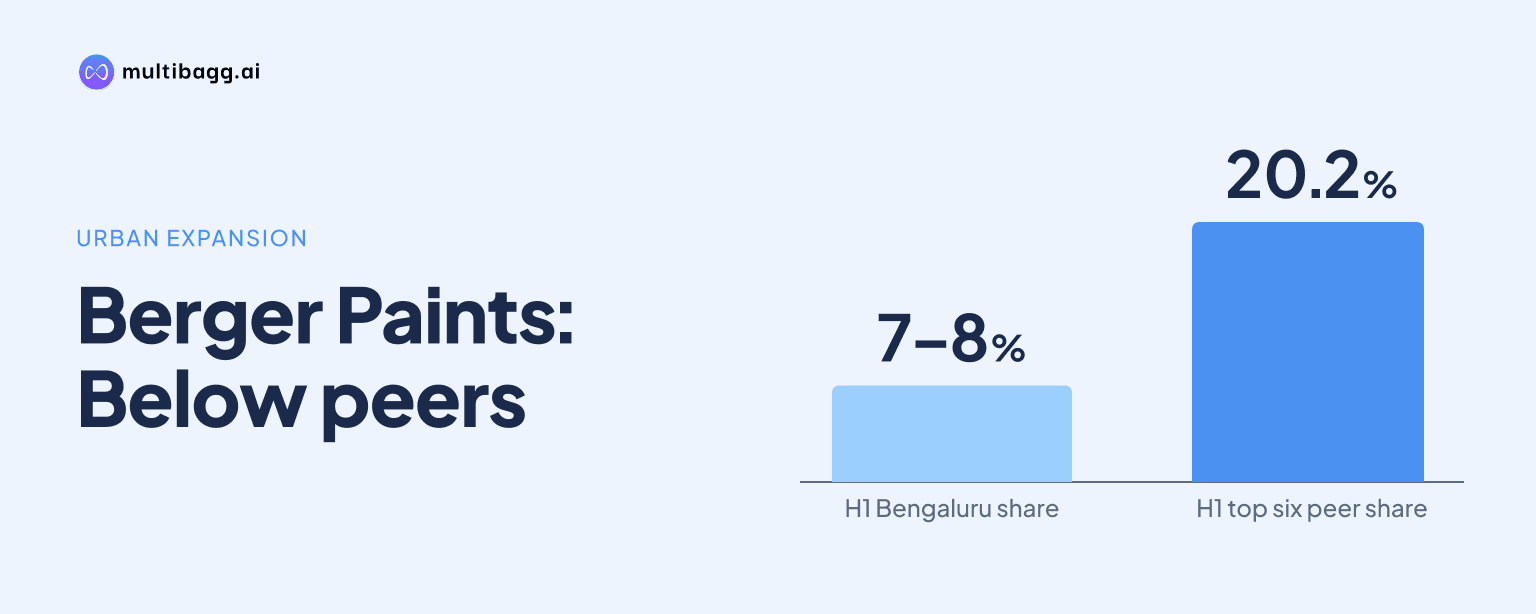
Berger Paints plans to accelerate its urban-market initiative from April next year after management said the pilot produced tangible positive benefits, targeting cities such as Bengaluru where its share is 7-8%, against about 20.2% across six listed peers at the end of the first half.
Know Berger Paints India inside out
Results, valuation, peers and who's buying, in one view.
What is Berger’s April urban-expansion plan?
Berger will move its urban-market initiative into an acceleration phase from April next year after completing and refining the experiment by the end of March. Management said it has identified what needs to be done in selected markets, but is still fine-tuning execution modalities before enlarging the programme. It did not disclose a city-by-city sales target, dealer-addition target or budget for the April rollout.
The initiative is being run through Berger’s MEGA approach, which management described as maintenance, experiment, grow and accelerate. Under this approach, activities that work in an experimental phase are expanded. Management said the urban pilot is yielding positive results and that this evidence has given it confidence to scale the initiative after March rather than treat it as a continuing trial.
Why are urban markets important for Berger?
Berger sees urban centres as a share-expansion opportunity because its position in several large cities is substantially below its wider peer-set standing. Management cited Bengaluru, where Berger has a 7-8% share, and said its shares in Pune and Mumbai are even lower. By comparison, Berger placed its share at about 20.2% among the top six listed paint companies at the end of the first half.
The comparison explains why management described the addressable opportunity as large in these cities. Berger’s peer-set share was broadly unchanged from 20.3% to about 20.2% by the end of H1, meaning management reported neither a material gain nor loss over that period. Its stated near-term expectation is to maintain the current level amid intense competition, rather than promise heavy share gains.
What did Berger’s MEGA pilot establish?
The pilot established, in management’s view, that Berger can produce tangible positive benefits in urban markets where it has historically been underrepresented. The remaining task through the end of March is to refine how the model is executed. Management did not quantify the pilot’s sales uplift, profit contribution, customer additions or market-share movement, so the evidence provided was qualitative rather than a disclosed financial outcome.
The measured rollout also reflects Berger’s view that urban execution needs a specific operating model rather than a simple nationwide extension. Management said it now knows what is required in these markets, while retaining the need to fine-tune delivery. The April acceleration therefore follows a defined experiment, but the call did not specify whether the model will initially cover Bengaluru, Mumbai, Pune or additional cities.
Got a follow-up? Ask IRIS
Which products will Berger pursue in urban markets?
Berger will focus on paints, coatings, construction chemicals and waterproofing rather than diversify into unrelated home-improvement categories. Management said its urban opportunity is centred on exterior applications, including texture, emulsion finish coats, primer, roof coatings and waterproofing. It described exterior repainting and associated coating work as a larger market segment than the premium interior finishes it is not targeting.
This positioning responded to an analyst’s observation that some Tier 1 households are using panels, wood and other wall finishes. Management said such products are mainly relevant to high-end home interiors, whereas Berger’s urban strategy is directed at exterior surfaces and related water-protection needs. The company’s stated product boundary remains paints and coatings, plus construction chemicals and waterproofing, even as the market leader pursues a broader share-of-space strategy.
Berger’s wider operating plan also includes investment in brand building, retail activation, store expansion, tinting and point-of-sale capability. Management said advertising requires sustained spending rather than a switch-on, switch-off approach. It said a corporate campaign had initially required higher spending, which could taper before another advertising burst after seven to eight months, although no urban-only marketing allocation was disclosed.
What could affect Berger’s urban rollout?
Competition remains a constraint on Berger’s effort to build urban share. Management said a new entrant had raised prices from roughly 5% below industry levels to match the industry, but was returning a large part of that increase to dealers through higher rebates. Berger therefore described competitive intensity as continuing, even though the announced price gap had narrowed.
Input costs and pricing recovery are another operating consideration. Management said average gross margin across decorative and industrial businesses had declined by about 2.5-3%, while industrial gross margin was down nearly 5.5%. It had partly passed through price increases and expected to recover almost 90% of the intended industrial increase by the end of November, with the remaining 10% to be pursued through December, subject to movements in crude-linked raw materials.
Capital allocation will also compete for Berger’s cash resources. Management said surplus cash is intended to fund factories planned at Panagar in West Bengal and Odisha, reducing the need for borrowing, though short-term borrowing could occur. Berger had completed an expansion at Hindupur and said it would assess West Bengal’s newly announced industrial incentive policy before deciding the scale of investment at Panagar.
Conclusion
Berger’s planned April acceleration is based on a pilot that management says has worked in urban markets where its local share, including 7-8% in Bengaluru, is well below its roughly 20.2% peer-set position. The strategy is focused on winning exterior paint, coating, waterproofing and construction-chemical demand rather than following competitors into broader interior décor categories.
The next points to watch are the completion of pilot refinements by the end of March and the execution details that accompany the April expansion. Management’s ability to maintain its 20.2% H1 peer-set share amid dealer rebates, complete industrial price recovery through December, and allocate cash to the Panagar and Odisha factories will shape the context for that rollout.