










Bikaji says Bhujia growth returned to 20% after disruption
Key highlights
- Bikaji said Bhujia growth returned to about 20% from the second half of Q1.
- Bikaneri Bhujia can carry that name only when it is produced in Bikaner.
- Bikaji plans to use its mother depot to raise inventory when disruption risk emerges.
- Management expects about 13.5% EBITDA margin in Q4 after a 3% to 3.5% price increase from 15 November.
powered by IRIS
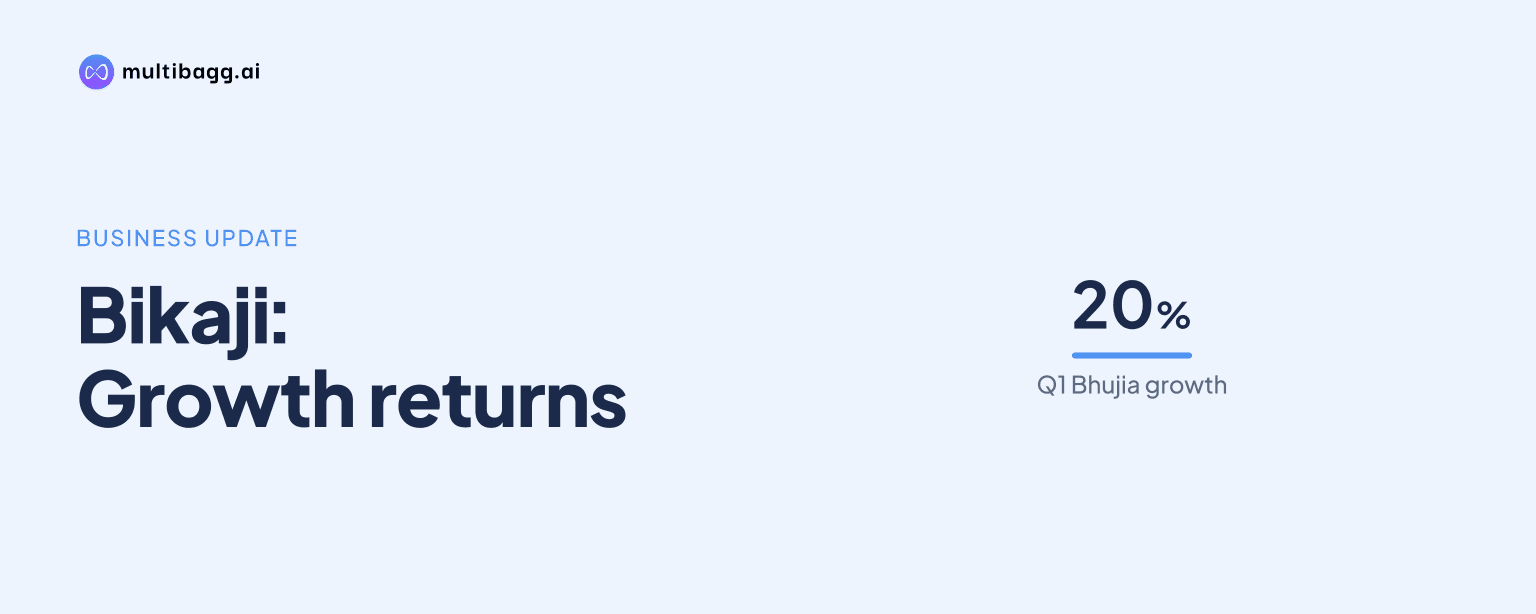
Bikaji Foods International said Bhujia growth returned to about 20% from the second half of the first quarter, after production issues in the first half, but products made outside Bikaner cannot be sold as Bikaneri Bhujia because that designation requires production in Bikaner.
Know Bikaji Foods International inside out
Results, valuation, peers and who's buying, in one view.
Has Bikaji's Bhujia growth recovered after the first-quarter disruption?
Yes. Bikaji said Bhujia growth was running at about 20% from the second half of the first quarter, or Q1, after production issues affected the first half. Management linked the earlier disruption at its Bikaner location to the Bengal elections and said Bhujia momentum was subsequently “on the high.” The call did not disclose Bhujia revenue, sales volume, production tonnage or the comparison base behind the 20% growth figure.
The disclosed change is between the first and second halves of Q1, rather than a full-quarter year-on-year comparison. Bikaji said the production issue affected the first half, while growth reached about 20% in the second half. Management did not say that the recovery came from moving Bikaneri Bhujia production away from Bikaner; its stated response combines inventory planning with production of other besan Bhujia products elsewhere.
Bhujia is part of a wider snacks business that management said grew more than 30% during the quarter and continued that momentum in October. Bikaji separately reported 44% growth in Western Snacks, which management described as largely on-the-go or out-of-home consumption. These figures show growth in other snack segments, but the company did not provide Bhujia's sales contribution to either the total snacks business or Western Snacks.
Why cannot Bikaji make Bikaneri Bhujia outside Bikaner?
Bikaji cannot use the Bikaneri Bhujia name for product made outside Bikaner. Management said the geographical indication, or GI, condition allows the name only when the product is produced in Bikaner. When an analyst asked whether alternative manufacturing locations would affect the GI tag, management said Bhujia made at those locations could not be called Bikaneri Bhujia.
The restriction applies to the Bikaneri Bhujia designation, not to every Bhujia product. Bikaji said other sites could make besan Bhujia, while Bikaner-made output would retain the Bikaneri Bhujia name. The transcript did not identify the alternative facilities, specify their capacity, state a launch date or explain whether the non-Bikaneri products would have a different recipe, pack size or distribution route.
This distinction sets a limit on the company's contingency options after the Q1 disruption. Alternative plants could support broader Bhujia supply, but they cannot replace Bikaner-made output using identical Bikaneri Bhujia branding. Bikaji did not disclose the relative sales, margins or volumes of Bikaneri Bhujia and other besan Bhujia, so the financial effect of that label-specific constraint cannot be calculated from the call.
Got a follow-up? Ask IRIS
How is Bikaji preparing for another Bhujia production disruption?
Bikaji's disclosed contingency measure is higher inventory at its newly established mother depot. Management said the depot would allow the company to increase inventories when needed and plan for a possible forced disruption. This is an inventory-buffer mechanism intended to maintain the flow of Bhujia while retaining Bikaner production for the Bikaneri Bhujia designation.
The company did not disclose mother-depot capacity, its location, the stock-cover period or the number of days of supply it could protect. It also did not say whether the depot would store only Bikaneri Bhujia or a mix that includes besan Bhujia from alternative facilities. The plan therefore identifies the supply-continuity mechanism, but not its measurable ability to offset a disruption of a given duration.
Management presented the depot arrangement as a proactive response to the production issue in the first half of Q1. Bikaji said it would ensure an uninterrupted free flow of Bhujia through these arrangements, while continuing to recognise that only Bikaner-made production can carry the Bikaneri Bhujia name. No new capacity addition in Bikaner was disclosed as part of this specific contingency plan.
What does Bikaji's operating outlook indicate about the supply plan?
Bikaji said its snacks business grew more than 30% during the quarter, making product availability relevant to its broader growth plan. Management also said it was raising advertising spending to sustain the momentum. The supply measure is separate from that spending decision, but both relate to maintaining availability and demand for snacks after the Q1 production issue.
Management expected the third quarter, or Q3, to face cost pressure because it had not taken a major price increase in September and October. Bikaji said it was at about 12.6% earnings before interest, tax, depreciation and amortisation, or EBITDA, margin in the first half and expected Q4 to be about 13.5%, with an exit run rate above 13%. These are management expectations, not reported Q4 results.
Bikaji said it began a 3% to 3.5% price increase from 15 November and did not expect a major further increase until the end of March unless conditions changed. For Rs 5 and Rs 10 packs, management also cited an approximately one-gram grammage reduction, equal to around 3% to 4% on a weighted-average basis. It expected lower edible-oil and packaging-material costs, fresh potato supply by mid-December and possible pulse-cost benefits in Q4.
Conclusion
Bikaji's message was that Bhujia growth had returned to about 20% after the first-half Q1 disruption, but its supply response must operate within the geographic naming condition. Bikaner production remains necessary for Bikaneri Bhujia, while alternative plants can make other besan Bhujia and the mother depot can hold inventory to support continuity.
The next point to watch is whether the inventory arrangement prevents another interruption while the company manages the November price increase and Q3 cost pressure. Management expects Q4 EBITDA margin of about 13.5% and an exit run rate above 13%, while saying no major additional price increase is expected through March unless conditions change.