










Bikaji forecasts THF revenue of Rs 160-170 crore this year
Key highlights
- Bikaji forecasts THF revenue of Rs 160 crore to Rs 170 crore this year, up 60% to 70% from close to Rs 100 crore last year.
- THF is expected to have roughly 31 to 33 stores by year-end.
- THF recorded 6% to 8% same-store growth in the first six months.
- Bikaji is testing 600 square feet to 700 square feet outlets alongside 2,000 square feet to 2,500 square feet THF stores.
powered by IRIS
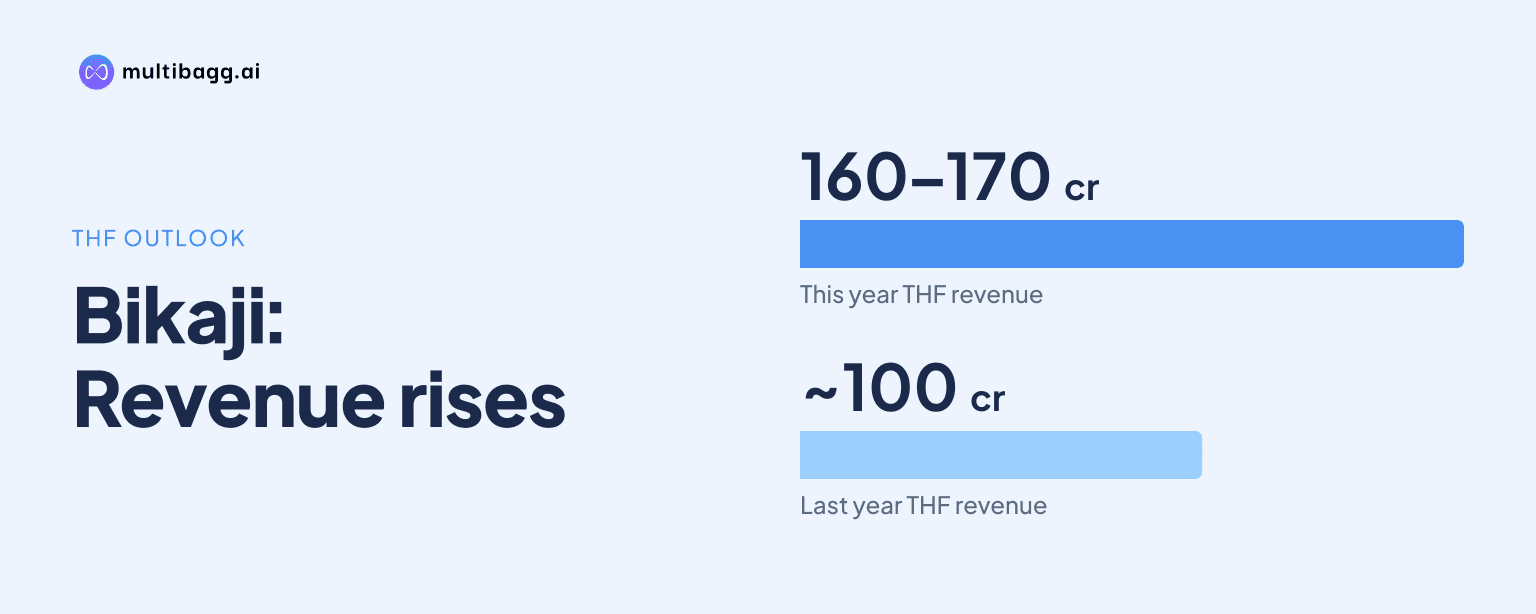
Bikaji Foods International forecasts THF revenue of Rs 160 crore to Rs 170 crore this year, up 60% to 70% from close to Rs 100 crore last year, with roughly 31 to 33 stores expected at year-end as management expands smaller formats and prioritises premium sweets and gifting over a quick-service restaurant, or QSR, only model.
Know Bikaji Foods International inside out
Results, valuation, peers and who's buying, in one view.
What is Bikaji forecasting for THF this year?
Bikaji is forecasting THF revenue of Rs 160 crore to Rs 170 crore this year, compared with close to Rs 100 crore last year. Management described that outlook as 60% to 70% growth and expects the network to reach roughly 31 to 33 stores by year-end. This is management's forecast, rather than a reported result.
The forecast combines store expansion with continued sales at existing sites. Management said THF had recorded 6% to 8% same-store growth in the first six months, providing the operating measure it disclosed for the current network. It did not provide a quarterly THF revenue breakdown, a store-opening timetable or a business-level profit target.
Management also said it sees potential for THF to grow at least 50% to 60% year on year over the next three to four years. That longer-term view rests on experiments with store sizes, premium sweets and brand building, rather than a disclosed commitment to a specified number of future openings.
How will smaller THF stores support expansion?
Bikaji is testing smaller THF outlets to create a format that management believes can be opened in malls across India. Its established outlets are generally 2,000 square feet to 2,500 square feet, while the company is trying stores of 600 square feet to 700 square feet. Management also referred to a 700 square feet to 800 square feet format.
The smaller format is not replacing the larger stores outright. Management said it is operating three models: a normal 2,500 square feet outlet, a 700 square feet to 800 square feet outlet and a premium experiential store. The approach allows Bikaji to test a more compact mall format while retaining larger sites for a broader customer experience.
Existing-store performance was management's main evidence on demand. THF reported 6% to 8% same-store growth in the first six months, while its six Lucknow stores grew by more than 6% to 7% despite no new Lucknow outlet having opened for four to five years. That comparison indicates that management expects growth to come from existing stores as well as new locations.
Management did not disclose sales per square foot, store-level margins or the sales mix of the 600 square feet to 800 square feet formats. An analyst asked whether a smaller store could change revenue per square foot, but management did not give a numerical response beyond the 6% to 8% same-store growth figure.
Got a follow-up? Ask IRIS
Why is Bikaji focusing THF on premium sweets?
Bikaji is focusing THF on premium sweets and gifting because management described those categories as a large and profitable business, rather than relying only on QSR growth. Management said its objective is for THF to be associated with premium sweets in India, which is a brand-positioning ambition rather than a reported market-share measure.
The company did not disclose THF's current revenue from sweets, gifting or QSR, nor did it provide category-level margins. Management nevertheless said the premium-sweets and gifting focus is central to building THF over the next three to four years, alongside the 50% to 60% annual growth potential it outlined.
Bikaji's broader sweets business provides context, though it is not a THF-specific measure. Management said sweets contributed about 12.5% of the overall business at the full-year level, while their contribution in focus states was 25%, or about twice the overall level. Those figures help explain management's emphasis on developing a premium sweets proposition within THF.
Management is also evaluating brand ambassadors for THF and expects to onboard some next year. It did not name potential ambassadors, state a campaign budget or give a launch date, but presented the plan as one of several initiatives intended to establish the brand beyond store additions.
What is Foundré by THF's role in strategy?
Bikaji plans to open a premium Gurgaon outlet called Foundré by THF, which management said would most likely open next month. Management described the site as an experimental and experiential format intended to uplift the THF brand, rather than as a template for every future outlet.
The planned Gurgaon store is expected to make Baklava live and serve coffee made from choco beans. Those features distinguish it from the 600 square feet to 700 square feet mall formats and the normal 2,500 square feet outlet. Bikaji did not disclose the planned store's area, investment, revenue target or expansion plans for the Foundré by THF concept.
The three-format approach therefore pairs a potential high-reach mall model with larger stores and a premium brand-building location. Management did not say which format would account for most of the roughly 31 to 33 THF stores expected by year-end, leaving the mix of expansion unresolved.
The near-term performance benchmark remains the Rs 160 crore to Rs 170 crore THF revenue outlook, alongside 6% to 8% same-store growth in the first six months. Management has not provided separate performance data for the new smaller formats or for Foundré by THF, so their sales contribution cannot yet be measured from the call.
Conclusion
Bikaji's THF strategy combines a Rs 160 crore to Rs 170 crore revenue outlook this year with expansion through smaller outlets, larger stores and a premium experiential location. The forecast implies 60% to 70% growth from close to Rs 100 crore last year, while the first six months' 6% to 8% same-store growth suggests management expects existing stores to contribute alongside new openings.
The next disclosed milestones are the planned opening of Foundré by THF in Gurgaon next month and the expected onboarding of brand ambassadors next year. It will also be important to watch whether Bikaji provides sales, margin or revenue-per-square-foot data for the 600 square feet to 800 square feet formats, since the call did not quantify their economics or THF's sweets and gifting mix.