










BIL targets Rs 60 crore recurring rent by FY29 with new mall
Key highlights
- BIL targets Rs 60 crore of recurring real-estate rental income by FY29, versus Rs 20 crore currently.
- Commercial phases of BIL's proposed mixed-use project are projected to generate more than Rs 30 crore of annual rent from FY29.
- BIL estimates the mall, commercial and luxury-residential development at Rs 500 crore to Rs 700 crore across four to five phases.
- BIL reported Rs 785 crore of consolidated assets and Rs 388 crore of equity in H1FY27.
powered by IRIS
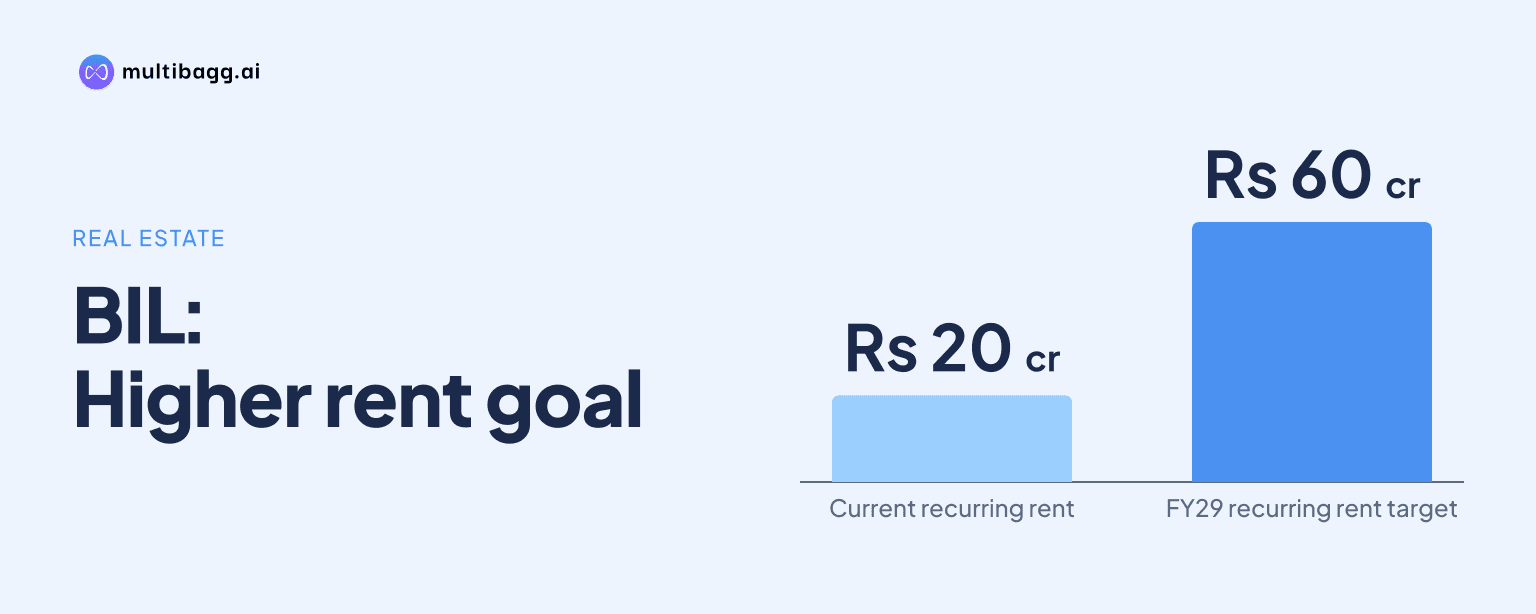
Brahmaputra Infrastructure Limited targets Rs 60 crore of recurring real-estate rental income by FY29, up from Rs 20 crore currently, with a proposed mixed-use mall and residential development expected to contribute more than Rs 30 crore of annual commercial rent beginning in FY29. The plan also relies on contractual rental escalations.
Know Brahmaputra Infrastructure inside out
Results, valuation, peers and who's buying, in one view.
What is BIL's recurring-rent target for FY29?
BIL aims to scale recurring real-estate rental income to Rs 60 crore by FY29. The company says its existing real-estate portfolio currently generates Rs 20 crore of recurring rent, making the FY29 objective three times the present level and implying an additional Rs 40 crore of annual rental income. Management identifies two mechanisms for the increase: the new mall development and contractual rental escalations in the existing portfolio.
BIL places this income goal in the fourth of its four strategic pillars, described as a recurring revenue engine. The presentation says real estate is expected to contribute 25% to 30%, although it does not specify whether that share refers to revenue, profit or another financial measure. Management also describes the property business as asset-backed and virtually debt-free, and says a larger rental stream is expected to improve free cash flow and earnings stability.
How will BIL's new mall and residential project generate rent?
BIL expects the commercial portions of its proposed New Shopping Mall Plaza & Residential Complex to generate more than Rs 30 crore of annual rental yield from FY29. The projected yield is tied specifically to the commercial phases, rather than the luxury-residential phases. This planned income would account for more than half of BIL's Rs 60 crore recurring-rent target, based on the stated Rs 30 crore-plus projection and the FY29 target.
The development is planned as a commercial and luxury-residential project with an approximate total project value of Rs 500 crore to Rs 700 crore. BIL envisages four to five phases: a Shopping Mall Plaza and retail outlet in phase one, expanded commercial and retail areas in phase two, a final commercial block in phase three, and luxury homes in phases four and five. The presentation does not provide expected sale value, costs, financing, leasable area or tenant commitments for any phase.
The commercial sequence is central to the rental plan. Phase one is labelled a flagship retail destination, phase two is intended to expand commercial and retail zones that generate yield, and phase three is described as the final commercial block with rental income active by FY29. In contrast, the later luxury-home phases are identified as residential, with details to be disclosed at project launch. The stated Rs 30 crore-plus annual yield therefore should not be read as including residential sales or income.
Got a follow-up? Ask IRIS
When does BIL plan to launch the mixed-use development?
BIL says the development is likely to launch in FY2027, while its project-overview panel separately lists FY2028 for the phase-one Shopping Mall Plaza. The phase roadmap calls for a grand launch of the retail outlet in FY2027, whereas the timeline box identifies FY28 as “Phase 1 launch.” The presentation consequently contains two different timings for phase one and does not reconcile them.
The timeline is clearer on the intended commencement of rent: it lists FY29 as the point at which yield generation begins. It also says commercial-phase rental income will commence in FY29 and identifies phase three as having rent active by that fiscal year. These statements link BIL's FY29 rental target to execution and leasing of the proposed commercial stages, rather than to rent expected during FY27 or FY28.
The project's four-to-five-phase design also means the residential component is scheduled after the initial commercial work. BIL identifies phases four and five as exclusive ultra-luxury residences, but provides no launch fiscal year, unit count or sales schedule for those phases. The only stated timing beyond the initial launch is the FY29 commencement of commercial yield and the final-phase designation for the luxury residential segment.
How does the rental strategy fit BIL's wider FY30 plan?
BIL presents property income alongside an engineering, procurement and construction, or EPC, expansion plan running toward FY30. For FY27, the company targets Rs 1,200 crore of order inflow and an earnings before interest, tax, depreciation and amortisation margin of more than 20%. It also states an approximate Rs 2,500 crore order-book target for FY28, positioning the rental initiative as a second income stream alongside project execution.
The geographic expansion pillar calls for BIL to grow its presence from 10 states to 20 states, including markets in North and East India. Its stated list includes West Bengal, Uttar Pradesh, Odisha, Punjab, Haryana, Delhi, Jharkhand and Chhattisgarh. BIL links this wider EPC footprint to government initiatives including PM Gati Shakti and the National Infrastructure Pipeline, while linking the property pillar specifically to Rs 60 crore of annual rent by FY29.
The balance-sheet presentation provides context for the plan but not a dedicated project-funding schedule. On a consolidated basis, total equity rose from Rs 345 crore in FY26 to Rs 388 crore in H1FY27, while total assets increased from Rs 717 crore to Rs 785 crore. Investment property was unchanged at Rs 86 crore in both FY26 and H1FY27; non-current borrowings rose from Rs 23 crore to Rs 60 crore, and current borrowings moved from Rs 104 crore to Rs 105 crore.
This comparison shows that the proposed Rs 500 crore to Rs 700 crore development is larger than the Rs 86 crore investment-property balance reported at H1FY27. However, BIL has not disclosed the capital structure, construction budget, land contribution, external funding, partner arrangement or approval status for the new project. Those omissions leave the economic path from the announced project value to the stated Rs 30 crore-plus rental yield unspecified.
Conclusion
BIL's stated property strategy is to lift recurring rent from Rs 20 crore currently to Rs 60 crore by FY29, with more than Rs 30 crore of annual commercial rent expected from the new mixed-use development. The plan would make the proposed mall, commercial blocks and contractual rental escalations the principal drivers of an additional Rs 40 crore of annual rent, alongside BIL's EPC order-book expansion.
The next disclosed milestones are the likely FY2027 launch, the separate FY2028 phase-one date shown in the project overview, and FY29 yield generation. Investors will need to watch for clarification of the conflicting launch dates, as well as details on development funding, project approvals, leasing progress and the luxury-residential phases, none of which the presentation specifies.