










Brahmaputra Infrastructure targets Rs 60 crore rent by FY29
Key highlights
- BIL targets Rs 60 crore of recurring rental income by FY29, compared with Rs 20 crore currently.
- Commercial phases of the proposed mixed-use development are projected to generate more than Rs 30 crore of annual rental yield from FY29.
- The mall plaza and residential complex has an approximate total project value of Rs 500 crore to Rs 700 crore.
- BIL reported consolidated investment property of Rs 86 crore at H1FY27, unchanged from FY26.
powered by IRIS
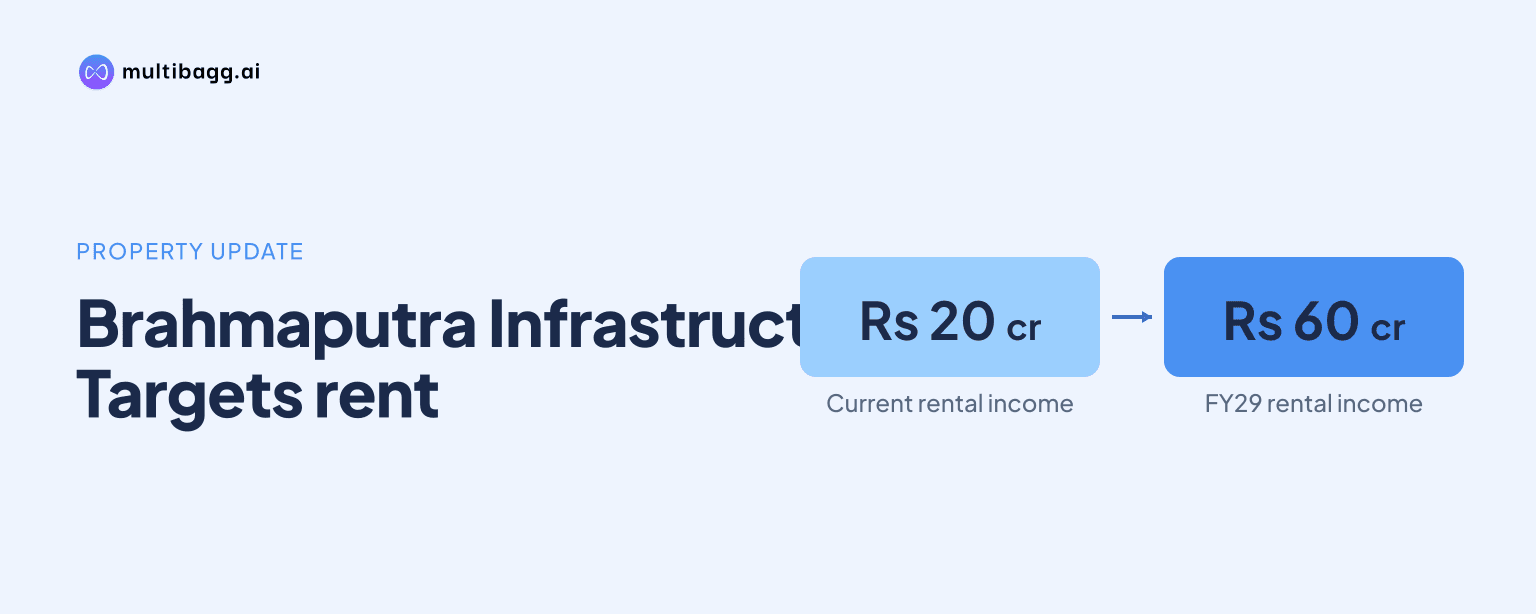
Brahmaputra Infrastructure (BIL) targets Rs 60 crore of recurring real-estate rental income by FY29, compared with Rs 20 crore currently, through a new mall-led development and contractual rental escalations. BIL says commercial phases of the proposed project are projected to generate more than Rs 30 crore of annual rental yield beginning in FY29.
Know Brahmaputra Infrastructure inside out
Results, valuation, peers and who's buying, in one view.
How will BIL reach Rs 60 crore of recurring rent by FY29?
BIL plans to raise annual recurring rental income by Rs 40 crore, from Rs 20 crore currently to Rs 60 crore by FY29. The company identifies a new mall development and contractual rental escalations as the two mechanisms for reaching the target, which forms Pillar IV of its stated path to FY30.
The planned commercial phases are projected to contribute more than Rs 30 crore of annual rental yield from FY29. That is more than half of the Rs 60 crore target, while BIL has not provided a split showing the expected contribution from existing properties, contractual escalations or individual commercial phases.
BIL describes the real-estate operation as an asset-backed, virtually debt-free business that is expected to enhance free cash flow and improve earnings stability. The presentation does not disclose occupancy, tenant concentration, lease tenures, rental escalation rates or property-level income for the Rs 20 crore current recurring-rent figure.
What does BIL plan to build in the new development?
BIL plans a shopping mall plaza and residential complex with an approximate total project value of Rs 500 crore to Rs 700 crore. The development is described as a landmark mixed-use project with commercial and luxury residential components, to be rolled out in four to five phases.
Phase 1 is a shopping mall plaza and retail outlet described as a flagship retail destination. Phase 2 would add commercial and retail zones generating yield, while Phase 3 is a final commercial block, with rental income described as active by FY29.
Phases 4 and 5 are planned as luxury homes. BIL says details of the exclusive ultra-luxury residential component will be provided at project launch, and the presentation gives no residential sales assumptions, rental assumptions, construction cost split or phase-wise funding requirement within the Rs 500 crore to Rs 700 crore project value.
The projected Rs 30 crore-plus annual rental yield is attributed specifically to commercial phases rather than the residential stages. This makes the commercial mall, retail and office rollout the disclosed source of the FY29 yield plan, while the later residential component is not identified as contributing to that rental figure.
When is BIL expected to start earning rent from the project?
BIL indicates that commercial yield generation is expected to begin in FY29. Its project timeline shows FY28 for the Phase 1 launch and FY29 for the beginning of yield generation, while the Phase 3 description says rental income will be active by FY29.
The presentation also contains different references for the initial launch. The page heading says the new real-estate development is likely to launch in FY2027, and the Phase 1 roadmap refers to a “Grand launch FY 2027”, whereas the project-overview table lists FY28 for the Phase 1 shopping mall plaza launch.
The disclosed timing therefore distinguishes the launch of Phase 1 from the expected commencement of commercial yield in FY29. BIL does not provide construction milestones, land details, regulatory approvals, leasing pre-commitments, built-up area or the point at which the projected Rs 30 crore-plus annual yield would be fully achieved.
Got a follow-up? Ask IRIS
What real-estate assets and funding context has BIL disclosed?
BIL reported consolidated investment property of Rs 86 crore at H1FY27, unchanged from FY26 and up from Rs 62 crore in FY25. The rise of Rs 24 crore between FY25 and FY26 was followed by no change through H1FY27, based on the consolidated balance sheet.
Consolidated non-current assets stood at Rs 522 crore at H1FY27, including Rs 22 crore of property, plant and equipment, Rs 86 crore of investment property and Rs 413 crore of other non-current assets. These figures provide balance-sheet context for the property strategy but do not identify which existing asset, if any, relates to the proposed mall and residential complex.
Total consolidated equity increased from Rs 286 crore in FY25 to Rs 345 crore in FY26 and Rs 388 crore at H1FY27. At the same H1FY27 date, consolidated borrowings were Rs 165 crore, comprising Rs 60 crore of non-current borrowings and Rs 105 crore of current borrowings.
BIL’s description of the real-estate business as virtually debt-free is specific to that business. The presentation does not quantify real-estate-only debt or state how the Rs 500 crore to Rs 700 crore development would be funded through equity, internal cash generation, borrowings, partners or another mechanism.
Why is BIL adding recurring real-estate income alongside EPC?
BIL says the rental strategy is intended to improve earnings stability and free cash flow alongside its engineering, procurement and construction (EPC) operations. The company is targeting FY27 order inflow of Rs 1,200 crore and an approximate FY28 order book of Rs 2,500 crore.
The broader strategy also calls for an earnings before interest, tax, depreciation and amortisation (EBITDA) margin above 20% and expansion from 10 to 20 states. BIL names West Bengal, Uttar Pradesh, Odisha, Punjab, Haryana, Delhi, Jharkhand and Chhattisgarh among the markets targeted beyond its Northeast India base.
BIL shows real-estate contribution at 25% to 30%, but does not define whether this refers to revenue, profit, cash flow or another measure. Its infrastructure portfolio is cited as more than 100 projects with a value of Rs 5,000 crore across more than 25 states, providing the operating context for the stated combination of EPC execution and recurring property income.
Conclusion
BIL’s disclosed plan is to triple recurring rental income from Rs 20 crore currently to Rs 60 crore by FY29, with more than Rs 30 crore of projected annual yield tied to the commercial phases of its proposed mixed-use development. The strategy places a planned recurring-income stream alongside FY27 EPC order-inflow guidance of Rs 1,200 crore and an approximate FY28 order-book target of Rs 2,500 crore.
The next milestones are clarification of the FY2027 and FY28 Phase 1 launch references, progress through the four-to-five-phase development plan, and the planned start of commercial yield in FY29. BIL has yet to disclose phase-wise capital deployment, funding, leasing commitments and the basis for its 25% to 30% real-estate contribution measure.