










Biryani By Kilo Targets 14%-15% Brand Contribution Range
Key highlights
- BBK reported 8.1% same-store sales growth in the quarter.
- BBK is targeting 14%-15% brand contribution in the short to medium term.
- Own Brands revenue was Rs 95 crore, nearly 11% higher year on year.
- Own Brands gross margin rose to 65.4% from 62.6%, while brand contribution was Rs 9 crore, or 9.4%.
powered by IRIS
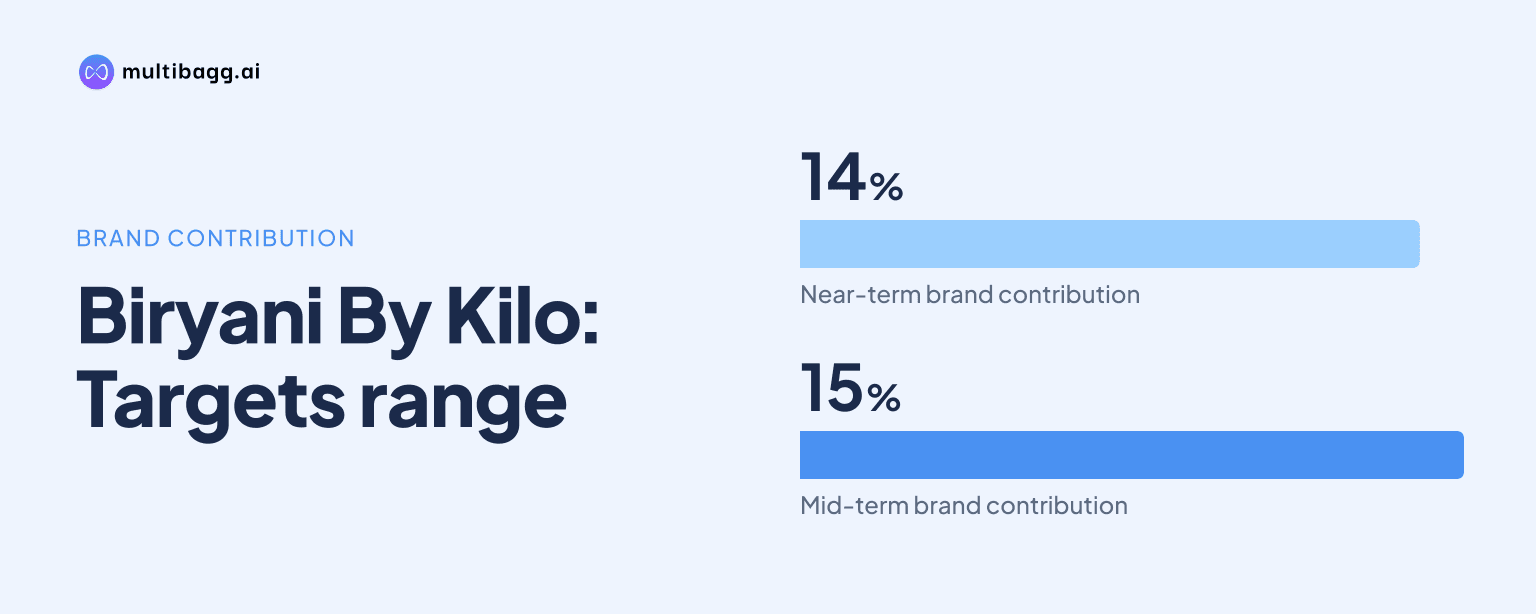
Biryani By Kilo, or BBK, is targeting brand contribution of about 14%-15% in the short to medium term after its Own Brands portfolio reported Rs 9 crore of contribution, equal to 9.4% of Rs 95 crore quarterly revenue. BBK’s same-store sales growth (SSSG) was 8.1% in the quarter discussed.
Know Devyani International inside out
Results, valuation, peers and who's buying, in one view.
What is BBK’s profitability target?
BBK’s stated short- to medium-term objective is brand contribution of about 14%-15%. Management said reaching that range would take time because several cost line items still need optimisation, and it did not provide a target date or a standalone current contribution figure for BBK.
The 14%-15% objective is below the 20%-plus brand-margin possibility raised by an analyst on the call. Management did not endorse the higher figure, even though the analyst noted that the format has no royalty cost. The disclosed target is therefore 14%-15%, rather than a commitment to exceed 20% over the next three to four years.
BBK’s progress sits within the Own Brands portfolio, which also includes Vaango. The portfolio generated Rs 95 crore in quarterly revenue, nearly 11% higher year on year, while gross margin increased to 65.4% from 62.6% a year earlier. The 2.8-percentage-point gross-margin increase is a portfolio result and cannot be assigned solely to BBK from the call.
Management said BBK’s contribution margin was close to double digits, whereas the Rs 9 crore and 9.4% figures apply to Own Brands as a whole. The source does not disclose BBK’s standalone revenue, gross margin, contribution amount or contribution margin. That prevents a direct calculation of the gap between BBK’s current level and the 14%-15% target.
What is driving BBK’s margin turnaround?
BBK’s turnaround is being driven by procurement benefits, more efficient store-level labour deployment and supervisory-layer efficiencies, according to management. Management also said the 8.1% SSSG provides operating leverage, while the broader Own Brands portfolio’s gross margin rose to 65.4% from 62.6%.
Procurement is the first mechanism management identified. It said BBK’s scale enables it to secure procurement benefits, but did not identify specific ingredients, suppliers or savings amounts. The source also does not state how much of the 2.8-percentage-point Own Brands gross-margin improvement came from sourcing.
The second mechanism is labour deployment within stores. Management said it had created store-level efficiencies through labour deployment, without giving employee-count changes, wage costs per order or sales per store. It also cited efficiencies at the overall supervisory layer but did not disclose the relevant cost base or savings.
Sales growth is the additional operating lever cited on the call. BBK recorded 8.1% SSSG, compared with 6.9% at Vaango, a difference of 1.2 percentage points. Management said positive comparable-store growth gives BBK some leverage, but did not quantify how the growth translated into contribution-margin expansion.
Got a follow-up? Ask IRIS
How does BBK compare with Devyani’s other businesses?
BBK’s reported 8.1% SSSG exceeded Vaango’s 6.9%, while the combined Own Brands portfolio delivered a 9.4% contribution margin. The portfolio had 225 stores at the quarter end, including 26 BBK Express stores.
The comparison separates sales growth by brand but reports financial results for Own Brands in aggregate. BBK’s 8.1% growth was 1.2 percentage points above Vaango’s 6.9%, yet the source does not disclose either brand’s revenue or contribution. It also does not say whether BBK Express stores are included in the SSSG calculation.
Devyani’s franchisee brands portfolio reported a 15.5% contribution margin, with gross margin of 74.2% against 73.6% a year earlier. That portfolio had 202 stores at quarter end. This is not a like-for-like comparison with BBK because BBK is one brand within Own Brands, while franchisee results cover different brands.
International business reported Rs 509 crore in quarterly revenue and Rs 91 crore in brand contribution, or a 17.9% margin. Its contribution margin increased by 1.2 percentage points year on year, although gross margin declined slightly sequentially. BBK’s 14%-15% target is below the current 17.9% international margin and broadly around the 15.5% franchisee-portfolio result.
What remains unknown about BBK’s 14%-15% target?
BBK’s 14%-15% target leaves its timetable, standalone starting margin and route to each percentage point of improvement undisclosed. Management said multiple cost line items require optimisation, but gave no annual milestone, capital-spending plan, store-sales target or quantified procurement and labour-savings target.
The call also does not define the costs included in BBK’s brand contribution. It reports Own Brands contribution of Rs 9 crore, or 9.4% of Rs 95 crore revenue, but does not list included or excluded expenses. The relationship between the portfolio-level 9.4% and BBK’s near-double-digit contribution margin therefore cannot be precisely calculated.
The 225-store Own Brands network offers one indication of scale, and 26 of those stores were BBK Express outlets. Management linked scale to procurement gains but did not disclose plans for additional BBK or BBK Express openings. It also provided no separate store economics for the Express format.
Company-wide input-cost commentary shows why management did not set a fixed timetable. Management said chicken, oil, paper and packaging-price inflation appeared to be stabilising, while gas prices had doubled from the prior year before appearing stable. Those observations were not specific to BBK and should not be treated as a forecast for its contribution margin.
Conclusion
BBK’s stated 14%-15% contribution objective follows an improvement supported by 8.1% SSSG and management’s cited procurement, store-labour and supervisory efficiencies. The clearest reported evidence remains at the combined Own Brands level, where revenue reached Rs 95 crore, gross margin rose to 65.4% from 62.6%, and brand contribution was Rs 9 crore, or 9.4%.
The next measure to watch is progress from BBK’s near-double-digit contribution margin toward management’s 14%-15% short- to medium-term objective. Management has not disclosed a deadline, a standalone contribution figure or savings targets, so future updates on separate brand economics, the 26 BBK Express stores and remaining cost optimisation would show how the plan is tracking.