










Devyani International Limited uses Rs 99 KFC meals to recruit
Key highlights
- DIL deployed Rs 99 and Rs 149 KFC meal combinations to support customer recruitment in Q2 FY27.
- DIL's KFC revenue rose 12.3% year-on-year to Rs 642 crore, with 4.4% same-store sales growth.
- DIL took a 1% to 2% year-to-date price increase while LPG prices were nearly double the previous year's level.
- DIL added 70 net new stores in Q2 FY27, including 50 KFC stores, taking KFC to 844 outlets.
powered by IRIS
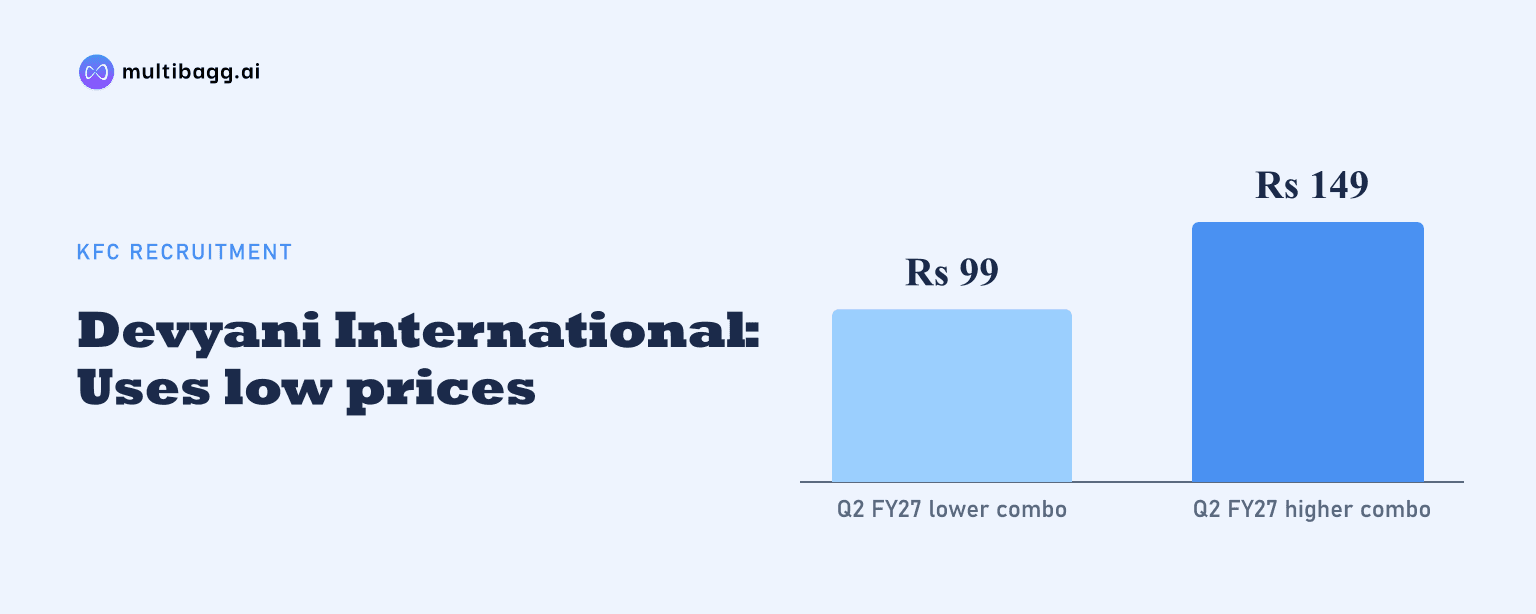
In Q2 FY27, Devyani International Limited deployed Rs 99 and Rs 149 KFC meal combinations to recruit customers while limiting year-to-date price increases to 1% to 2% amid higher food, fuel and wage costs. KFC revenue rose 12.3% year-on-year to Rs 642 crore and same-store sales growth was 4.4%.
Know Devyani International inside out
Results, valuation, peers and who's buying, in one view.
Why is DIL using Rs 99 and Rs 149 KFC meals?
DIL is using Rs 99 and Rs 149 KFC meal combinations to increase customer recruitment at entry price points as household budgets face pressure. Management cited food and fuel inflation, rising interest rates and job losses linked to artificial-intelligence adoption, and said discretionary spending could remain under pressure. The company said it needs to reorient more towards value in response to the current macroeconomic environment.
The KFC offers add to the brand's existing Wednesday value proposition and targeted buy-one-get-one, or BOGO, offers in relevant markets. In July, KFC ran Fried Chicken Month, including a BOGO bucket offer each Friday for dine-in and takeaway. DIL said a customer-recruitment engine is a critical long-term investment as its brands expand into emerging cities.
Management said the plan is calibrated because it wants to achieve higher recruitment with minimal impact on margins. The measures are not described as across-the-board menu discounts: they combine defined meal price points, market-specific BOGO promotions and optimisation of deals. DIL also said it intends to use consistent marketing to bring customers back into its restaurants.
How much cost inflation is DIL passing on to customers?
DIL said it has taken only a small, calibrated 1% to 2% price increase on a year-to-date basis, even as chicken, edible oils and dairy prices rose year-on-year. Older inventories provided some carryover mitigation, according to management. Liquefied petroleum gas, or LPG, availability normalised, but its price was nearly double the previous year's level.
Several states announced steep minimum-wage increases, adding to pressure from food and utility costs. Management said it would monitor movements in key raw materials and take price increases on a staggered basis to avoid further affecting muted consumer sentiment. It is seeking to offset costs through promotion execution, deal optimisation and cost-saving measures.
KFC's 68.2% gross margin was broadly flat year-on-year despite food inflation, while its 13.9% brand contribution margin was virtually flat despite higher wages and LPG prices. Consolidated gross margin improved by 70 basis points to 68.5%, while brand contribution rose 23% year-on-year to Rs 198 crore. A basis point is one-hundredth of a percentage point.
What did DIL's KFC performance show in Q2 FY27?
DIL's KFC business recorded 4.4% same-store sales growth, or SSSG, and revenue growth of 12.3% year-on-year to Rs 642 crore in Q2 FY27. SSSG measures sales growth from comparable existing stores. Management said growth across its brands was transaction-led, while KFC's on-premise sales saliency was 56%, showing the continued importance of restaurant visits.
DIL added 50 net new KFC stores in India during the quarter, taking the KFC network to 844 stores. Those additions accounted for more than two-thirds of DIL's 70 net new stores, including 68 added in India. As of September 30, 2026, DIL had 1,923 stores in India and 2,325 globally, and management said it remained on track for 200 to 220 net additions in FY27.
Management told an analyst that quarter comparisons were affected by festival timing. DIL has substantial KFC exposure in South and East India, where Durga Puja is favourable, but the festival fell in the October-to-December quarter in the current year. Management said combined Q2 and Q3 performance would therefore be more comparable, and it was targeting a slight improvement from the reported 4.4% SSSG.
Got a follow-up? Ask IRIS
Will DIL extend value offers beyond KFC?
DIL plans to roll out similar value-focused initiatives at Pizza Hut over the next couple of quarters and is testing a better value proposition through Biryani By Kilo's BBK Express food-court outlets. Management said Pizza Hut needs a stronger innovation pipeline and better price laddering. It said customer feedback showed Pizza Hut had a weak entry-level assortment despite a good premium-end product range.
Pizza Hut's Q2 FY27 results explain the focus on entry prices. Its SSSG decline narrowed to 1.4%, revenue was nearly flat year-on-year at Rs 184 crore, and average daily sales were Rs 32,000 per store per day. Gross margin improved to 76.7% on targeted promotions, but LPG and wage costs resulted in a negative 1.8% brand contribution margin and a Rs 3.3 crore loss.
DIL said Pizza Hut would use innovation, products at multiple price points and channel-specific offers to balance demand generation and margins. Pizza Hut added six net stores to end the quarter with 632, replacing underperforming stores that had closed. DIL also tested a spicy range, including three-in-one spicy pizzas, while its Own Brands portfolio reached 225 stores, including 26 BBK Express stores.
Can DIL maintain margins while recruiting customers?
DIL said sales leverage, promotion optimisation and cost controls helped protect overall margins in Q2 FY27 despite inflation. Consolidated operating earnings before interest, tax, depreciation and amortisation, or EBITDA, on a pre-Ind AS basis rose almost 34% year-on-year to Rs 125 crore. The pre-Ind AS operating EBITDA margin increased to 8.2% from 6.8% a year earlier; Ind AS means Indian Accounting Standards.
The company separately reported consolidated EBITDA of Rs 229 crore, up nearly 18% year-on-year, and profit before tax of Rs 5.7 crore against a loss in the prior-year quarter. DIL reported first-half profit before tax of Rs 29 crore, compared with a Rs 24 crore loss in the previous year. Management did not provide a reconciliation on the call between the Rs 229 crore consolidated EBITDA figure and Rs 125 crore pre-Ind AS operating EBITDA.
Margin outcomes differed across the portfolio. International revenue was Rs 509 crore despite flooding in Thailand during September, while international brand contribution margin rose 1.2 percentage points year-on-year to 17.9% and brand contribution reached Rs 91 crore. Pizza Hut's Rs 3.3 crore brand contribution loss contrasted with KFC's broadly stable 13.9% margin, making execution on KFC value offers central to DIL's approach.
Conclusion
DIL is combining limited menu price increases with entry-price meals, targeted promotions and cost actions rather than relying on a broad price pass-through. The Q2 FY27 figures show that this approach coincided with revenue growth and stable KFC brand contribution, while Pizza Hut's loss highlights the different effect of cost inflation where sales remain nearly flat.
The next indicators are whether KFC can sustain or improve its 4.4% SSSG after the Durga Puja timing effect, and whether Pizza Hut's planned value initiatives narrow its 1.4% SSSG decline. Management is also targeting 200 to 220 net new stores in FY27 and expects the proposed Sapphire Foods merger to close by the end of the financial year, subject to a Securities and Exchange Board of India no-objection and National Company Law Tribunal proceedings.