










BMW Industries’ TMT utilisation reaches 85.6% in H1 FY27
Key highlights
- BMW Industries’ TMT mill annualised utilisation reached 85.6% in H1 FY27, versus 41.7% in FY26.
- BMW Industries produced 77,067 MT of TMT in H1 FY27, compared with 74,975 MT in all of FY26.
- BMW Industries’ Pipes & Tubes dispatches rose to 73,603 MT in Q2 FY27 from 41,877 MT a year earlier.
- BMW Industries’ CGL Complex generated Rs 96.80 crore in Q2 FY27 revenue, up 12.0% year-on-year.
powered by IRIS
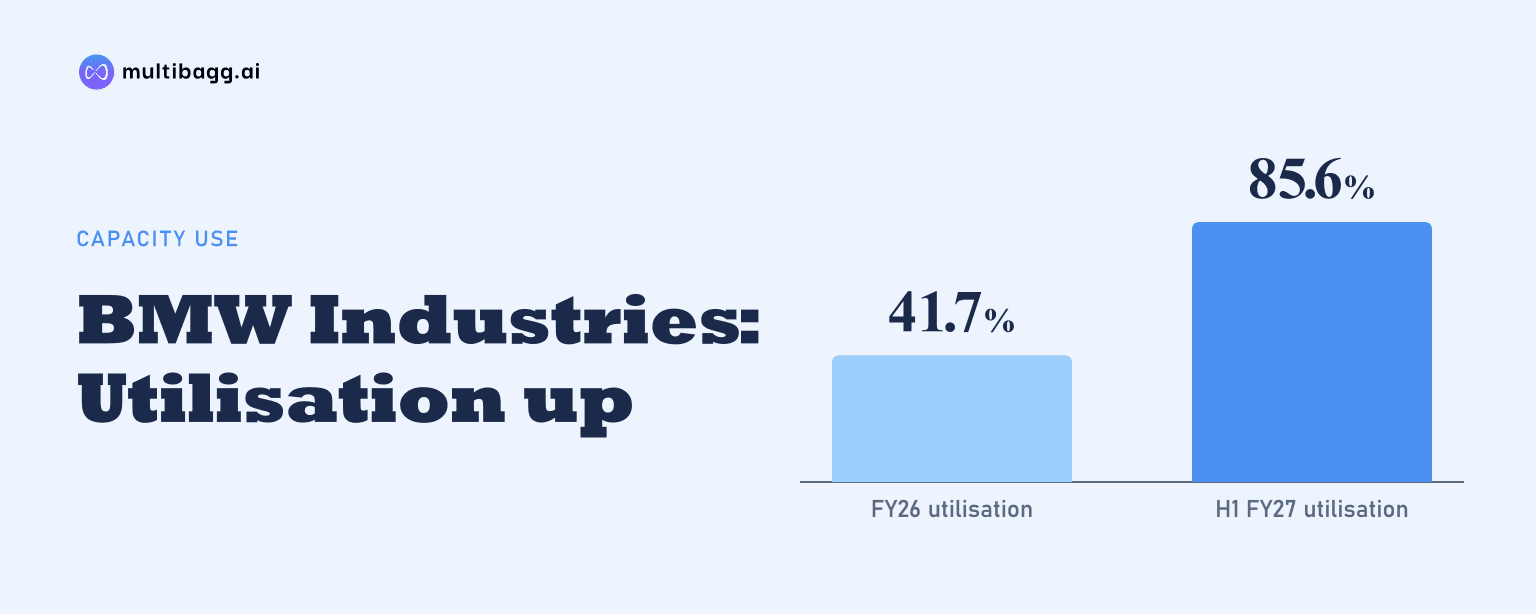
BMW Industries Ltd. raised annualised utilisation at its TMT rolling mill to 85.6% in H1 FY27 from 41.7% in FY26, supported by 77,067 metric tonnes (MT) of production; Pipes & Tubes dispatches reached 73,603 MT in Q2 FY27, 75.8% above a year earlier.
Know BMW Industries inside out
Results, valuation, peers and who's buying, in one view.
How did BMW Industries’ TMT mill utilisation change?
BMW Industries’ TMT mill annualised utilisation increased to 85.6% in H1 FY27 from 41.7% in FY26. H1 FY27 production was 77,067 MT, exceeding the 74,975 MT produced during all of FY26, while installed capacity remained 180,000 MT. The H1 FY27 utilisation measure is annualised, whereas the FY26 measure covers the full year.
The increase was visible in both FY27 quarters. TMT production rose from 37,583 MT in Q1 FY27 to 39,484 MT in Q2 FY27, compared with 10,637 MT in Q2 FY26. Dispatches reached 40,008 MT in Q2 FY27, against 36,714 MT in Q1 FY27 and 12,105 MT a year earlier.
TMT revenue was Rs 26.92 crore in Q2 FY27, up 214.3% from Rs 8.57 crore in Q2 FY26 and 5.4% from Rs 25.53 crore in Q1 FY27. BMW Industries states that Rolling Mill dispatch and revenue exclude Bansal Super TMT Rebars, so the disclosed figures do not cover that product’s dispatches or revenue.
What happened to BMW Industries’ Pipes & Tubes volumes?
BMW Industries’ Pipes & Tubes dispatches rose to 73,603 MT in Q2 FY27 from 41,877 MT in Q2 FY26 and 68,987 MT in Q1 FY27. The year-on-year increase was 31,726 MT, or 75.8%, while the sequential increase was 4,616 MT, or 6.7%. Production was 68,166 MT, below 73,345 MT in Q1 FY27 but above 44,990 MT in Q2 FY26.
Pipes & Tubes produced 141,511 MT in H1 FY27, with annualised utilisation of 38.7%, compared with FY26 production of 201,623 MT and utilisation of 34.2%. The H1 FY27 calculation uses installed capacity of 732,000 MT. Thus, utilisation rose despite the capacity base being higher than during much of FY26.
Capacity increased from 534,000 MT to 600,000 MT in Q1 FY26, with the addition commissioned in May 2025. It then increased to 732,000 MT in Q4 FY26, when the further addition was commissioned in March 2026. The FY26 utilisation figure therefore spans periods with a lower capacity base than the H1 FY27 measure.
How did Pipes & Tubes revenue compare with TMT revenue?
BMW Industries’ Pipes & Tubes revenue of Rs 31.58 crore exceeded TMT revenue of Rs 26.92 crore in Q2 FY27, although TMT recorded the faster year-on-year percentage increase. Pipes & Tubes revenue rose 93.4% from Rs 16.33 crore in Q2 FY26 and was 0.3% above Rs 31.48 crore in Q1 FY27. TMT revenue rose 214.3% from a lower Q2 FY26 base.
In H1 FY27, Pipes & Tubes generated Rs 63.05 crore, up 70.5% from Rs 36.98 crore in H1 FY26. The Rolling Mill generated Rs 52.46 crore, up 124.3% from Rs 23.39 crore. Pipes & Tubes therefore remained the larger disclosed revenue stream over the half year, while TMT delivered the higher growth rate.
The CGL Complex remained BMW Industries’ largest disclosed conversion segment by Q2 FY27 revenue, at Rs 96.80 crore. Its production reached 191,983 MT and dispatches reached 100,463 MT, compared with TMT production of 39,484 MT and Pipes & Tubes production of 68,166 MT. The CGL Complex includes proprietary sales, production and dispatches of galvanised iron products.
Got a follow-up? Ask IRIS
Did BMW Industries’ CGL Complex also improve in Q2 FY27?
BMW Industries’ CGL Complex improved in Q2 FY27, with production of 191,983 MT, dispatches of 100,463 MT and revenue of Rs 96.80 crore. Production increased from 162,609 MT in Q2 FY26 and 165,609 MT in Q1 FY27, while dispatches rose from 83,284 MT and 84,261 MT, respectively. Revenue increased 12.0% year-on-year and 24.5% sequentially.
CGL annualised utilisation was 70.5% in H1 FY27, marginally below 70.9% in FY26. H1 production was 357,592 MT against FY26 production of 718,605 MT, with installed capacity of 1,014,000 MT. This contrasts with the TMT mill’s rise to 85.6% utilisation and Pipes & Tubes’ increase to 38.7% after its capacity expansion.
Across the three legacy businesses, TMT had the highest reported H1 FY27 annualised utilisation at 85.6%, followed by CGL at 70.5% and Pipes & Tubes at 38.7%. TMT operated on 180,000 MT of capacity, compared with 1,014,000 MT for CGL and 732,000 MT for Pipes & Tubes.
How did higher volumes relate to BMW Industries’ quarterly revenue?
BMW Industries reported revenue from operations of Rs 181.5 crore in Q2 FY27, up 25.3% from Rs 144.89 crore in Q2 FY26 and 9.3% from Rs 166 crore in Q1 FY27. The CGL Complex, Rolling Mill and Pipes & Tubes together generated Rs 155.3 crore in Q2 FY27, and each reported higher revenue than a year earlier.
The faster volume growth in TMT and Pipes & Tubes did not coincide with higher quarterly operating EBITDA. Operating EBITDA was Rs 34.81 crore in Q2 FY27, down 5.7% from Rs 36.91 crore in Q2 FY26, while the operating EBITDA margin declined to 19.2% from 25.5%. BMW Industries nevertheless reported profit after tax of Rs 21.62 crore, up 42.7% year-on-year.
Conclusion
BMW Industries’ H1 FY27 operating data show that the 180,000-MT TMT mill moved substantially closer to full use, with annualised utilisation of 85.6% versus 41.7% in FY26. Pipes & Tubes added higher dispatches and revenue after its capacity reached 732,000 MT, while CGL remained the largest disclosed conversion segment by Q2 FY27 revenue at Rs 96.80 crore.
The next measure to watch is whether BMW Industries sustains the H1 FY27 TMT utilisation rate and raises Pipes & Tubes utilisation beyond 38.7%. Management said it will focus on improving capacity utilisation and ramping up Bokaro facilities after the Colour Coating line received Consent to Operate on 5 October 2026.