










BMW Industries Limited Bokaro build-out lifts leverage to 4.3x
Key highlights
- BMWIL reported net debt of Rs 588.52 crore at 30 September 2026, versus Rs 363.82 crore at 31 March 2026.
- BMWIL's annualized net-debt-to-operating-EBITDA ratio increased to 4.30x at September 2026 from 2.20x in FY26.
- BMWIL's annualized cash conversion cycle rose to 107 days at September 2026 from 87 days at March 2026.
- BMWIL had deployed Rs 516.4 crore in Bokaro by 30 September 2026, including Rs 307.5 crore funded through debt.
powered by IRIS
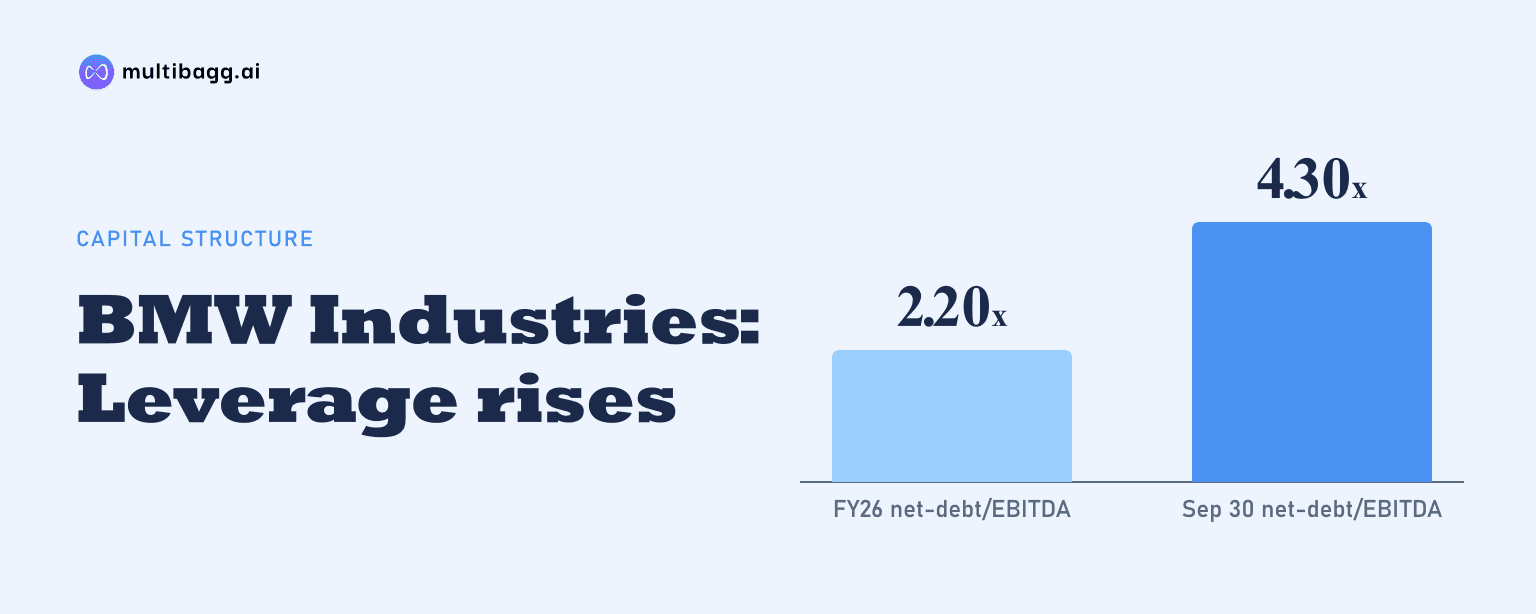
BMW Industries Limited reported annualized net-debt-to-operating-EBITDA of 4.30x at 30 September 2026 and a 107-day cash conversion cycle as Bokaro investment increased debt and working-capital use. BMWIL had deployed Rs 516.4 crore in the greenfield project by that date, including Rs 307.5 crore funded through debt.
Know BMW Industries inside out
Results, valuation, peers and who's buying, in one view.
Why did BMWIL's leverage rise in September 2026?
BMWIL's reported net debt rose to Rs 588.52 crore at 30 September 2026, taking net-debt-to-operating-EBITDA to 4.30x from 2.20x in FY26 and 0.96x in FY25. The September ratio is annualized. BMWIL defines net debt as total borrowings plus lease liabilities, less cash and cash equivalents and current investments.
The balance-sheet movement coincided with the Bokaro greenfield downstream steel complex. Management said Rs 516.4 crore had been deployed by 30 September 2026, comprising Rs 208.9 crore from internal accruals and Rs 307.5 crore through debt. BMWIL also states that capital employed at that date included the Rs 307.5 crore of debt associated with the Bokaro undertaking. About Rs 60 crore was capitalised to the first-phase Colour Coating line as of 5 October 2026.
Net debt increased by Rs 224.70 crore between 31 March 2026 and 30 September 2026, while net worth increased by Rs 31.03 crore. Net-debt-to-equity therefore reached 0.70x from 0.45x at FY26-end. Net fixed assets increased by Rs 201.23 crore over the same six-month interval, while total assets increased by Rs 274.94 crore.
How much has BMWIL's cash conversion cycle lengthened?
BMWIL's annualized cash conversion cycle was 107 days at September 2026, compared with 87 days at March 2026 and 67 days at March 2025. The cycle reached 111 days in June 2026 before declining by four days in the September quarter. BMWIL calculates this measure using revenue from operations.
Receivable days were the main contributor to the change from March 2025, rising to 77 days at September 2026 from 41 days, although they fell from 85 days in June 2026. Inventory days rose to 43 from 37 over the same period. Payable days increased only to 13 from 11, leaving a larger amount of cash tied up in receivables and inventory.
BMWIL's net current assets, which exclude cash, current investments, short-term borrowings and current lease liabilities, rose to Rs 308.48 crore at September 2026 from Rs 244.34 crore at March 2026. Capital-employed turnover moved in the opposite direction, declining to an annualized 0.52 from 0.61 in FY26 and 0.70 in FY25.
Got a follow-up? Ask IRIS
How does BMWIL present Bokaro's working-capital impact?
BMWIL presents adjusted net cash from operating activities, or NCOA, of Rs 53.87 crore for H1 FY27 and adjusted NCOA to operating EBITDA of 0.39x. The H1 calculation adjusts for working-capital changes associated with the Bokaro downstream steel complex. BMWIL reported NCOA of Rs 11.99 crore at 30 September 2026 and a reported NCOA-to-operating-EBITDA ratio of 0.09x.
Management attributed the difference primarily to Rs 41.88 crore deployed for Bokaro plant working-capital requirements before the Colour Coating facility commenced operations on 5 October 2026. The adjusted H1 FY27 NCOA figure cannot be directly compared with FY26 NCOA of Rs 83.17 crore because H1 FY27 covers six months and excludes Bokaro-related working-capital changes.
The reported NCOA captures the cash deployment ahead of commissioning, while the adjusted measure removes the Bokaro working-capital effect. BMWIL also disclosed FY26 regrouping and reclassification: operational suppliers' credit was moved under short-term borrowings, and some costs previously reported in other expenses were moved to finance costs. The company said prior periods were retrospectively regrouped for ratio comparability.
Is operating profit growth covering BMWIL's higher funding needs?
BMWIL's operating earnings were almost unchanged in H1 FY27 despite revenue growth, while finance costs increased. Operating EBITDA was Rs 68.50 crore, up 0.2% from Rs 68.36 crore in H1 FY26, on revenue from operations of Rs 347.50 crore, up 18.4%. Operating EBITDA margin declined to 19.7% from 23.3%.
In Q2 FY27, revenue increased 25.3% year on year to Rs 181.50 crore, but operating EBITDA declined 5.7% to Rs 34.81 crore and margin fell by 630 basis points to 19.2%. H1 FY27 finance costs rose 36.7% to Rs 11.47 crore from Rs 8.39 crore. Profit after tax attributable to owners increased 34.3% to Rs 40.74 crore, while other income rose to Rs 24.60 crore from Rs 6.92 crore.
Segment revenue trends differed during the investment period. H1 FY27 revenue from the CGL Complex was Rs 174.55 crore, 1.9% above H1 FY26, while Rolling Mill revenue rose 124.3% to Rs 52.46 crore and Pipes & Tubes revenue rose 70.5% to Rs 63.05 crore. The CGL Complex recorded 70.5% annualized utilisation in H1 FY27, compared with 85.6% for the Rolling Mill and 38.7% for Pipes & Tubes.
Conclusion
The Bokaro build-out has increased BMWIL's debt funding, fixed assets and working-capital requirement at the same time as operating profitability has lagged revenue growth. The 4.30x annualized net-debt-to-operating-EBITDA ratio, 107-day cash conversion cycle and 19.7% H1 operating EBITDA margin show the financial effects disclosed during the expansion phase.
The next disclosed development is the ramp-up of the Bokaro facilities after the Colour Coating line received consent to operate on 5 October 2026. Management says it will focus on capacity utilisation, proprietary operations, value-added products and disciplined capital deployment; the presentation provides no Bokaro utilisation, revenue, margin or debt-reduction target.