










BMW Industries Limited Bokaro line gets CTO after Rs 516 crore
Key highlights
- BMWIL’s Bokaro colour-coating line received Consent to Operate on 5 October 2026.
- BMWIL had deployed Rs 516.4 crore in the Bokaro greenfield project as of 30 September 2026.
- The Bokaro project used Rs 208.9 crore of internal accruals and Rs 307.5 crore of debt.
- BMWIL capitalised approximately Rs 60 crore for the first-phase colour-coating line as of 5 October 2026.
powered by IRIS
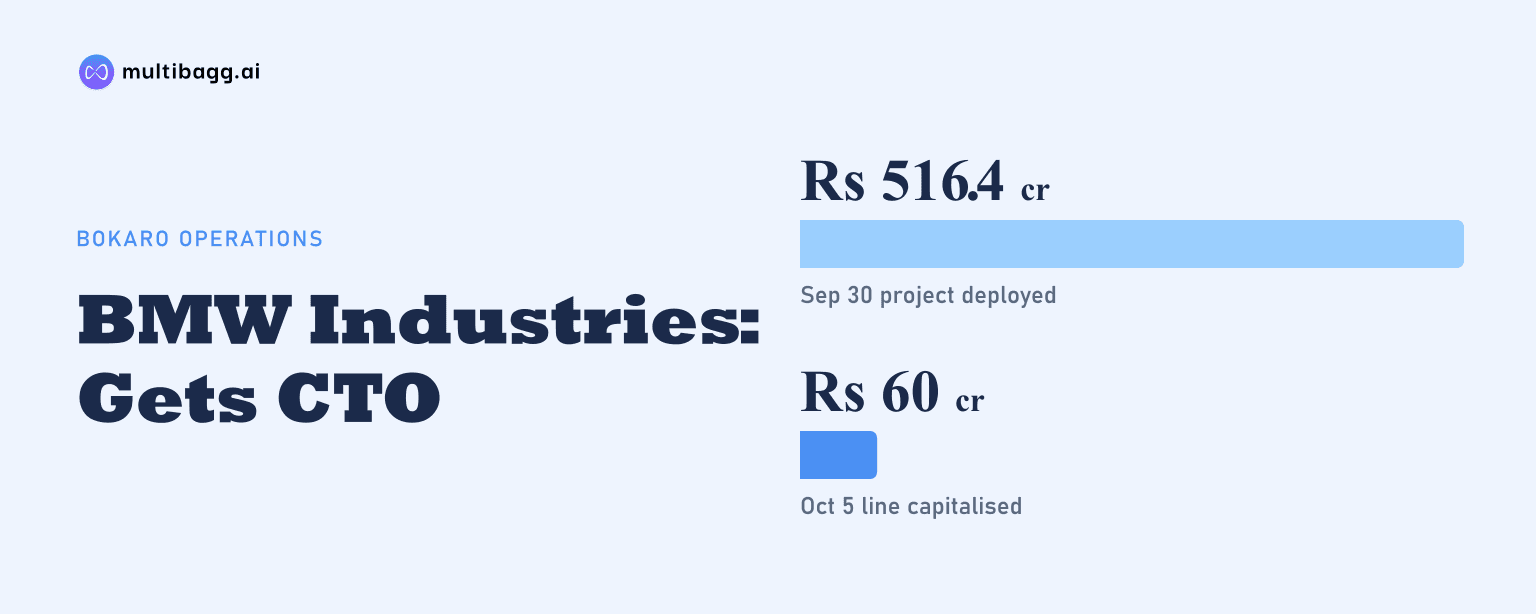
BMW Industries Limited’s Bokaro colour-coating line received Consent to Operate (CTO) on 5 October 2026, commissioning the first phase after Rs 516.4 crore had been deployed in the greenfield expansion by 30 September 2026, including Rs 307.5 crore of debt and Rs 208.9 crore of internal accruals.
Know BMW Industries inside out
Results, valuation, peers and who's buying, in one view.
What did BMWIL commission at Bokaro?
BMWIL commissioned the first phase of its Greenfield Downstream Steel Complex at Bokaro, Jharkhand, when the colour-coating line received CTO on 5 October 2026. Management described the approval as BMWIL’s entry into the colour-coated steel segment. The disclosed milestone applies to the first phase and does not indicate that the entire Bokaro complex has been completed.
The Bokaro expansion lists galvanised steel, Galvalume, ZAM and colour-coated coils as its core offerings. BMWIL says the location is close to major raw-material suppliers, which management links to raw-material security and logistics efficiency. The presentation does not disclose installed capacity, first output, utilisation, customer contracts or revenue from the colour-coating line.
BMWIL’s legacy conversion business includes hot rolled pickled and oiled steel, cold rolled steel, pipes and tubes, and TMT bars. The Bokaro facility extends the company’s stated value chain from hot rolled and cold rolled inputs into downstream coated products. Management characterises the new offerings as higher-value-added products, while separate post-commissioning sales or profitability for the Bokaro products have not been reported.
How was BMWIL’s Bokaro project funded and capitalised?
BMWIL had deployed Rs 516.4 crore in the Bokaro greenfield expansion as of 30 September 2026, using Rs 208.9 crore of internal accruals and Rs 307.5 crore of debt. The presentation identifies those two sources of funding but does not state the total approved project cost, debt interest rate, repayment schedule or undrawn financing.
Approximately Rs 60 crore was capitalised towards the first phase of the colour-coating line as of 5 October 2026. That capitalisation figure is distinct from the Rs 516.4 crore deployed across the wider project as of 30 September 2026. The source therefore indicates that expenditure beyond the first-phase line had been deployed by the reporting date.
BMWIL’s net debt was Rs 588.52 crore on 30 September 2026, compared with Rs 363.82 crore on 31 March 2026 and Rs 142.11 crore on 31 March 2025. The company defines net debt as total borrowings plus lease liabilities, less cash and cash equivalents and current investments. Its annualised net-debt-to-operating-EBITDA ratio was 4.30 at September 2026, compared with 2.20 in FY26 and 0.96 in FY25.
Got a follow-up? Ask IRIS
How does Bokaro extend BMWIL’s operating model?
BMWIL says Bokaro adds coated steel products to its conversion business, which serves infrastructure, construction and engineering end markets. Management describes the legacy operations as having processing-led economics and long-term customer relationships, while presenting Bokaro as forward integration from hot rolled and cold rolled steel into coated products.
Management says the Bokaro mix can use shared infrastructure, utilities and logistics alongside the legacy platform. It also describes the expansion as offering higher value addition and margin accretion. These are management’s stated operating objectives, rather than reported Bokaro margins, because the presentation provides no segment-level sales, volume or profitability figures after the 5 October 2026 CTO.
Legacy utilisation showed different trends across the three reported operations in H1 FY27. The CGL Complex recorded annualised utilisation of 70.5%, versus 70.9% in FY26, while the rolling mill rose to 85.6% from 41.7%. Pipes and tubes reached 38.7%, compared with 34.2% in FY26.
The rolling mill produced 77,067 metric tonnes in H1 FY27, while pipes and tubes produced 141,511 metric tonnes. Pipes-and-tubes capacity rose to 732,000 tonnes in March 2026 from 600,000 tonnes, after an increase from 534,000 tonnes in May 2025. BMWIL does not disclose whether Bokaro output has contributed to these legacy production metrics.
What financial results accompanied the Bokaro milestone?
BMWIL reported Q2 FY27 operating income of Rs 181.5 crore, up 25.3% year on year, and operating earnings before interest, tax, depreciation and amortisation of Rs 34.81 crore, down 5.7%. The operating EBITDA margin, calculated by BMWIL on operating income, was 19.2% in Q2 FY27.
Profit after tax attributable to owners was Rs 21.62 crore in Q2 FY27, up 42.7% year on year, with an 11.1% margin. The differing growth rates show that operating income increased while operating EBITDA declined, whereas profit after tax rose. The presentation does not attribute those movements to Bokaro, whose CTO came after the 30 September quarter-end.
For H1 FY27, operating income was Rs 347.5 crore, up 18.4% year on year, while operating EBITDA was Rs 68.5 crore, up 0.2%. Profit after tax was Rs 40.74 crore, up 34.3%, and the operating EBITDA margin was 19.7%, compared with the Q2 FY27 margin of 19.2%.
Net fixed assets increased to Rs 1,035.01 crore on 30 September 2026 from Rs 833.78 crore on 31 March 2026, while total assets rose to Rs 1,565.5 crore from Rs 1,290.56 crore. Over the same period, annualised capital-employed turnover declined to 0.52 from 0.61 and the cash-conversion cycle increased to 107 days from 87 days.
Conclusion
BMWIL has moved the first phase of its Bokaro expansion to an operating approval, with the colour-coating line receiving CTO on 5 October 2026. The Rs 516.4 crore deployment establishes a platform for galvanised, Galvalume, ZAM and colour-coated coils alongside its conversion operations, while Rs 307.5 crore of project debt coincided with net debt rising to Rs 588.52 crore at 30 September 2026.
Management says its next priorities are improving capacity utilisation, ramping up the Bokaro facilities, expanding proprietary operations and increasing value-added products. The next disclosures to watch are Bokaro capacity, output, utilisation, product sales and the contribution of the approximately Rs 60 crore capitalised first phase to operating income and margins.